

In 2023, India’s tech sector rallied behind a seductive promise: Sovereign AI. The thesis was straightforward. A nation of 1.4 billion people could not afford to rent its cognitive infrastructure from Silicon Valley.
Backed by a $41 million Series A led by Lightspeed, Peak XV, and Khosla Ventures, Bengaluru-based Sarvam AI became the standard-bearer of this movement. The mandate appeared clear: train foundation models from scratch on native Indian languages.
Today, the operational reality is entirely different.
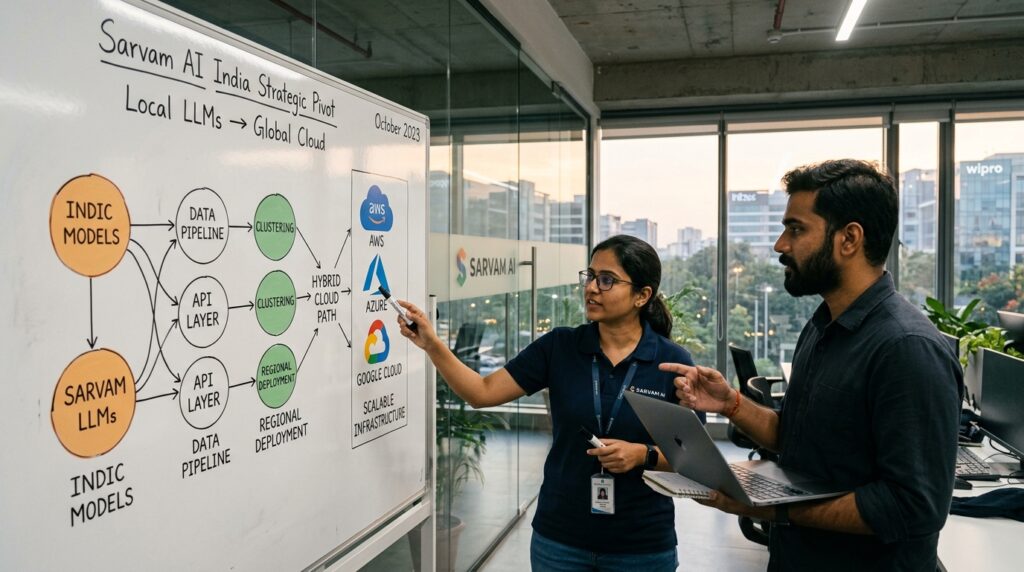
Sarvam AI is no longer burning capital to pre-train a 100-billion-parameter generalist rival to Western frontier labs. Instead, founders Vivek Raghavan and Pratyush Kumar have executed a sharp strategic shift.
Rather than competing against trillion-parameter frontier runs, Sarvam is building an applied enterprise orchestration platform. The company integrates American frontier backbones like OpenAI’s GPT-4o through Microsoft Azure for complex reasoning, while focusing domestic engineering on the high-friction sensory edge: voice pipelines, document vision, Indic tokenizers, and air-gapped appliances.
This transition has triggered sharp debate. Critics question whether Sarvam has retreated into an enterprise API wrapper. Enterprise buyers, however, see the move as the only viable exit from an impossible compute trap.
Below is an exhaustive forensic audit of Sarvam AI’s strategic realignment: the thermodynamic reality of frontier pre-training, the mechanics of their three-tier enterprise stack, the economics of tokenizer inflation, and whether genuine sovereignty can exist when an enterprise leases its reasoning engine from foreign clouds.
The Thermodynamic Wall: Why Pre-Training Sovereign Frontier Models Is Capital Suicide
To understand why Sarvam walked away from the race to build a massive general-purpose foundation model, one must examine the unit economics of frontier training.
Training a competitive frontier model requires an order of magnitude more than clean text. Frontier reasoning systems require continuous training runs on clusters of 24,000 to 100,000 NVIDIA H100 or Blackwell B200 GPUs. Silicon Valley hyperscalers deploy tens of billions of dollars per quarter in pure data center capital expenditure.
Against this scale, India’s national compute initiative, the IndiaAI Mission, allocated approximately $1.25 billion (₹10,372 crore) across hardware subsidies, datasets, and startup grants. While the mission has successfully onboarded over 38,000 GPUs across domestic operators like Yotta Shakti and Tata Communications, the fleet is distributed among dozens of academic and commercial initiatives.
A domestic 70-billion-parameter foundation model trained at a cost of $25 million to $30 million in raw compute depreciates toward zero asset value the moment an open-weight model, like Llama 3.3 70B or DeepSeek V3, is released freely under a permissive commercial license. The pre-training capital expenditure cannot be recouped from domestic inference margins alone.
If Sarvam had committed its early treasury to pre-training a proprietary 70-billion-parameter Indic model from raw tokens, three compounding bottlenecks would have crushed the company:
First is the pre-training depreciation trap. Open-source models commoditize raw weights at breakneck speed. Any startup spending $30 million to match a frontier reasoning benchmark finds its proprietary checkpoint rendered obsolete within months by a zero-cost open release.
Second is the Indic web data deficit. The open internet in Indian languages is exceptionally small and plagued by broken encoding and machine-translated spam. High-quality pre-training corpora in Tamil, Telugu, Marathi, or Kannada are orders of magnitude smaller than English datasets.
Third is the post-training reinforcement learning moat. The frontier is no longer defined by raw pre-training. The gulf between a base model and a reliable enterprise assistant lies in reinforcement learning from human feedback, process reward verifiers, and test-time search. Replicating this post-training infrastructure would consume hundreds of millions of dollars.
Sarvam recognized early that attempting to beat Silicon Valley at brute-force foundational pre-training was an economic dead end. The real commercial opportunity lay in owning the enterprise workflow.
Anatomy of the Shift: The Tri-Tier Applied Enterprise Stack
Rather than operating as a consumer chatbot or a pure research lab, Sarvam AI reorganized its architecture into a three-tier system. This structure splits workflows between what must be built domestically and what should be leased globally.
Specialized compact SLMs handling 8kHz telephony, code-switching across 22 languages, and complex non-Latin document layout recovery. Normalizes unstructured messy inputs into structured semantic representations.
Deep logical deduction, autonomous multi-step tool calling, ERP schema orchestration, and deterministic code generation. Sarvam routes structured prompts to American frontier engines, bypassing the multi-billion-dollar pre-training hurdle.
PII stripping, local redaction, edge-inferencing on single commodity enterprise GPUs, and integration with banking cores inside Indian sovereign perimeters.
Tier 1: The Sovereign Perception Boundary
American frontier models possess immense reasoning capabilities, but they fail abruptly when exposed to the sensory messiness of Indian enterprise data.
In voice, Western models are trained predominantly on clean, wideband audio in standard accents. In an Indian banking contact center, where callers alternate between Hindi and English over noisy 8kHz telecom lines, generic models suffer high error rates.
Sarvam built Saaras for speech-to-text and Bulbul for text-to-speech specifically to solve this physical reality. Saaras is trained on authentic Indian conversational audio, capturing phonetic nuances across 22 official languages.
Similarly, in document parsing, Western vision models frequently struggle with degraded land revenue records in Marathi or multi-column tax petitions in Tamil. Sarvam built Sarvam Vision 2.1, a compact 3-billion-parameter State-Space Model architecture that delivers top-tier accuracy on complex non-Latin document layouts while running at modest compute cost.
Tier 2: The Frontier Reasoning Engine
Once Tier 1 converts chaotic Indian voice and degraded documents into structured, sanitized text, Sarvam does not attempt to use an in-house model for complex business logic.
For loan underwriting evaluations, dispute resolution, or claims adjudication, Sarvam routes structured prompts to frontier backbones. This is achieved primarily through its strategic collaboration with Microsoft Azure.
By delegating general semantic reasoning to proven frontier systems, Sarvam gains state-of-the-art instruction following without spending capital on post-training RL compute.
Tier 3: The Enterprise Sovereign Perimeter
The third tier enables Sarvam to sell into India’s most conservative institutions: public sector banks, insurance firms, and government ministries.
Under India’s Digital Personal Data Protection (DPDP) Act and Reserve Bank of India mandates, regulated entities cannot stream unencrypted consumer financial data outside national borders. Direct API calls to overseas endpoints create compliance violations.
Sarvam positions itself as a sovereign gateway. Tier 1 executes on-premises or within Indian cloud regions, stripping personal identifiers and tokenizing data locally before any reasoning call occurs.
The Tokenizer Tax: How Western LLMs Squeeze Enterprise Margins
The technical justification for Sarvam’s hybrid architecture becomes clear when examining tokenization mechanics.
Most American foundation models use tokenizers trained heavily on English text and source code. In standard tokenizers, an English word typically maps to a single token.
Because Indic scripts were underrepresented during tokenizer pre-training, standard algorithms lack dedicated tokens for common Indian syllables. The tokenizer defaults to byte fallback, splitting a single character into multiple individual bytes.
In computational linguistics, this penalty is measured through token fertility, which is the ratio of tokens generated per word. While English maintains near one token per word, Indic scripts on standard Western tokenizers suffer an inflation factor of 3.2x to 5.8x. An enterprise processing queries in Hindi or Tamil pays for up to five times more tokens for identical semantic content, while shrinking effective context windows by up to 80%.
Consider the Hindi word “शुभकामनाएं” (congratulations):
In a standard Western tokenizer, this single word fragments into 6 to 8 tokens because characters and matras are split into raw UTF-8 byte sequences.
In Sarvam’s native 128k Indic tokenizer, the word compresses into a single token.
Direct Western API Routing: A 100-word customer query in Hindi expands into roughly 480 tokens, causing latency spikes and nearly 5x the raw API cost.
Sarvam Native Pipeline Routing: The same 100-word query compresses into roughly 115 tokens, restoring 1:1 token efficiency and cutting transmission overhead by up to 75%.
Sarvam proved this tokenizer efficiency when releasing Sarvam-1, an open-source 2-billion-parameter model trained on 4 trillion tokens.
By placing its proprietary perception models as a translation and distillation proxy, Sarvam converts verbose Indic inputs into compact representations before any frontier reasoning call occurs.
Forensic Audit: Sovereign Foundation Model or Enterprise Wrapper?
The central debate is whether this architecture qualifies as sovereign AI, or whether it is fundamentally an enterprise wrapper.
To evaluate this objectively, one must contrast Sarvam against both pure foundation model labs and thin API wrappers.
| Dimension | Generic API Wrapper | Sarvam Applied Stack | Sovereign Frontier Lab |
|---|---|---|---|
| Model Ownership | 0% (Pure third-party API) | Hybrid (Owns Perception SLMs; Leases Reasoning) | 100% (Owns Base Pre-training Weights) |
| Perception Layer | Default public endpoints | Custom Indic SLMs (Saaras, Bulbul, Vision 2.1) | Native Multimodal Frontier Model |
| Air-Gapped Deployment | Impossible (requires public internet) | Supported (Sarvam Vision Edge on local GPUs) | Supported (Requires multi-node clusters) |
| Defensibility | Zero (vulnerable to prompt updates) | High (Acoustic data, DPDP compliance, banking integration) | Capital and Compute Moat |
| Capital Efficiency | High (Zero training costs) | Very High (Targeted SLM training on domestic clusters) | Low (Requires recurring hundreds of millions in CAPEX) |
Why the Wrapper Label Misses the Point
Calling Sarvam an enterprise wrapper misjudges the reality of applied AI engineering. A wrapper is a superficial interface layer that adds zero proprietary technology, simply reselling third-party API calls behind a system prompt.
Sarvam’s defensible intellectual property does not sit in the reasoning core. It lives in the domain-adapted perception stack:
Acoustic engineering is a primary example. Saaras processes narrowband Indian telephony codecs and dialectal code-mixing where standard models fail.
Document intelligence is another. Sarvam Vision 2.1 parses complex government forms, revenue registers, and multi-script layouts with rubber stamps.
Systems integration completes the picture. Connecting autonomous agents to core banking platforms requires strict latency budgets, reliable fallbacks, and audit trails.
In enterprise procurement, CTOs do not buy models because of parameter scale. They purchase systems that solve operational problems while meeting strict regulatory standards.
The Contrast with Krutrim’s Launch
To see the discipline in Sarvam’s approach, consider the missteps surrounding Krutrim.
Krutrim marketed itself as India’s first sovereign full-stack AI, promising a ground-up foundation model trained domestically. Upon release, users discovered that the chatbot intermittently claimed to have been created by OpenAI.
Ola later clarified that this was an unintended training data leakage issue, caused by OpenAI attribution text embedded in open-source fine-tuning sets. The technical explanation was valid, but aggressive marketing ahead of production readiness hurt technical credibility.
Sarvam chose a different path. Rather than claiming to train an omniscient frontier model, Sarvam demonstrated core competence with Sarvam-1 and open-source releases, while building enterprise products on a hybrid architecture.
The Geopolitical Trade-Off: Rented Intelligence vs Domestic Control
Sarvam’s enterprise strategy is commercially rational, but it highlights an underlying geopolitical tension.
Can a country achieve genuine technological sovereignty if its most critical enterprises rely on American frontier models for high-level reasoning?
An enterprise AI ecosystem can simultaneously achieve at most two of three properties:
1. Frontier Reasoning Capability (Matching GPT-4o or Claude-level deduction)
2. Capital Viability (Operating on a venture balance sheet under $100M)
3. Complete Sovereign Autonomy (Zero reliance on foreign compute, weights, or APIs)
By prioritizing frontier capability and capital viability, Sarvam accepts structural trade-offs.
If international trade rules shift or API access terms change, platforms depending on foreign cloud endpoints face operational exposure.
Hyperscalers can also adjust wholesale pricing or bundle their own enterprise tools, compressing middle-tier margins.
Sarvam’s strategic hedge against this vulnerability is continuous investment in Small Language Models like Sarvam-1 and its MoE architectures. If complete data air-gapping is required, the foreign backbone can be replaced with an ensemble of fine-tuned domestic models.
Verdict: Pragmatic Engineering Over Nationalistic Illusion
Sarvam AI’s strategic shift represents commercial and engineering maturity, not a retreat.
The early rhetoric around Sovereign AI assumed every major economy needed its own capital-intensive foundation model lab. That premise ignored semiconductor supply chains, energy infrastructure, and training economics.
Sarvam’s founders recognized early that India’s opportunity lies in solving the physical, linguistic, and regulatory friction of enterprise operations:
Capturing noisy speech across hundreds of regional dialects.
Digitizing complex land records across multiple non-Latin scripts.
Eliminating the punitive token inflation tax imposed by Western tokenizers.
Ensuring compliance with domestic data sovereignty statutes.
Is Sarvam an enterprise wrapper? Only if one reduces software engineering to raw matrix multiplication. In practice, Sarvam builds the essential nervous system connecting global cognitive backbones to India’s economy.
Building a profitable, compliant enterprise platform that powers real-world operations is far more valuable than spending tens of millions of dollars on a second-tier sovereign model that enterprises cannot use.
Frequently Asked Questions
Why did Sarvam AI stop focusing exclusively on training large foundation models?
Training frontier large language models requires tens of thousands of GPUs and hundreds of millions of dollars in compute capital. As global open-source models like Llama 3 commoditized base weights, training generalist models from scratch became economically unviable for an independent startup. Sarvam pivoted toward high-margin applied enterprise solutions where defensible moats exist.
What is the Tokenizer Tax in Indian languages?
Standard foundation models use tokenizers trained predominantly on English text. When processing Indian languages, these tokenizers lack dedicated syllable tokens and fall back to raw byte representations. This inflates the token count for Indic text by 3x to 5x compared to English, driving up inference costs and shrinking context windows. Sarvam’s custom 128k tokenizer compresses Indic words into compact, efficient representations.
Does Sarvam AI use OpenAI models?
Yes. Through a collaboration with Microsoft, Sarvam AI utilizes Microsoft Azure infrastructure, including Azure OpenAI Service, to provide reasoning and planning capabilities for enterprise workflows, while deploying its own proprietary models for speech, voice, and document perception.
What are Saaras and Bulbul?
Saaras is Sarvam AI’s speech-to-text model family, engineered to handle Indian accents, noisy 8kHz telephony audio, and multilingual code-switching across 22 official languages. Bulbul is the companion text-to-speech engine, generating natural, expressive voices across regional Indian languages.
Can Sarvam AI run in air-gapped environments?
Yes. Through offerings like Sarvam Vision Edge, Sarvam packages compact 1B to 3B parameter models into FP8 footprints that run on commodity GPUs inside private firewalls. This allows banks and government agencies to process sensitive data on-premises in compliance with RBI regulations and the DPDP Act.