

The global small-satellite launch sector is colliding with an unforgiving economic reality: rideshare economics are crushing dedicated launch vehicles on raw launch cost per kilogram, while orbital congestion and payload scheduling gridlocks demand dedicated, precision orbital insertion.
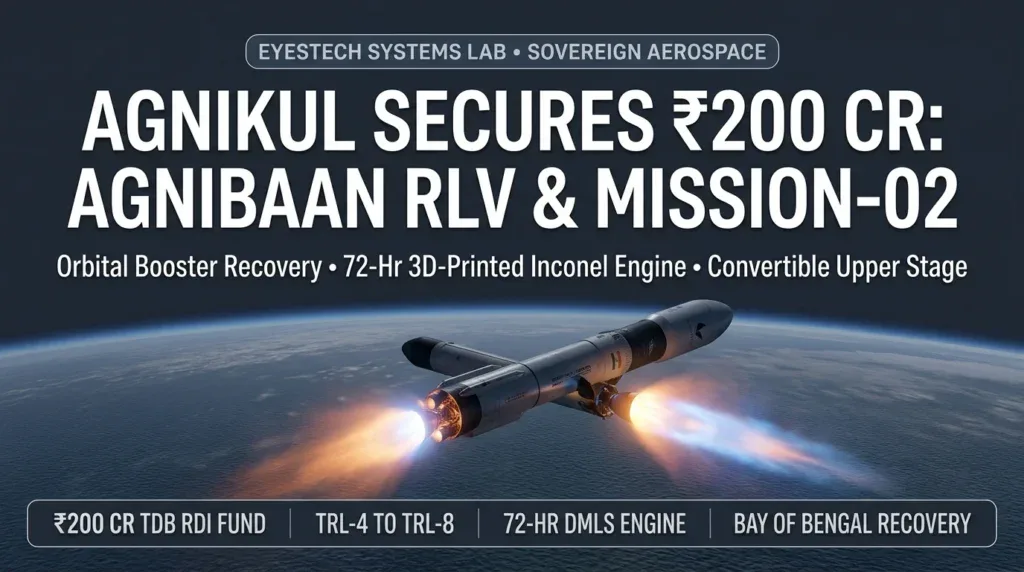
On September 25, 2026, the Technology Development Board (TDB), an autonomous statutory body under India’s Department of Science and Technology (DST), executed a landmark agreement injecting ₹200 crore (~$24 million) into Chennai-based orbital launch startup Agnikul Cosmos. Financed under the Government of India’s Research Development and Innovation (RDI) Fund via Optionally Convertible Debentures (OCDs), the capital commitment targets a singular technological mandate: advancing the Agnibaan Reusable Launch Vehicle (Agnibaan RLV) from its current Technology Readiness Level 4 (TRL-4) directly to TRL-8—full orbital system qualification and operational deployment.
The development sets the stage for Mission-02, targeted for early 2027. With Mission-02, Agnikul is executing India’s first attempted recovery of an orbital-class booster on Indian soil, while flight-testing a patented convertible upper stage that refuses to become space debris. Coupled with former ISRO Chairman S. Somanath joining Agnikul’s board as an observer in July 2026, the venture marks India’s decisive transition from state-subsidized exploration to sovereign-backed commercial orbital reusability.
The Sovereign Capital Blueprint: Why TDB Chose Convertible Debt Over Venture Equity
Hardware capital expenditure in orbital aerospace routinely decimates early-stage capitalization tables. Building test stands, cryogenic cleanrooms, autoclave-free composite over-wrapped pressure vessel (COPV) winding lines, and deep-throttling test cells consumes tens of millions of dollars before a single kilogram reaches orbit. When private venture rounds fund this expenditure, founders face severe equity dilution, creating misaligned incentives that favor premature commercialization over rigorous metallurgical validation.
As we analyzed in our investigation into how India’s sovereign defense innovation funds structure deep-tech capital, state-backed quasi-debt models offer an essential firewall against foreign venture capture. The Technology Development Board structured its ₹200 crore backing through Optionally Convertible Debentures (OCDs) under the national RDI Fund. This mechanism provides three decisive structural advantages:
- Non-Predatory Runway for Deep Hardware R&D: OCDs function as long-horizon quasi-debt with milestone-gated conversion terms. Agnikul secures immediate liquidity to finance critical tooling and testing infrastructure without surrendering governance autonomy or diluting founder control at a pre-orbital valuation.
- Derisking the TRL-4 to TRL-8 Chasm: While Agnikul proved sub-orbital atmospheric stability, flight software avionics, and single-piece 3D-printed engine operation during the Agnibaan SOrTeD (Sub-Orbital Technology Demonstrator) mission on May 30, 2024, that milestone represented TRL-4. Achieving TRL-8 demands continuous firing cycles, aerodynamic re-entry survival, dynamic pressure control across Mach regimes, and repeated turnaround qualification. Sovereign capital absorbs structural risk that short-duration venture funds cannot underwrite.
- Institutional Anchoring: The funding synchronizes directly with statutory oversight. Having retired ISRO Chairman S. Somanath on the board provides Agnikul with veteran mission command over structural flight dynamics, retro-propulsive guidance, and launch safety clearance under IN-SPACe.
Mission-02 Flight Profile: Engineering India’s First Orbital Booster Recovery
SpaceX demonstrated that recovering the first stage of an orbital rocket is the single most effective lever for collapsing launch costs. However, replicating Falcon 9’s booster recovery on a small-lift vehicle (100 kg to 300 kg payload capacity to 700 km Low Earth Orbit) presents brutal mass-fraction physics.
On an orbital rocket, the first stage accelerates the stack to approximately Mach 5 to Mach 7 before staging at altitudes between 60 km and 80 km. To return that booster to a controlled vertical touchdown or targeted ocean recovery zone, the vehicle must reserve propellant for three distinct retrograde burns: the boostback burn (canceling downrange velocity), the re-entry burn (shielding the base from peak aerodynamic heating), and the terminal landing burn (reducing velocity from terminal fall to zero).
The Small-Lift Recovery Paradox: Because dry structural mass does not scale down linearly with tank volume (the square-cube law penalizes smaller vehicle diameters), reserving 15% to 25% of first-stage propellant mass for recovery maneuvers can slash a small rocket’s net orbital payload by 40% to 60%.
Solving the Thrust-to-Weight Hoverslam Bottleneck
A fundamental barrier to recovering small orbital boosters is minimum throttle capability. SpaceX’s Falcon 9 first stage cannot hover: a single Merlin 1D engine throttled down to its absolute minimum (approximately 40% of rated thrust) still outputs roughly 360 kN of thrust. Because an empty, dry Falcon 9 booster weighs only 22 to 25 metric tons (~245 kN of gravitational force), its minimum thrust-to-weight ratio exceeds 1.4 (T/W > 1). Falcon 9 must execute a “suicide burn”—a mathematically precise ignition where deceleration reaches zero velocity at the exact millisecond the landing gear contacts the deck.
Agnikul sidesteps this dilemma through a multi-engine semi-cryogenic architecture. By clustering modular Agnilet engines on the Agnibaan first stage (a cluster of up to 7 engines delivering ~140 kN of aggregate sea-level thrust), Agnikul achieves a major operational advantage:
- Engine Out & Shutdown Sequencing: During return descent, the booster cuts thrust sequentially, shutting down outer engines until only the center engine or a sub-cluster fires.
- Deep Electric-Pump Throttling: Unlike traditional gas-generator or staged-combustion turbopumps with severe mechanical inertia, Agnilet propellants are delivered via electric motor-driven pumps. By adjusting motor RPM digitally via software-defined motor controllers and variable-area cavitation venturis, Agnikul achieves rapid, continuous throttle modulation.
- True Hover Capability (T/W ≈ 1): With a single small engine throttled to its baseline minimum, the net thrust matches the dry weight of the returning stage. This eliminates the catastrophic timing margin of a pure suicide burn, enabling real-time closed-loop aerodynamic descent and soft touchdown.
For Mission-02, Agnikul is targeting a controlled atmospheric descent profile over the Bay of Bengal. Following stage separation, the booster reorients via cold-gas reaction control system (RCS) thrusters, deploys aerodynamic control surfaces, guides through trans-sonic deceleration, and fires its landing burn for a targeted ocean splashdown and barge retrieval.
The In-Orbit Stage Repurposing Architecture: Ending the Disposable Rocket Era
The space industry has historically treated upper stages as disposable waste. After firing for 400 to 600 seconds to accelerate a satellite to orbital velocity (7.8 km/s), the spent upper stage becomes an uncontrollable projectile—either left to drift in low Earth orbit for years as dangerous space debris or forced into an expensive destructive de-orbit burn.
Agnikul has engineered and patented a radically different solution: a convertible upper stage that transforms from a propulsion unit into an active in-orbit platform. This matches the paradigm shift we examined in Google Project Suncatcher’s orbital TPU architecture, where space hardware transitions from passive aluminum shells into continuous, solar-powered edge computing nodes.
Legacy Upper Stage Architecture
• Lifespan: 15 minutes to 2 hours post-separation.
• Power: Primary silver-zinc / low-capacity lithium batteries drained rapidly.
• Avionics: Flight computers shut down after telemetry confirmation.
• Fate: Tumbling orbital debris hazard or deliberate atmospheric burnup.
• Economic Value: Zero revenue generation post payload release.
Agnibaan Patented Convertible Stage
• Lifespan: Weeks to months of active on-orbit operation.
• Power: Body-mounted conformal solar arrays + redundant Li-ion energy storage.
• Avionics: Transitions from flight guidance to 3-axis orbital attitude control.
• Fate: Stabilized microgravity laboratory, edge-computing bus, or sensor host.
• Economic Value: Secondary monetization of launch structural mass.
The Mechanical & Electrical Transformation
Converting a spent propulsion stage into an active satellite bus requires solving three interrelated engineering hurdles:
- Propellant Depletion & Passivation Without Structural Venting Shocks: Unspent liquid oxygen and kerosene inside tanks can boil, expand, and trigger structural rupture. Agnikul’s stage executes an automated passivation burn, venting residual cryogenic vapor through balanced dual nozzles to eliminate net rotational torque.
- Thermal & Power Autonomy: While traditional upper stages rely on short-lived chemical batteries, the Agnibaan upper stage integrates structural photovoltaic panels bonded to its exterior skin. Combined with high-cycle lithium-ion cells, the stage maintains continuous bus voltage across orbital eclipse cycles.
- Payload Hosting Bus Interfaces: Rather than deploying customer sensors onto independent small-sat bodies with redundant solar panels, radios, and propulsion, customers can bolt scientific experiments, hyperspectral sensors, or edge AI compute nodes directly to the upper stage hull. The stage supplies shared telemetry, attitude pointing, and electrical power.
This strategy draws direct lineage from ISRO’s POEM (PSLV Orbital Experimental Module), which successfully proved the feasibility of turning the PSLV’s fourth stage (PS4) into an in-orbit testbed. Agnikul is commercializing this concept for the private small-sat market, granting academic institutions, defense laboratories, and startup constellations access to orbital microgravity testing without paying for a custom satellite bus.
3D-Printed Monolithic Metallurgy: The Agnilet Propulsion Advantage
At the technical center of Agnikul’s vehicle architecture is Agnilet: the world’s first single-piece, fully 3D-printed rocket engine, protected under Indian Patent Office Patent No. 409949.
Traditional liquid-propellant rocket engines are manufacturing nightmares. A standard regeneratively cooled liquid engine requires over 1,000 separate components: precision-milled injector faces, fuel manifold domes, hundred-piece brazed copper cooling jackets, igniter housings, and high-pressure flange fittings. Each seam requires manual welding, vacuum brazing, or elastomeric O-rings. In rocket propulsion, every weld is a crack propagation risk, and every braze joint is a potential catastrophic high-pressure leak under 50-bar combustion chamber pressure.
| ENGINE METRIC | CONVENTIONAL LIQUID ENGINE | AGNIBAAN AGNILET (3D-PRINTED) | ENGINEERING ADVANTAGE |
|---|---|---|---|
| Part Count | 1,000+ distinct components | 1 monolithic piece | Zero assembly joints, zero flange seal leaks |
| Fabrication Lead Time | 6 to 12 months | Approximately 72 hours | 100x acceleration in build-to-test iteration cadence |
| Material & Alloy | Milled Copper-Alloy + Steel Sleeve | Aerospace-grade Inconel 718 | Exceptional fatigue strength under thermal shock |
| Cooling Architecture | External braze channels / milled slots | Internally grown conformal channels | Optimal heat-flux geometry without tool clearance limits |
| Propellant Combination | Variable (Hypergolic or Hydrolox) | Sub-cooled LOX + ATF (Aviation Kerosene) | High density impulse, zero toxicity, clean relight |
The Metallurgical Physics of DMLS Inconel 718
Agnikul produces Agnilet using Selective Laser Melting (SLM) / Direct Metal Laser Sintering (DMLS) from Inconel 718—a high-strength nickel-chromium superalloy resistant to oxidation and creep at temperatures exceeding 700°C. This computational manufacturing evolution parallels what we documented in Shodh AI’s breakthrough in physical AI modeling and Zoho’s fabless semiconductor vertical integration in Tamil Nadu: physical simulation and automated synthesis collapsing year-long industrial cycles to days.
In traditional fabrication, machining sub-millimeter internal regenerative cooling channels into a curved rocket throat requires complex multi-axis CNC EDM (Electrical Discharge Machining) followed by electro-plating or furnace brazing an outer structural jacket. If a single channel contains a brazing defect, the rocket wall melts through within 200 milliseconds of engine startup due to heat fluxes exceeding 50 MW/m².
Additive manufacturing eliminates this failure mode entirely:
- Continuous Wall-to-Channel Integration: The injector face, the coaxial swirl elements, the combustion chamber wall, and the complex helical cooling channels are sintered layer-by-layer (20 to 40-micron powder layers) by high-power ytterbium lasers.
- Unified Fluid Geometry: Fuel flows through the internal cooling jacket to absorb heat from the throat, vaporizes slightly to improve combustion efficiency, and enters the injector dome through internal conduits—without passing through an external braided hose or bolted flange.
- Factory-1 Cadence: At Agnikul’s “Rocket Factory-1” located within the IIT Madras Research Park, this end-to-end additive manufacturing pipeline produces a complete, flight-ready rocket engine in roughly 72 hours.
Global Small-Sat Launch Economics: Where Agnibaan RLV Fits
To understand the commercial imperative behind Agnibaan RLV, one must evaluate the competitive dynamics of the international small-satellite launch market.
While SpaceX’s Falcon 9 Transporter rideshare missions offer rock-bottom pricing (often below $6,000 to $7,000 per kg to standard Sun-Synchronous Orbit), rideshares present severe operational constraints for commercial satellite operators:
- Orbital Compromise: A rideshare drops 80 satellites into a single orbital plane at a fixed altitude and local time of ascending node (LTAN). Satellites must spend months using weak electric propulsion to drift into their operational orbits.
- Launch Schedule Inelasticity: If a secondary payload faces integration delays, the main rocket launches anyway.
- Security & Sovereignty: As explored in our teardown of sovereign on-orbit space control and orbital defense architecture, defense, intelligence, and sovereign communications assets cannot co-manifest on foreign commercial rideshares alongside unvetted third-party satellites.
| LAUNCH VEHICLE | LEO PAYLOAD (KG) | PROPULSION CYCLE | RECOVERY METHOD | IN-ORBIT STAGE CONVERSION | PRIMARY COMPETITIVE MOAT |
|---|---|---|---|---|---|
| Agnikul Agnibaan RLV | 100 – 300 kg | Semi-Cryo (Electric-Pump LOX + ATF) | Deep-throttle Ocean / Barge | Patented Convertible Platform | 72h 3D-printed engine, mobile launchpad |
| Rocket Lab Electron | 300 kg | Electric-Pump (LOX + RP-1) | Parachute Ocean Splashdown | Optional Photon Satellite Bus | Established flight heritage, Wallops pad |
| Firefly Alpha | 1,000 kg | Tap-Off Cycle (LOX + RP-1) | Expendable (Alpha) | None | Higher lift class, defense responsiveness |
| ISRO SSLV | 500 kg | Solid (3 stages) + Liquid VTM | Expendable | None | State infrastructure, 72h assembly turnaround |
| SpaceX Transporter | 22,800 kg (Full Stack) | Gas Generator (LOX + RP-1) | Autonomous Drone Ship / LZ | None (De-orbited) | Unbeatable per-kg marginal price |
The Operational Multiplier: Dhanush Mobile Launchpad (ALP-01)
Launch vehicles are traditionally bound to rigid, heavily congested launch complexes like Sriharikota, Cape Canaveral, or Vandenberg. Scheduling conflicts and range safety hold-ups regularly delay missions by weeks.
Agnikul decouples the rocket from fixed spaceport infrastructure through ALP-01 (“Dhanush”)—India’s first private mobile launchpad, commissioned at Sriharikota during the SOrTeD mission. Because the Agnibaan launch architecture carries self-contained propellant loading, pneumatic checkout, and automated launch sequencer umbilical towers, the entire launchpad can be transported on heavy flatbed trailers. This mobile operational posture allows launch execution from any cleared coastal strip, unlocking custom orbital inclination injections without expensive dogleg steering maneuvers that bleed rocket velocity.
Forensic Systems Audit: Unsolved Engineering Vulnerabilities
Achieving TRL-8 and executing Mission-02 will require overcoming four harsh physical bottlenecks:
1. Saltwater Corrosion & 3D-Printed Micro-Channels
Ocean splashdown recovery presents severe metallurgical hazards. When an Inconel 718 rocket engine, running at combustion temperatures exceeding 2,500°C, is suddenly submerged in hyper-saline seawater, two failure modes emerge:
- Thermal Shock Micro-Cracking: Rapid quench rates create high localized tensile stresses across thin regenerative cooling channel walls (often 0.5 mm thick).
- Halide Salt Clogging: Seawater entering the sub-millimeter cooling passages leaves behind sodium chloride deposits upon drying. Flushing, ultrasonic descaling, and non-destructive CT-scan requalification of monolithic additive structures remain unproven at high operational frequency.
2. High Dynamic Pressure Aerodynamic Actuation
Unlike Falcon 9, which uses massive forged titanium grid fins to steer through hypersonic re-entry, small-diameter launch vehicles have minimal physical surface area to generate control authority in the upper atmosphere. Agnikul’s aerodynamic control surfaces must balance hinge-moment torque limits against severe localized boundary layer heating during the Mach 4 to Mach 1 trans-sonic deceleration corridor.
3. Stage Testing and Requalification Facilities
To address post-recovery turnaround, Agnikul commissioned two proprietary facilities in Chennai on September 8, 2026:
- STIF (Stage Testing & Inspection Facility): Houses structural proof-testing bays, cryogenic cold-flow loops down to 73 Kelvin, and automated gimbal actuator characterization benches supporting thrust profiles from 1 kN to 200 kN with up to 150-second continuous burns.
- PROOF (Pressurant Tank Realisation, Over-wrapping and Outfitting Facility): Focused on in-house filament winding of carbon composite overwrapped pressure vessels (COPVs) producing over 10 tanks monthly rated up to 350 bar and 3,500 liters for helium and nitrogen pressurant management.
The viability of Agnikul’s ₹200 crore TRL-8 timeline hinges on how quickly STIF can turn a recovered booster from post-splashdown inspection into an engine re-acceptance hot-fire test.
Frequently Asked Technical Inquiries (Rank Math Schema Target)
The capital is allocated under the DST Research Development and Innovation (RDI) Fund via Optionally Convertible Debentures (OCDs). It finances the stage testing, manufacturing expansion, and flight hardware qualification needed to transition Agnibaan from TRL-4 (sub-orbital technology demonstration) to TRL-8 (full orbital flight qualification and operational recovery readiness).
Mission-02 represents India’s first attempted recovery of an orbital-class rocket booster on domestic soil or territorial waters. It also features the orbital debut of Agnikul’s patented convertible upper stage, which transforms from a spent propulsion unit into a sustained in-orbit microgravity and sensor platform.
By sintering the injector, combustion chamber, and internal cooling channels as a single contiguous Inconel 718 component, the Agnilet engine eliminates over 1,000 separate components, welds, and brazed seams. This removes common vibration and thermal-shock failure modes while cutting engine production cycles from 9 months to roughly 72 hours.