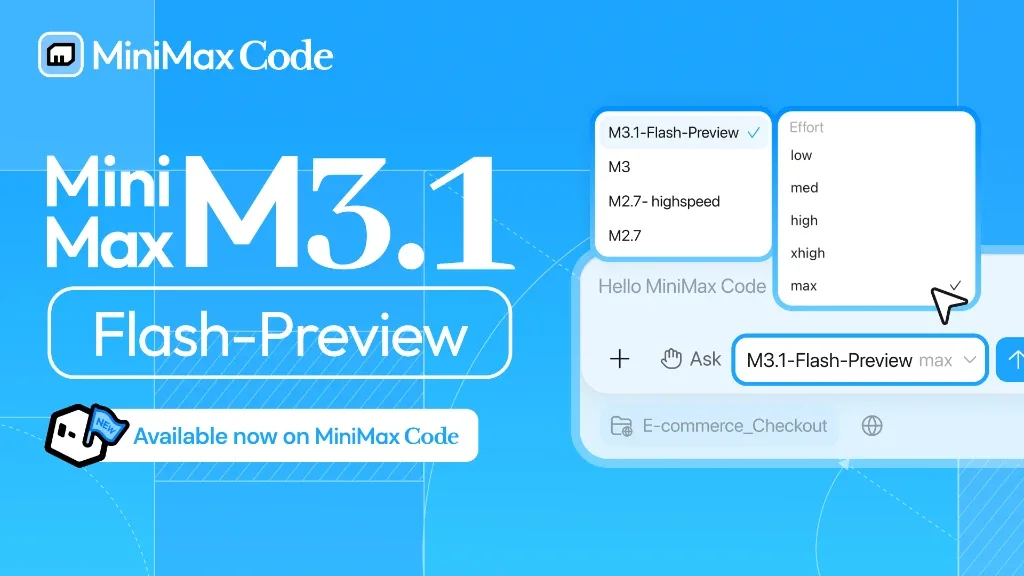

- M3.1-Flash-Preview Launch: MiniMax has deployed its newest text model,
M3.1-Flash-Preview, natively into the MiniMax Code integrated development environment, targeting daily software engineering workflows from rapid bug isolation to full-feature implementations. - Granular 5-Tier Reasoning: Unlike binary reasoning models that force an all-or-nothing latency hit, M3.1-Flash-Preview exposes a five-level test-time compute slider (
low,med,high,xhigh, andmax) within the code prompt interface. - Closed-Loop Regression Verification: The model architecture is optimized for automated requirement comprehension, AST edge-case handling, test suite generation, and downstream diff verification inside active workspace trees.
- Global Quota Resets & 2x Daily Credits: To drive adoption, MiniMax executed an immediate baseline reset of all user Token Plan allowances and launched a 10-day event (September 28 – October 7, UTC+8) granting double credits on daily check-ins.
- Cross-Modal Token Fungibility: Earned credits operate across MiniMax’s entire model catalog, allowing developers to allocate compute dynamically between code synthesis on M3.1 and generative video rendering on H3 and H3 Max.
On September 27, 2026, frontier AI lab MiniMax officially launched M3.1-Flash-Preview across its native developer environment, MiniMax Code. Built specifically for everyday software engineering, the model pairs low-latency token projection with an explicit five-tier test-time reasoning slider, enabling granular compute allocation across multi-file refactoring, regression testing, and code impact auditing.
Alongside the model deployment, MiniMax initiated an aggressive developer acquisition campaign: an immediate, universal reset of all Token Plan quotas, followed by a double-credit daily check-in window running from September 28 through October 7 (UTC+8). Crucially, the platform maintains cross-modal token fungibility, allowing engineers to channel accrued credits directly into MiniMax’s high-end video synthesis models, H3 and H3 Max.
Interface Forensics: The 5-Tier Reasoning Architecture in MiniMax Code
The debut of M3.1-Flash-Preview exposes a clear architectural pivot in how AI-native code environments manage computational trade-offs. In conventional developer tooling, teams are forced into a rigid dichotomy: either accept shallow autoregressive completion models that lack deep reasoning, or invoke massive reasoning systems that impose 30-to-60-second latency penalties for routine inline modifications.

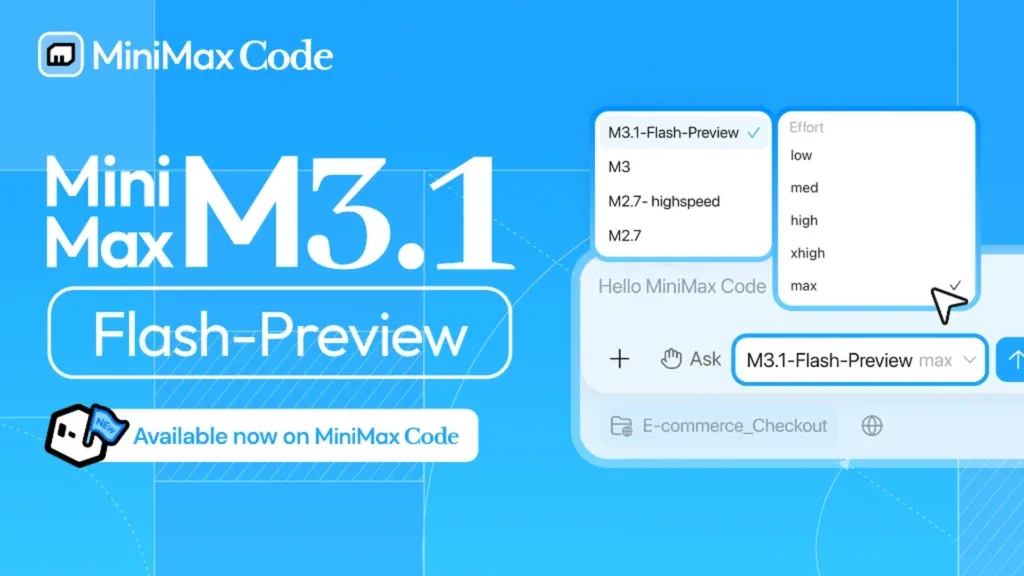
Inspection of the MiniMax Code interface reveals a tiered model stack operating beneath the command input:
- M3.1-Flash-Preview: The newly minted default daily driver, engineered for rapid response times and bounded reasoning overhead.
- M3: The flagship foundation model featuring a 1-million-token context window powered by MiniMax Sparse Attention (MSA).
- M2.7- highspeed: A specialized high-throughput tier tuned for low-overhead token streaming.
- M2.7: The established baseline generation engine for routine script automation.
The decisive structural feature is the adjacent Effort dropdown. By exposing five discrete compute states—low, med, high, xhigh, and max—MiniMax Code implements explicit test-time compute budgeting directly into developer prompts. When scoped to a local workspace context (such as the E-commerce_Checkout directory depicted in the release build), engineers can modulate search depth dynamically based on task risk profile:
| Effort Tier | Search Horizon | Target Engineering Task | Latency Profile |
|---|---|---|---|
low | Single-shot greedy decoding; minimal branch exploration. | Syntax correction, docstring generation, single-line completions. | Sub-second (< 800ms TTFT) |
med | Shallow AST inspection; local scope reference checks. | Function refactoring, isolated unit test scaffolding. | 1.5s – 3.0s |
high | Multi-hop dependency resolution across import graphs. | Cross-file API adaptations, database schema migrations. | 4.0s – 8.0s |
xhigh | Speculative code rollouts with simulated execution passes. | Edge-case stress testing, security vulnerability patches. | 10.0s – 18.0s |
max | Full tree search; comprehensive regression impact simulation. | Architectural feature additions, breaking API overhauls. | 20.0s – 45.0s |
Mechanistic Depth: Test-Time Compute Budgeting in Code Generation
Why does a 5-tier reasoning dial matter for developer ergonomics? In programmatic code generation, the failure modes of raw autoregressive models stem from an asymmetry: verifying a solution is computationally cheaper than searching for it, yet standard transformers allocate identical compute to trivial syntax tokens as they do to critical architectural interfaces.
Search Horizon Governance: Where E ∈ {low, med, high, xhigh, max} represents the configured effort tier, Y(E) defines the candidate rollout space, and λ(E) acts as the adaptive penalty scalar regulating test-time token expenditure Ctokens against ground-truth verification rewards RAST and Rtest.
Under the max configuration, M3.1-Flash-Preview expands intermediate Chain-of-Thought (CoT) exploration into a guided candidate beam. Instead of emitting code tokens directly into the user buffer, the model evaluates candidate diffs against the local repository’s Abstract Syntax Tree (AST), checking for broken variable bindings, type signature regressions, and missing dependencies before presenting the patch.
Conversely, dropping effort to low collapses λ(E) to prioritize immediate streaming velocity. For repetitive edits—such as converting dataclass schemas or scaffolding boilerplate routes—this avoids the 10,000-token internal deliberation loops that make heavy reasoning models impractical for real-time coding.
Competitive Benchmarks: How M3.1 Flash Positions in the Coding Tier
The developer tooling arena in late 2026 is defined by intense pressure across three vectors: inference velocity, architectural reliability, and operational cost. MiniMax’s decision to launch M3.1-Flash-Preview inside MiniMax Code directly challenges Cursor, Claude Code, and open-weight serving runtimes.
| Model / Engine | Deployment Context | Reasoning Control | Context Architecture | Ecosystem Tie-In |
|---|---|---|---|---|
| MiniMax M3.1-Flash-Preview | MiniMax Code (Native IDE) | 5 Tiers (low → max) | Sparse Attention + Local AST index | Cross-modal (Code & H3/H3 Max video) |
| Claude 3.5 Sonnet | Claude Code / API / Cursor | Thinking budget token cap | 200k dense attention window | Anthropic API credits only |
| DeepSeek-R1 / V3 | Open weights / Hosted API | Binary (Full CoT or none) | 128k Multi-Head Latent Attention | Decoupled cloud inference |
| Qwen 2.5 Coder 32B | Ollama / vLLM / Local IDEs | Fixed non-reasoning generation | 128k context length | Self-hosted hardware dependency |
| OpenAI o3-mini | ChatGPT / Codex API | 3 Tiers (low, medium, high) | 200k dense context window | OpenAI ecosystem lock-in |
While models like Claude 3.5 Sonnet dominate benchmark discussions on complex multi-turn agency, engineering teams encounter friction when deploying them for high-frequency micro-edits. A developer modifying five checkout handlers in an e-commerce backend cannot afford to wait 30 seconds per file for a massive model to reason through the entire repository history. By offering five discrete reasoning levels on a compact Flash backbone, M3.1-Flash-Preview targets the high-volume operational zone between lightweight copilots and heavyweight autonomous agents.
Closed-Loop Development: Solving the Diff Verification Bottleneck
The primary failure mode of automated code generation is not producing incorrect syntax; modern tokenizers rarely emit unparseable code. Rather, it is the silent introduction of regression faults: modifying a payment gateway method that subtly alters the return signature expected by upstream order orchestrators.
MiniMax Code approaches this through a four-phase closed-loop verification pipeline embedded directly within the execution engine:
# Forensic representation of MiniMax Code's internal execution cycle
class CodeVerificationPipeline:
def __init__(self, workspace_root: str, effort_tier: str):
self.workspace = workspace_root
self.effort = effort_tier # "low" | "med" | "high" | "xhigh" | "max"
def synthesize_patch(self, instruction: str, target_file: str) -> dict:
# Step 1: Parse contextual AST and workspace symbols
symbols = self.extract_ast_symbols(target_file)
# Step 2: Sample candidate rollouts bounded by effort budget
candidate_diffs = self.generate_candidates(instruction, symbols, self.effort)
# Step 3: Execute in-memory syntax and regression evaluation
validated_diff = self.evaluate_regressions(candidate_diffs)
# Step 4: Emit audited diff with impact metrics
return {
"patch": validated_diff.patch_content,
"verification_status": validated_diff.passed_regression,
"modified_symbols": validated_diff.impacted_ast_nodes,
"search_steps_used": validated_diff.budget_consumed
}By combining AST parsing with runtime regression checks, MiniMax Code ensures that code changes are audited before they are committed to the file system. In complex directories such as E-commerce_Checkout, this verification step prevents breaking changes in critical checkout components and state handlers.
Developer Acquisition: The Token Reset & Multimodal Arbitrage Strategy
Beyond raw architectural improvements, MiniMax’s rollout strategy reflects an aggressive play for developer adoption. While Western AI development environments typically restrict free usage tiers and meter reasoning tokens aggressively, MiniMax paired the M3.1 release with immediate economic incentives.

The economic mechanics unfold across two distinct initiatives:
- Daily Check-in Doubling (Sep 28 – Oct 7 UTC+8): Both new and existing accounts earn 2x standard credit allocations simply by authenticating into MiniMax Code each day. This guarantees an active runway of zero-cost compute during the preview evaluation period.
- Universal Token Plan Resets: All paid and free Token Plan quotas were cleared and restored to full capacity upon M3.1’s debut, with additional surprise reset intervals scheduled throughout the promotional window.
The broader strategic lever lies in cross-modal token fungibility. MiniMax does not silo developer tokens inside a closed coding sandbox. Credits accrued within MiniMax Code can be spent interchangeably across text reasoning and MiniMax’s flagship video synthesis models, H3 and H3 Max.
This creates a unique cross-subsidization dynamic: software engineers evaluating M3.1-Flash-Preview for backend refactoring can route surplus credits into generative video pipelines without maintaining separate billing relationships. In an industry where developers are increasingly weary of fragmented subscriptions—paying simultaneously for Cursor, Midjourney, and specialized video generators—MiniMax is using token consolidation as an ecosystem retention moat.
The Engineering Verdict: Practical Compute Scaling for Daily Workflows
The release of M3.1-Flash-Preview on MiniMax Code demonstrates a clear maturation in AI-assisted development tools. Rather than chasing raw parameter scale or imposing monolithic reasoning delays, the platform emphasizes practical engineering throughput: fast baseline completions with an explicit test-time compute dial that adapts to problem complexity.
By combining granular reasoning control with aggressive quota resets and multimodal token utility, MiniMax has delivered a compelling developer proposition. For engineering teams managing high-velocity production codebases, M3.1-Flash-Preview offers a calibrated, cost-effective balance between execution speed and deep architectural verification.