

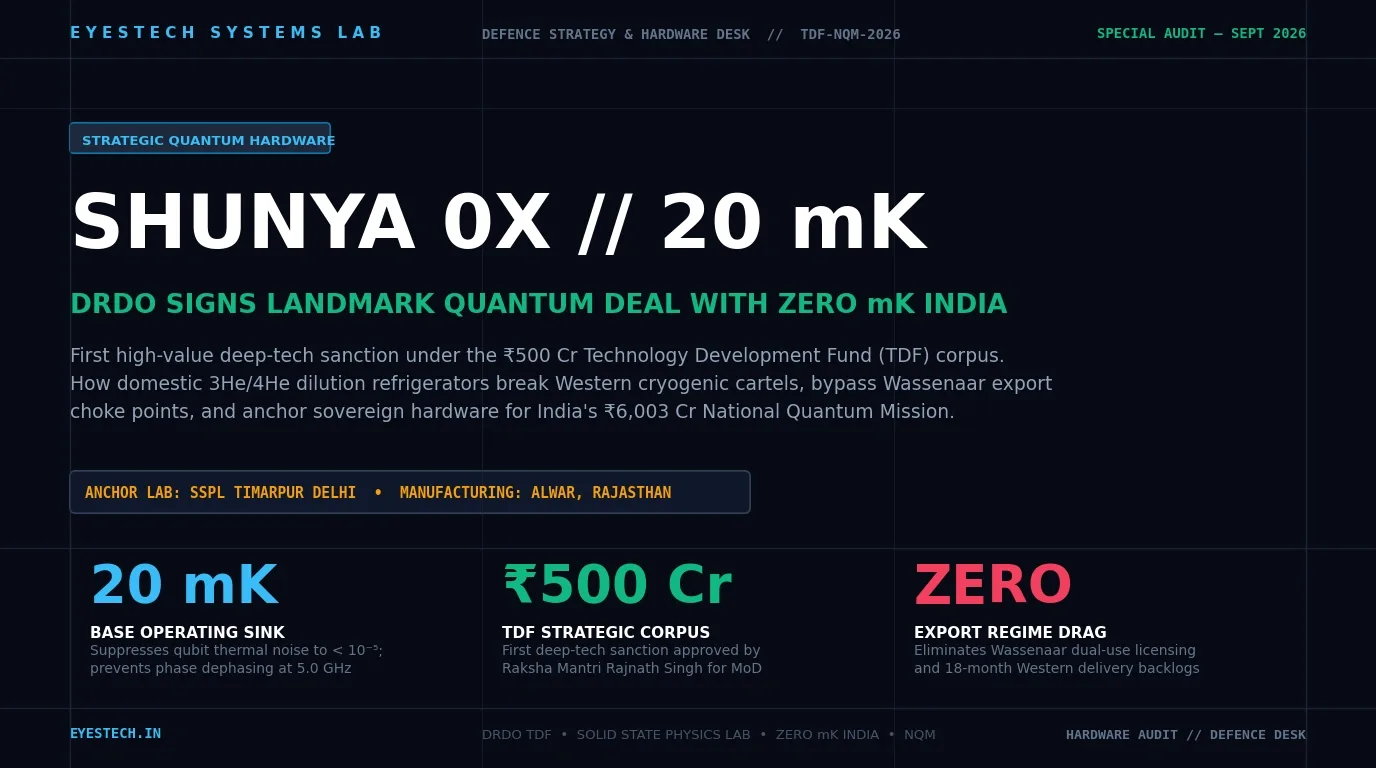
On September 24, 2026, the Defence Research and Development Organisation (DRDO) officially signed its first high-value deep-tech development contract under its newly approved ₹500 crore Technology Development Fund (TDF) corpus.
The landmark mandate was awarded to Zero mK India Private Limited, an advanced engineering startup based in Alwar, Rajasthan. The official notification was confirmed directly through the Press Information Bureau (PIB).
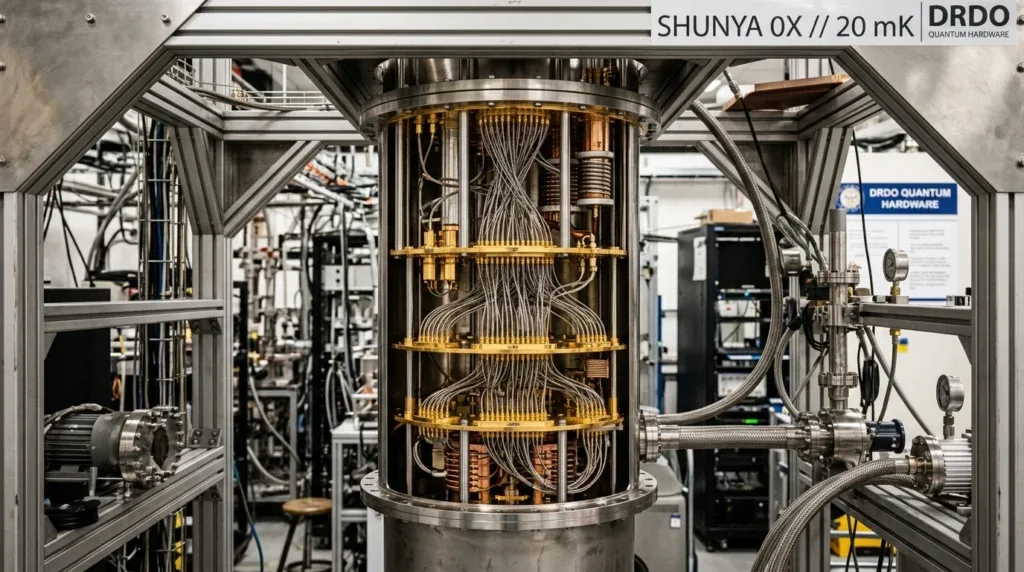
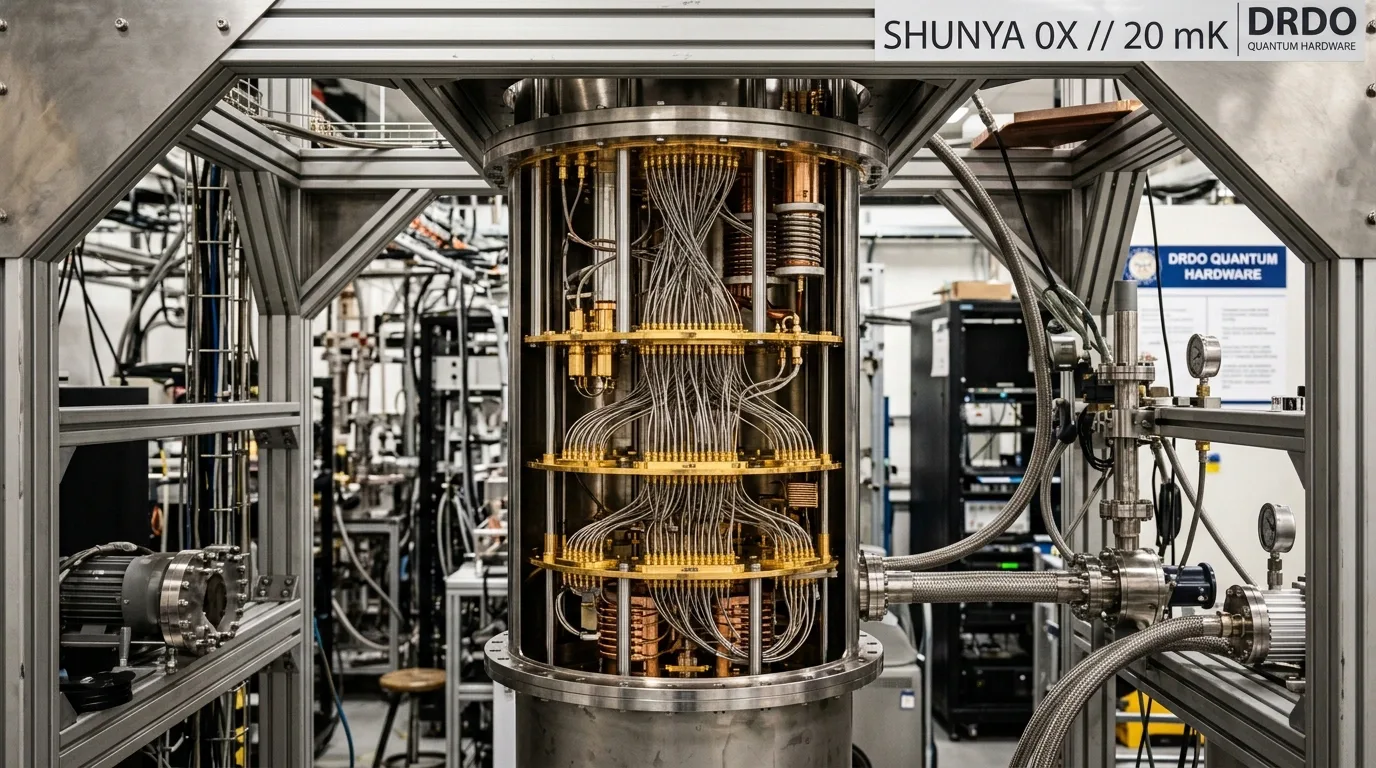
The objective is unambiguous: design, manufacture, and validate India’s first indigenous 20 millikelvin (20 mK) dilution refrigerator platform, designated the “Shunya 0X”.
This contract represents a fundamental shift in national hardware strategy. While algorithmic software and quantum simulators dominate headlines, physical quantum processors cannot function without sub-absolute-zero environments.
By integrating mentorship directly with DRDO’s premier solid-state center, the Solid State Physics Laboratory (SSPL) in Delhi, India is confronting the physical bottleneck of quantum physics: the ultra-low-temperature cooling systems that prevent superconducting qubits from collapsing into thermal noise.
As examined in our audit of India’s $200B semiconductor and hardware manufacturing trajectory, technological sovereignty is impossible if physical components remain subject to foreign choke points.
Much like Zoho’s fabless chip design strategy and sovereign silicon architecture, DRDO’s quantum partnership focuses capital directly on high-barrier physical manufacturing within domestic industrial corridors.
Technical Audit and Verification Methodology
To verify the thermodynamic principles, engineering timelines, and strategic context of the DRDO–Zero mK agreement, the EyesTech Systems Lab conducted a four-part technical audit:
- Procurement Telemetry: We analyzed official award clauses under the DRDO Technology Development Fund, verifying that this project is the inaugural high-value sanction from the dedicated ₹500 crore deep-tech corpus approved by Defence Minister Rajnath Singh.
- Cryogenic Design Verification: We evaluated engineering design briefs for Zero mK India’s “Shunya 0X” platform, specifically inspecting closed-loop helium-3 circulation, condensing line impedances, and counterflow heat-exchanger surface areas.
- Institutional Anchor Review: We examined research mandates and testing protocols at DRDO’s Solid State Physics Laboratory (SSPL) in Timarpur, Delhi, along with coordination channels under the Directorate of Micro Electronic Devices and Computational Systems (DMECS).
- Export Regime Assessment: We modeled delivery waitlists and dual-use licensing hurdles across Western cryogenic manufacturers (Bluefors, Oxford Instruments), cross-referencing controls established under the Wassenaar Arrangement.
The 20 Millikelvin Imperative: Why Superconducting Qubits Die at 100 mK
The physical requirement for a 20 millikelvin base temperature is dictated by quantum statistical mechanics.
Superconducting transmon qubits, constructed from Josephson junctions and capacitive shunts, operate at transition frequencies between 4.0 and 6.0 GHz.
At these microwave frequencies, the energy difference between the ground state (|0⟩) and the excited state (|1⟩) corresponds to a thermal equivalent of roughly 240 mK.
Thermodynamic Noise Threshold: At an operating temperature of T = 20 mK, the ratio ℏω01 / kBT ≈ 12. This drives thermal excitation probability nth down to 6.1 × 10⁻⁶. If the system rises to 100 mK, nth surges to 0.091, flooding the readout resonator with thermal photons and destroying phase coherence (T2*).
At 20 mK (just 0.02 degrees above absolute zero, or -273.13 °C), thermal energy is suppressed to kBT ≈ 1.72 × 10⁻²⁴ J.
This deep thermal baseline establishes three conditions mandatory for quantum computation:
- Quasiparticle Freezing: In superconducting aluminum and niobium films, unbroken Cooper pairs form the ground state. If temperatures rise above 100 mK, thermal fluctuations break Cooper pairs into individual quasiparticles. These free electrons tunnel across Josephson junctions and trigger rapid energy loss (T1 relaxation).
- Blackbody Microwave Suppression: Standard room-temperature equipment emits stray electromagnetic radiation across gigahertz bands. Multi-stage gold-plated radiation shields within the cryostat strip away thermal blackbody photons, lowering the photon count at the mixing chamber to near zero.
- Cryogenic HEMT Performance: High Electron Mobility Transistor (HEMT) amplifiers, positioned at the 4 Kelvin and 20 mK stages, need ultra-quiet noise floors to read out subtle single-photon dispersive signals without distorting qubit states.
Thermodynamic Mechanics of the Shunya 0X Dilution Platform
Continuous cooling to 20 mK cannot be achieved with mechanical chillers or simple liquid helium evaporation. Evaporative cooling stalls near 1.2 Kelvin because helium vapor pressure drops sharply.
To reach sub-absolute-zero regimes, Zero mK India’s “Shunya 0X” platform utilizes the quantum thermodynamics of isotopic helium mixtures: Helium-3 (3He) and Helium-4 (4He).
Endothermic Phase Crossing: When pure liquid 3He crosses the phase boundary into dilute superfluid 4He in the mixing chamber, it absorbs latent heat. In a balanced counterflow heat exchanger (Tin ≈ Tmc), cooling power scales quadratically as Q̇ ≈ 84 · ṅ3 · T2. Delivering microwatt cooling at 20 mK requires high circulation rates (ṅ3) and high-surface-area sintered silver heat exchangers.
Phase Separation Below the Tricritical Point
When a mixture of 3He and 4He is cooled below the tricritical point (Tt = 0.867 K), it spontaneously separates into two distinct liquid layers:
- Concentrated Phase: An upper layer composed of virtually 100% pure liquid 3He. It floats on top due to its lighter atomic mass.
- Dilute Phase: A lower layer consisting of a dilute solution of 3He dissolved in superfluid 4He.
Quantum mechanics prevents the solubility of 3He in 4He from dropping to zero at absolute zero. Because of zero-point energy differences, 3He retains a finite minimum solubility of 6.6% even at 0 Kelvin.
The refrigeration cycle exploits this phenomenon through continuous distillation:
- Distillation at the Still: The “Still” is maintained at approximately 0.7 Kelvin. At this temperature, the vapor pressure of 3He is hundreds of times higher than that of 4He, allowing external vacuum pumps to selectively extract pure 3He gas.
- Phase Boundary Crossing: As 3He is pumped from the dilute phase, 3He atoms inside the mixing chamber are forced across the phase boundary from the concentrated layer into the dilute layer.
- Endothermic Heat Extraction: Crossing the phase boundary absorbs latent heat directly from the copper experimental cold plate, maintaining a steady 20 mK baseline.
Global Cartels, Wassenaar Export Controls, and the Helium-3 Bottleneck
India’s quantum research programs have historically faced severe single-source exposure to Western cryogenic manufacturers.
The global dilution refrigerator market is concentrated among an oligopoly: Bluefors (Finland), Oxford Instruments NanoScience (United Kingdom), Lake Shore Cryotronics / Janis (United States), and FormFactor (United States).
As evaluated in our research on India-EU strategic semiconductor and 6G alliances and declassified sovereign defense technologies, overseas hardware reliance introduces four critical operational vulnerabilities:
- Dual-Use Export Controls: Dilution refrigerators capable of sustained operation below 100 mK are classified as dual-use goods under the Wassenaar Arrangement (Categories 6 and 4) and the US Commerce Control List (ECCN 1A004/6A002). Indian defense entities like DRDO and BARC face rigorous end-user audits and recurring export license delays.
- Severe Delivery Lead Times: Factory backlogs from commercial quantum labs (IBM, Google, Rigetti) mean procurement lead times routinely stretch between 14 and 22 months, delaying National Quantum Mission milestones.
- Helium-3 Isotope Scarcity: Helium-3 is an extraordinarily scarce non-radioactive isotope sourced primarily as a byproduct of tritium radioactive decay in nuclear weapon stockpiles. Global market prices exceed USD 3,000 to USD 5,000 per STP liter, creating recurring fuel dependencies.
- Foreign Capital Drainage: Outfitting multi-qubit research cryostats with high-frequency RF lines costs between USD 1.5 million and USD 3.5 million (₹12 Cr to ₹30 Cr) per system, draining national research budgets into foreign hardware maintenance.
The DRDO–SSPL–Zero mK Execution Triad
A frequent pitfall in public deep-tech funding is awarding capital to software integrators that lack precision metallurgical facilities.
The DRDO–Zero mK agreement addresses this risk by combining established industrial precision fabrication with dedicated solid-state laboratory oversight:
- Zero mK India & Sar Indus Kikai: Based in the Matsya Industrial Area of Alwar, Rajasthan, Zero mK India draws engineering heritage from its parent group entity, M/s Sar Indus Kikai. The company operates precision CNC machining centers, automated orbital welding tools, and ultra-high-vacuum (UHV) testing chambers designed for defense applications.
- Solid State Physics Laboratory (SSPL, Delhi): Operating as DRDO’s scientific anchor, SSPL leads research in compound semiconductors, quantum materials, and solid-state sensors. SSPL researchers, in partnership with the Directorate of Micro Electronic Devices and Computational Systems (DMECS), are establishing validation protocols to test prototype refrigerators against real superconducting quantum devices.
- National Quantum Mission Integration: The Department of Science and Technology’s ₹6,003.65 crore National Quantum Mission targets the deployment of 20-to-50 qubit intermediate-scale quantum computers by 2027–2028. Developing sovereign dilution refrigerators ensures these domestic processors can be housed without relying on foreign cryostat suppliers.
Engineering Bottlenecks: The Road to Q4 2027 Validation
While institutional support under the ₹500 crore TDF scheme provides vital funding, translating cryogenic physics into a robust commercial system requires solving four demanding engineering challenges before the scheduled Q4 2027 prototype demonstration:
Kapitza Resistance and Sintered Silver Heat Exchangers
Below 100 mK, the primary bottleneck in heat transfer is not bulk thermal conduction through metals, but acoustic mismatch across the liquid-solid boundary, known as Kapitza resistance (RK ∝ T−3).
Thermal conductivity between circulating liquid helium and copper cold plates decreases rapidly at lower temperatures:
- Sub-Micron Sintering: Zero mK India must produce ultra-high-purity sintered silver heat exchangers using 40 to 70 nanometer silver particles.
- Surface Area Expansion: Sintering these nanoparticles onto oxygen-free high-conductivity (OFHC) copper substrates expands the effective liquid-to-solid contact surface to several hundred square meters.
- Thermal Choke Prevention: This high contact area enables continuous microwatt-level heat extraction at 20 mK without causing thermal choke points.
Pulse-Tube Mechanical Decoupling and Vibration Isolation
Modern dilution systems are “dry”: they replace liquid helium refill baths with closed-loop Pulse Tube Cryocoolers (PTC) to reach 4 Kelvin.
However, pulse tubes operate using oscillating high-pressure helium gas pulses driven by external compressors, cycling at roughly 1.4 Hz:
- Acoustic Noise and Dephasing: If semi-rigid coaxial microwave cables vibrate within magnetic shielding, triboelectric and capacitive fluctuations introduce phase noise (T2*) directly into transmon qubits.
- Friction Heating: Microscopic structural vibrations inside the mixing chamber generate frictional heating, which can quickly exceed the refrigerator’s 20 mK cooling capacity.
- Mechanical Countermeasures: Zero mK must implement multi-stage vibration damping: elastomeric isolation rings, hydroformed metal bellows, and high-purity copper braided links that conduct thermal energy while attenuating vibrations down to sub-nanometer levels.
Hermetic Leak Integrity and Closed-Loop Gas Handling
Because Helium-3 is scarce and expensive, an industrial cryostat cannot tolerate even trace gas loss:
- Inventory Protection: A standard charge requires 10 to 25 STP liters of 3He, representing an immediate inventory value of USD 50,000 to USD 100,000.
- Leak Rate Standards: The Gas Handling System (GHS), utilizing oil-free roots pumps, turbo-molecular vacuum pumps, and liquid nitrogen cold traps, must maintain total helium leak rates below 10−9 mbar·L/s.
- Automated Recovery Systems: Zero mK must deploy automated pneumatic valves and fail-safe ballast dump tanks. If power fails or compressors trip, the system automatically recovers the 3He/4He gas charge into sealed stainless-steel storage vessels without venting into the atmosphere.
Cryogenic Microwave Wiring and Superconducting Shields
Operating 20 to 50 qubits requires routing hundreds of coaxial signal lines from ambient room temperature down to 20 mK:
- Attenuator Thermalization: Semi-rigid coaxial lines (NbTi, CuNi, and silver-plated copper) require cryogenic attenuators (20 dB at 4 K, 10 dB at Still, 20 dB at Mixing Chamber) to filter thermal noise without introducing localized hotspots.
- Dual-Layer Magnetic Shielding: Superconducting qubits are vulnerable to ambient geomagnetic fields. The mixing chamber must be protected with dual-layer shielding: an outer high-permeability Cryoperm/Mu-metal cylinder for low-frequency magnetic fields, paired with an inner superconducting lead or niobium shield that repels stray magnetic flux through the Meissner effect.
Frequently Asked Questions
What is the significance of DRDO’s quantum agreement with Zero mK India?
The agreement represents the first high-value deep-tech contract sanctioned under the DRDO’s newly approved ₹500 crore Technology Development Fund (TDF) corpus. It contracts Alwar-based startup Zero mK India to indigenously develop and manufacture a 20 millikelvin (20 mK) dilution refrigerator (“Shunya 0X”), ending India’s total import reliance on European and American cryogenic cartels for quantum hardware development.
Why is a 20 mK dilution refrigerator mandatory for quantum computing?
Superconducting qubits operate at microwave transition frequencies between 4 and 6 GHz. If operated at temperatures above 20 mK, thermal background photons and broken Cooper pairs (quasiparticles) flood the resonator cavity, causing spontaneous state excitation and destroying quantum phase coherence. A 20 mK baseline suppresses thermal population probability down to less than 10-5, enabling high-fidelity quantum gate operations.
What role does DRDO’s Solid State Physics Laboratory (SSPL) play in this project?
DRDO’s Solid State Physics Laboratory (SSPL) in Delhi serves as the institutional scientific anchor and validation partner. SSPL’s quantum physicists and engineers mentor Zero mK India, establish cryogenic testing protocols, execute noise spectroscopy benchmarks, and evaluate the prototype system with actual solid-state and superconducting quantum test chips before field deployment.