

In autonomous agentic coding, the most expensive mistake is assigning frontier reasoning models to operational plumbing. On local developer machines, multi-agent swarms look effortless in scripted demonstrations: a single prompt dispatches workers, file trees parse cleanly, and a green test pass lands in git history. But take that same workflow into an enterprise repository with nested dependencies, and the failure point is rarely high-level reasoning. The workflow breaks on deterministic execution plumbing: unescaped shell commands, runaway context accumulation, tool schema bloat, and rate limit exhaustion.
Production harnesses like Claude Code spend up to 82% of their cumulative token volume on deterministic, low-level execution: searching file trees, running regex filters, parsing terminal error tracebacks, and verifying git diffs. In these high-frequency loops, Claude Haiku 5.5 has emerged as Anthropic’s most under-appreciated asset—delivering a 72.4% success rate on OSWorld 2.1 compared to 48.9% for OpenAI’s GPT-6 Luna at an identical base price of $0.10 per million input tokens.
The divergence between the two lightweight models lies in orchestration physics rather than marketing claims. While GPT-6 Luna was optimized for flat long-context ingestion and wide classification batches—as seen in Freebuff’s rollout of GPT-6 Luna—Claude Haiku 5.5 was calibrated for rapid, sprint-oriented tool manipulation within nested sub-agent environments. When orchestrating multi-agent systems inside Claude Code, deploying Haiku as the dedicated execution worker resolves the primary operational bottleneck of autonomous coding: the compounding of context tokens, shell execution retries, and rate limit starvation.
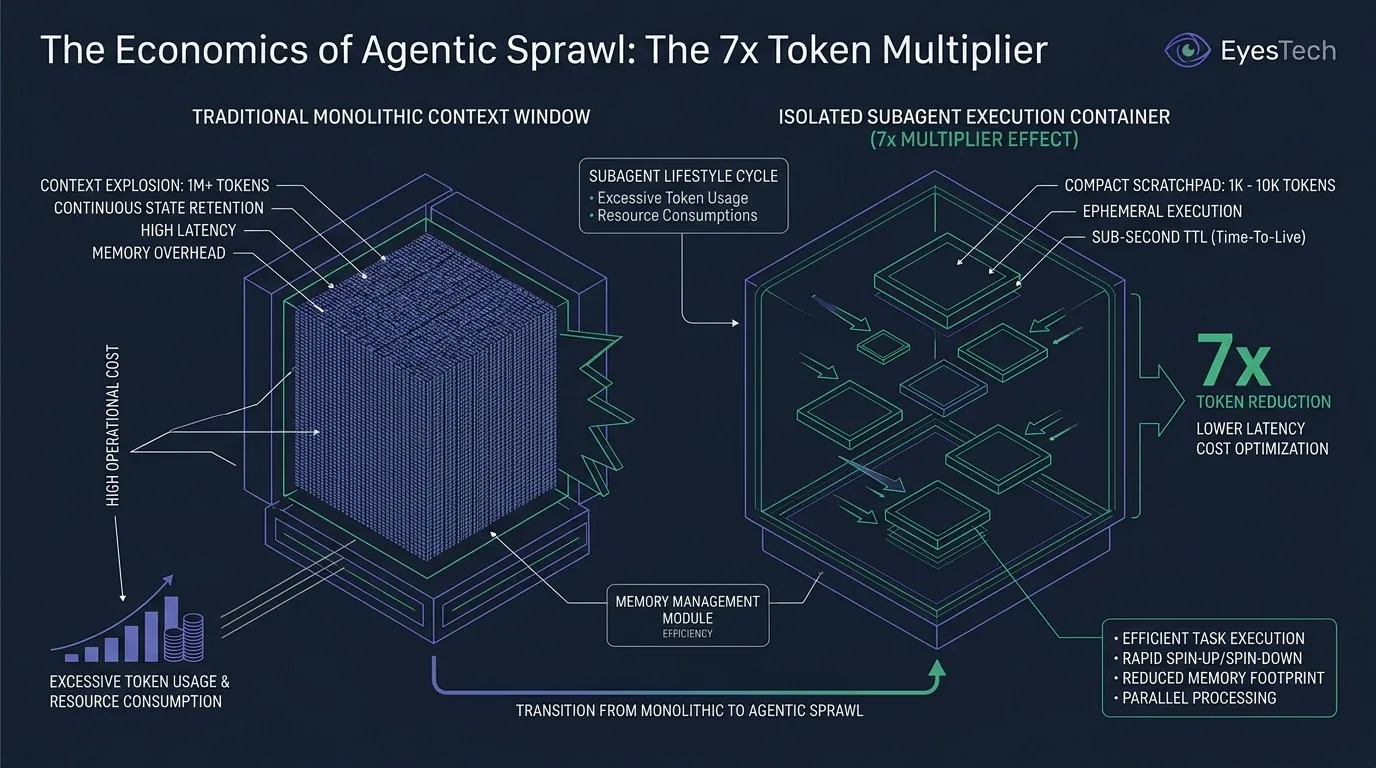
The Economics of Agentic Sprawl: The 7x Multiplier
Every autonomous coding session that branches into sub-agents incurs an immediate structural penalty: the sub-agent startup bill. When a primary orchestrator (such as Claude Sonnet 5.5 or Opus 5.5) delegates a task—for example, indexing a repository’s dependency graph—the spawned sub-agent does not inherit the active memory of the parent. Instead, it spins up an isolated execution context.
To function, that sub-agent must ingest the base system prompt, workspace configuration, and the serialized JSON schemas of every tool available in the environment. In unmanaged multi-agent frameworks, this causes token consumption to compound at roughly seven times the rate of a linear, single-session chat. As documented in our analysis of state isolation in Claude Code harnesses, context management dictates whether an agent completes a task or crashes on token limits.
The 7× Compounding Law: When workers inherit unpruned tool schemas (Ttools > 15k tokens) and run on the primary frontier tier (Pworker = POpus), operational spend compounds exponentially per delegated task.
| Metric / Architectural Feature | Claude Haiku 5.5 | GPT-6 Luna | Operational Consequence |
|---|---|---|---|
| Base Input Price (<100K Tokens) | $0.10 / 1M tokens | $0.10 / 1M tokens | Price parity during short, bounded subagent exploration sprints |
| Base Output Price (<100K Tokens) | $0.50 / 1M tokens | $0.50 / 1M tokens | Identical base unit economics for synthesized result payloads |
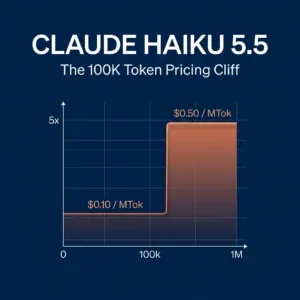
| Extended Context Tier Surcharge | 5× surge at 100K tokens ($0.50 / $2.50) | Flat rate up to 272K tokens | Haiku enforces short execution sprints; Luna permits broad ingestion |
| OSWorld 2.1 Benchmark Pass Rate | 72.4% | 48.9% | Haiku exhibits +23.5% higher tool fidelity in live OS environments |
| Reasoning Effort Control | Native slider (low / med / high / max) | Configurable via reasoning.mode | Tuning effort controls latency and token cost before model selection |
| Primary Architectural Placement | High-velocity terminal execution sub-agent | Bulk document classifier & batch worker | Determines optimal harness integration and task delegation routing |
If a developer configures Claude Code to spawn sub-agents using the primary model, a single exploratory investigation can burn through 200,000 tokens in under two minutes. Spawning three parallel Sonnet sub-agents to search log files and run test suites quickly trips organization-level Tokens Per Minute (TPM) limits, starving the primary planner.
Routing those sub-agent threads to Claude Haiku 5.5 alters the unit economics. At $0.10 per million input tokens and $0.50 per million output tokens, Haiku absorbs the repetitive startup overhead at a fraction of Opus’s expense, while preserving rate-limit headroom for high-level architectural decisions.
# Configure Claude Code CLI to route all spawned subagents to Claude Haiku 5.5
export CLAUDE_CODE_SUBAGENT_MODEL="claude-haiku-5-5"

# Restrict maximum recursive sub-agent delegation depth
export CLAUDE_CODE_MAX_SUBAGENT_DEPTH="3"

# Verify active session model routing
claude code --status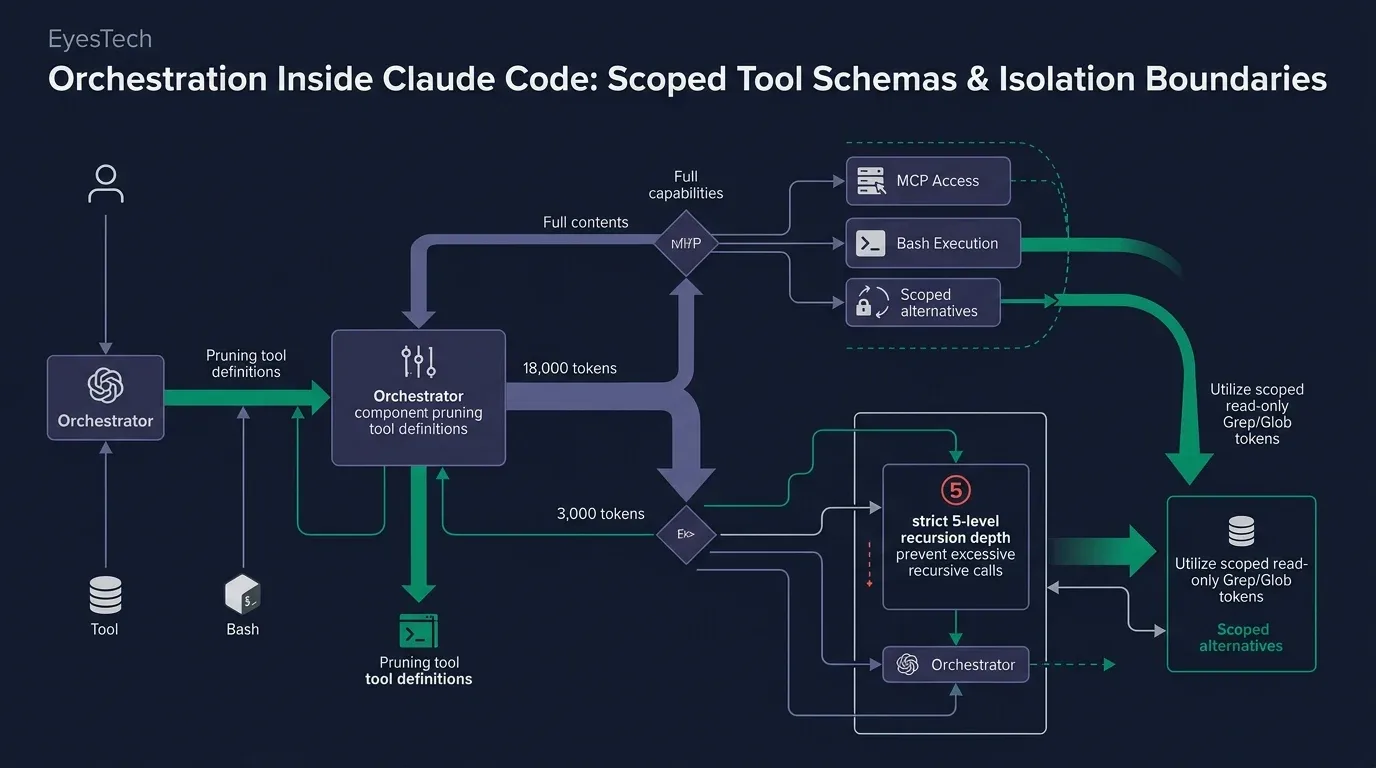
Orchestration Inside Claude Code: Scoped Tools and Clean Boundaries
Claude Code structures multi-agent work through hierarchical isolation rather than shared blackboard memory. When a complex command is dispatched, the orchestrator divides the objective into bounded deliverables.
This orchestration model relies on three architectural safeguards:
- Dynamic Tool Schema Pruning: A major driver of the sub-agent startup bill is tool definitions. Claude Code prunes unused capabilities based on the agent’s assigned role. A read-only research sub-agent receives only
read,grep, andglobschemas, omitting file-writing, bash execution, and external MCP endpoints. This reduces the sub-agent’s prompt overhead by 3x to 6x on every iteration. - Context Isolation and Summarization: Sub-agents run inside encapsulated scratchpads. If a research agent greps across 50 source files and inspects 4,000 lines of terminal output, that raw text never enters the parent orchestrator’s context window. Instead, the sub-agent synthesizes its findings into a concise markdown payload, terminates its runtime, and returns only the verified result.
- Nesting Depth Caps and Pre-Screening: Claude Code enforces a maximum nesting limit of 5 levels deep, paired with classifier pre-screening to prevent recursive spawning loops.
This is precisely where Claude Haiku 5.5’s pricing structure aligns with harness mechanics. Anthropic’s pricing imposes a 5x cost increase once a context window crosses 100,000 tokens ($0.50 / $2.50 per million tokens). Rather than an arbitrary limitation, this pricing cliff functions as an architectural forcing function. It penalizes unmanaged context accumulation and incentivizes developers to build ephemeral, sprint-oriented sub-agents that spin up, execute atomic tasks in under 15,000 tokens, and tear down immediately.
Why GPT-6 Luna Stumbles on the Command Line
OpenAI’s GPT-6 Luna is a capable model, but its strengths lie in a different operational regime. As detailed in our breakdown of the broader GPT-6 pricing tiers, Luna maintains its $0.10 base input pricing up to 272,000 tokens without a surcharge, making it suitable for ingesting large PDF archives or running flat classification swarms through the OpenAI Decisions API.
However, when deployed as an autonomous execution worker inside terminal harnesses, Luna exhibits friction that degrades multi-agent workflows:
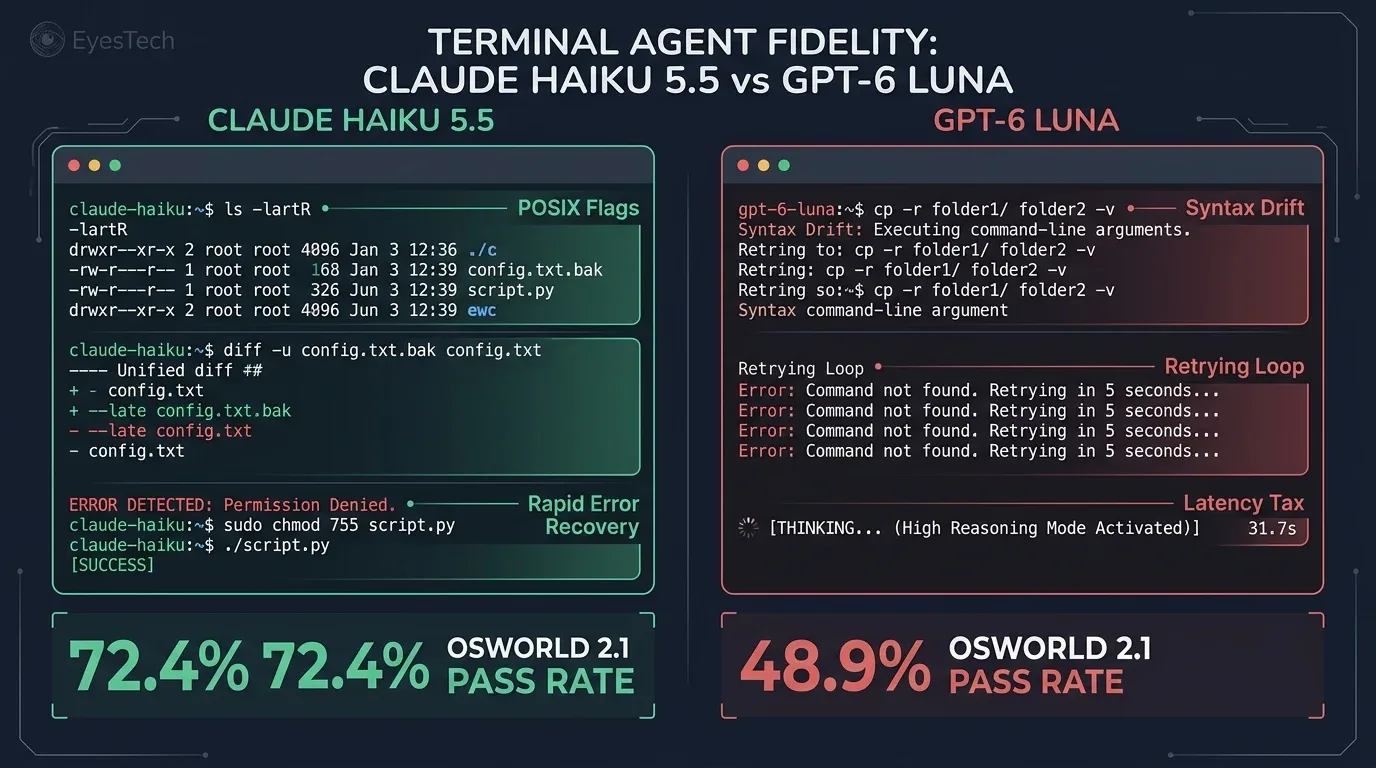
- POSIX Argument Precision: In benchmark testing on Terminal-Bench 4 and OSWorld 2.1, Haiku 5.5 achieved a 72.4% task completion rate compared to Luna’s 48.9%. Terminal-based coding agents require precise handling of command-line flags, quoted regex strings, and unified diff formats. Luna frequently dropped required escaping when issuing bash tool calls, resulting in immediate execution errors.
- The Reasoning Mode Tax: To achieve reliable tool-calling compliance on multi-step refactoring tasks, Luna frequently requires its reasoning effort set to
high(reasoning.mode="high"). While this improves syntactic accuracy, it introduces substantial chain-of-thought token generation, which inflates total token consumption and increases execution latency. - State Recovery Failure: When a shell command returns a non-zero exit code, Haiku 5.5 inspects the stderr message and issues a corrective command in a single turn. Luna more frequently enters retrying loops, re-issuing identical failed commands until hitting harness recursion limits.
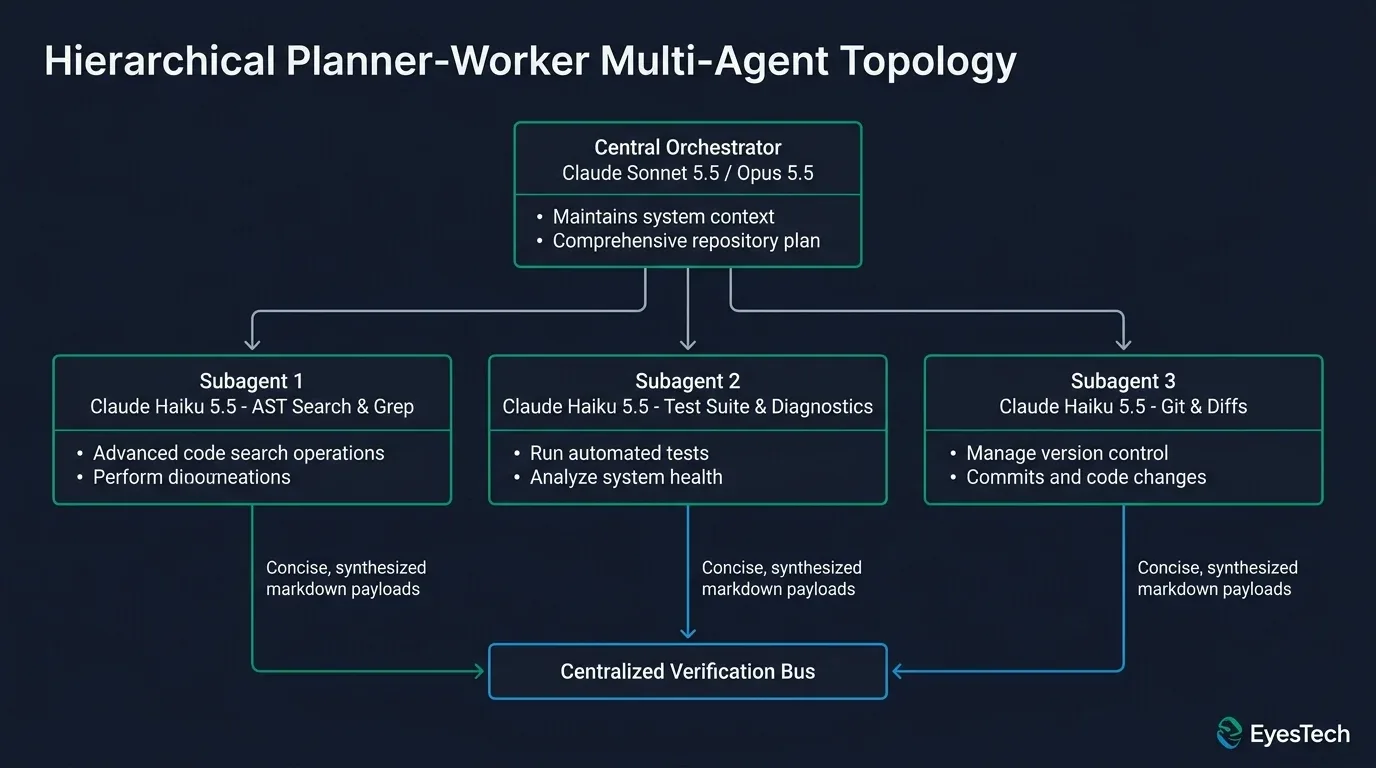
The Hierarchical Blueprint: Planner-Worker Agent Topologies
The modern enterprise consensus has moved away from homogeneous model swarms. Deploying dozens of identical large models in an uncoordinated swarm generates exponential context growth and high error rates. The dominant architecture in production developer platforms is a strictly decoupled Planner-Worker Topology.
In this architecture, the primary orchestrator holds the architectural mental model, repository goals, and user conversation history. It does not touch raw files directly. When an implementation step requires verification:
- The orchestrator dispatches a prompt to an ephemeral Haiku worker specifying the exact hypothesis to test.
- The Haiku sub-agent executes deterministic terminal commands in a private context window.
- The worker evaluates the output, formats a structured response, and exits.
- The orchestrator ingests the clean result and advances the plan.
This division of labor exploits the core advantages of both tiers: the deep reasoning and edge-case handling of Sonnet or Opus, paired with the rapid execution speed and minimal cost footprint of Haiku.
Unlocking Haiku’s Potential in Production
Claude Haiku 5.5 remains under-appreciated because public evaluation benchmarks focus almost exclusively on single-turn reasoning, creative writing, and competitive coding trivia—domains where large frontier models naturally excel.
In production software engineering, raw reasoning power is useless if the system exhausts its rate limits before executing a build. By serving as an efficient, deterministic, and cost-effective execution tier, Claude Haiku 5.5 provides the practical foundation that makes multi-agent systems viable at scale.
Frequently Asked Questions
Why does Claude Haiku 5.5 outperform GPT-6 Luna on terminal benchmarks?
Claude Haiku 5.5 scores 72.4% on OSWorld 2.1 compared to 48.9% for GPT-6 Luna because Anthropic calibrated Haiku specifically for structured tool calling, POSIX flag compliance, and terminal diff application. GPT-6 Luna frequently exhibits syntax drift with shell quote escaping, triggering execution errors that require higher reasoning modes and introduce latency.
How does Claude Code prevent sub-agents from blowing up token budgets?
Claude Code enforces strict context boundaries by isolating each sub-agent into its own temporary scratchpad, capping nesting depth at 5 levels, and pruning unused tool schemas. A read-only research sub-agent has bash and file-write tool definitions stripped from its system prompt, reducing per-turn prompt overhead by 3x to 6x.
Why is Anthropic’s 100K token pricing threshold beneficial for agent architectures?
Anthropic’s 5x price increase above 100,000 tokens ($0.50 / $2.50 per million) functions as an architectural forcing function. It penalizes developers for allowing sub-agents to accumulate unmanaged context and encourages short, bounded execution sprints (under 15,000 tokens) that return synthesized results to the primary orchestrator and terminate immediately.