
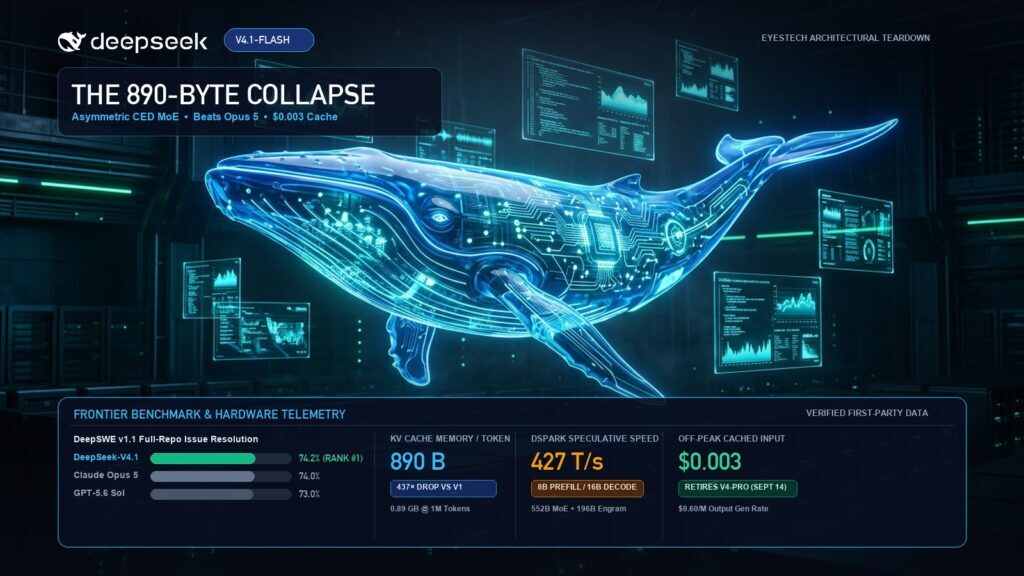

At 11:40 AM on September 10, 2026, DeepSeek dropped what may be the most consequential architectural disruption of the post-transformer era: DeepSeek-V4.1-Flash. Clocking in at a 552B-parameter Mixture-of-Experts (MoE) backbone paired with an externalized 196B-parameter Engram memory module, the model introduces an asymmetric Causal Encoder–Decoder (CED) architecture that activates just 8B parameters during input prefill and 16B parameters during autoregressive decoding. Simultaneously, DeepSeek achieved an unprecedented compression of the persistent global Key-Value (KV) cache down to 890 bytes per token—a 4× reduction over V4-Flash and a 437× collapse compared to V1. In an aggressive commercial maneuver, DeepSeek announced the immediate retirement of V4-Flash and confirmed that all deepseek-v4-pro API endpoints are being permanently routed to V4.1-Flash at Flash pricing, effectively euthanizing their own flagship tier in favor of extreme, high-throughput agentic efficiency.
1. The Architectural Pivot: Why Decoder-Only Hit the Agentic Wall
For half a decade, the generative AI industry operated under an unquestioned dogma: the standard causal decoder-only Transformer was the optimal convergence point for language modeling. However, the rise of autonomous coding harnesses (such as Claude Code, Devin, and DeepSeek Harness) exposed a catastrophic thermodynamic and hardware mismatch in decoder-only designs when operating over long horizons.
In production agentic loops, workloads are overwhelmingly prefill-heavy. An agent regularly ingests 100,000 to 500,000 tokens of repository context, terminal logs, and system prompt constraints just to emit a terse 20-token shell command or diff patch. Under conventional decoder-only topologies, every token processed during prefill forces the entire parameter suite through High-Bandwidth Memory (HBM), creating massive latency penalties and memory bandwidth saturation.
40 Layers Total
8B Active / Token
Ingests up to 1,000,000 tokens of agent histories, repository trees, and multimodal inputs at peak arithmetic intensity. Keeps routed MoE activation capped at 8B parameters.
16B Active / Token
Autoregressively generates tokens with doubled active parameter capacity (16B active) for deep symbolic reasoning, code synthesis, and speculative token draft verification.
→ Direct Global KV Projection (WKproj, WVproj) →
Decoder Autoregressive State
DeepSeek-V4.1-Flash breaks this bottleneck by implementing a 40-layer Transformer partitioned into a 20-layer Causal Encoder and a 20-layer Decoder. By enforcing this causal asymmetry, DeepSeek enables a radically lean 8B-parameter prefill path while reserving a richer 16B-parameter active compute pathway for autoregressive generation. The MoE backbone utilizes 1 shared expert and 384 routed experts per layer, selecting the top 6 routed experts per token.
2. The Mathematics of the 890-Byte KV Cache Collapse
The fundamental operational ceiling for long-context LLMs has never been raw compute FLOPs—it is memory capacity and memory bandwidth. When serving concurrent agent sessions with context windows extending to 1,000,000 tokens, storing uncompressed FP16 KV caches requires hundreds of gigabytes per active user. DeepSeek’s multi-generational war on KV cache footprint—pioneered in the foundational Multi-Head Latent Attention (MLA) architecture and detailed in our 2026 AI Inference & Hardware Economics Index—reached an inflection point with V4.1-Flash.
The Causal Encoder-Decoder Global KV Projection & Active Footprint Equation
Vdec = Henc(20) · WVproj
Forensic Systems Interpretation: By caching the main KV tensor in native FP4 (E2M1 format with one E4M3 scale per 16 channels) and applying SWA Bounded Replay, the sliding-window attention (SWA) states are reconstructed ephemerally from the latest nwin tokens during decode rather than persisted to storage. This shrinks the persistent state down to exactly 890 bytes per token.
To achieve this 890-byte milestone, DeepSeek engineered a suite of four interconnected memory technologies under the umbrella of Compressed Sparse Attention 2 (CSA2):
Every layer is statically assigned to Full, Reindex, or Reuse mode. This permits cross-layer sharing of both the primary KV states and the sparse indexer keys, completely eliminating redundant attention caches across intermediate depths.
In the decoder, deeper indexing layers are strictly bounded to a candidate pool established by the first Full Mode layer. This guarantees that Top-K index traversal overhead remains O(1) constant time regardless of sequence length.
Main KV states are aggressively compressed into 4-bit floating point (2 exponent bits, 1 mantissa bit), scaled dynamically with an E4M3 scale factor every 16 channels, minimizing precision degradation while cutting memory footprint in half.
Sliding Window Attention states are no longer committed to persistent NVMe/SSD storage. During decode, missing window activations are reconstructed on the fly by replaying only the most recent nwin tokens.
389,120 B (389.1 GB / session)
48,068 B (48.1 GB / session)
3,514 B (3.51 GB / session)
890 B (0.89 GB / session)
3. Speculative Acceleration: DSpark Decoding & 196B Engram Memory
Shrinking the memory footprint solves host capacity, but autoregressive generation remains bounded by the memory latency of sequential token emission. DeepSeek tackled this bottleneck via two structural innovations: the DSpark Speculative Decoding head and an externalized Engram Conditional Memory layer.
Rather than bloating the core Transformer weights, factual n-gram associations and memorized knowledge are isolated into a standalone 196B-parameter table. This table is sparsely addressed via token-based hashing.
Implements semi-autoregressive speculative drafting paired with confidence-scheduled verification. Multiple subsequent tokens are proposed in parallel and validated in a single forward pass.
In addition to text, DeepSeek-V4.1-Flash integrates native multimodal capabilities from scratch. Rather than affixing a post-hoc visual adapter, DeepSeek trained a dedicated DeepSeek-ViT encoder featuring 2D-RoPE positional encodings and 3×3 pixel-unshuffle downsampling. Visual tokens are projected through a two-layer MLP directly into the shared latent space and pre-trained jointly over a massive 45-trillion-token multimodal dataset, with context length extended to 1,000,000 tokens at the 34T token mark.
4. The Frontier Benchmark Crucible: Beating Opus 5 and GPT-5.6 Sol
The most staggering aspect of the V4.1-Flash release is not its efficiency metrics, but the fact that a “Flash” tier model systematically matches or eclipses premier frontier flagship models across agentic execution, terminal manipulation, and code resolution. In post-training, DeepSeek introduced a continuously controllable reasoning effort parameter (ranging as an integer from 1 to 100). At maximum reasoning effort (reasoning_effort=100), the benchmark telemetry reveals a dramatic reordering of the competitive hierarchy:
Pass@1
30.0%
43.3%
34.4%
WINNER
74.2%
74.0%
73.0%
WINNER
88.1%
84.5%
84.5%
WINNER
54.8%
50.3%
45.8%
On DeepSWE v1.1, the gold standard for full-repository software issue resolution, DeepSeek-V4.1-Flash achieved a 74.2% resolved rate, topping Claude Opus 5 (74.0%) and GPT-5.6 Sol (73.0%) while running at roughly one-tenth of the per-token inference expenditure. On Automation-Bench (54.8%) and CyberGym (88.1%), it established outright global state-of-the-art benchmarks for autonomous systems execution.
5. The Commercial Killshot: Phasing Out V4-Pro & The API Economics
The most disruptive operational decision announced by DeepSeek is not technological—it is ruthless market positioning. Typically, AI labs retain multiple product tiers: an expensive, high-margin “Pro/Max” model to subsidize cheap, low-margin “Flash/Mini” variants. DeepSeek inverted this convention completely.
Effective Sept 10, 2026
Peak: 01:00–04:00
05:00 UTC
Peak: 06:00–10:00
12:00 UTC
18:00 UTC
24:00 UTC
Peak Hours (7 Hours Weekdays)
At $0.003 per million tokens for cached input, DeepSeek has virtually demonetized context ingestion. In an agent workflow consuming 100M tokens of repeated context daily, cache charges drop from hundreds of dollars under frontier Western cloud providers to just thirty cents. This margin disparity places existential pricing pressure on Western frontier AI labs whose business models depend on charging $3.00 to $15.00 per million input tokens.
6. Forensic Systems Audit: The Enterprise Infrastructure Verdict
For enterprise infrastructure directors and CTOs, the release of DeepSeek-V4.1-Flash provides three profound structural takeaways:
Conventional architectural theory posited that heavy KV quantization (sub-8-bit) would degrade multi-step logical coherence. DeepSeek’s combination of hierarchical sparse indexing, FP4 (E2M1) caching, and SWA Bounded Replay proves that KV cache compression can be pushed to 890 bytes per token while simultaneously setting new state-of-the-art records on Codeforces (3471 Elo) and DeepSWE v1.1.
DeepSeek released complete model weights on Hugging Face under the permissible MIT License, accompanied by deepseek-recipe—a high-performance Rust library with Python bindings for conversation serialization and prompt parsing. Native inference integration is already operational in vLLM and SGLang, targeting NVIDIA Hopper/Blackwell (H100/H200/B200/GB200) and AMD Instinct (MI300X/MI350) accelerators.
By achieving frontier capabilities with only 8B/16B activated parameters per token and offloading the 196B Engram memory to secondary storage tiers, DeepSeek has demonstrated that export-restricted Chinese research labs can achieve competitive parity with uncapped Western clusters. Architectural topology and cache efficiency have officially superseded raw hardware brute force.
The era of the monolithic, memory-choked decoder-only Transformer is ending. With DeepSeek-V4.1-Flash, the industry enters a new paradigm where asymmetric prefill/decode routing, extreme KV cache pruning, and speculative draft execution define the frontier of production AI.