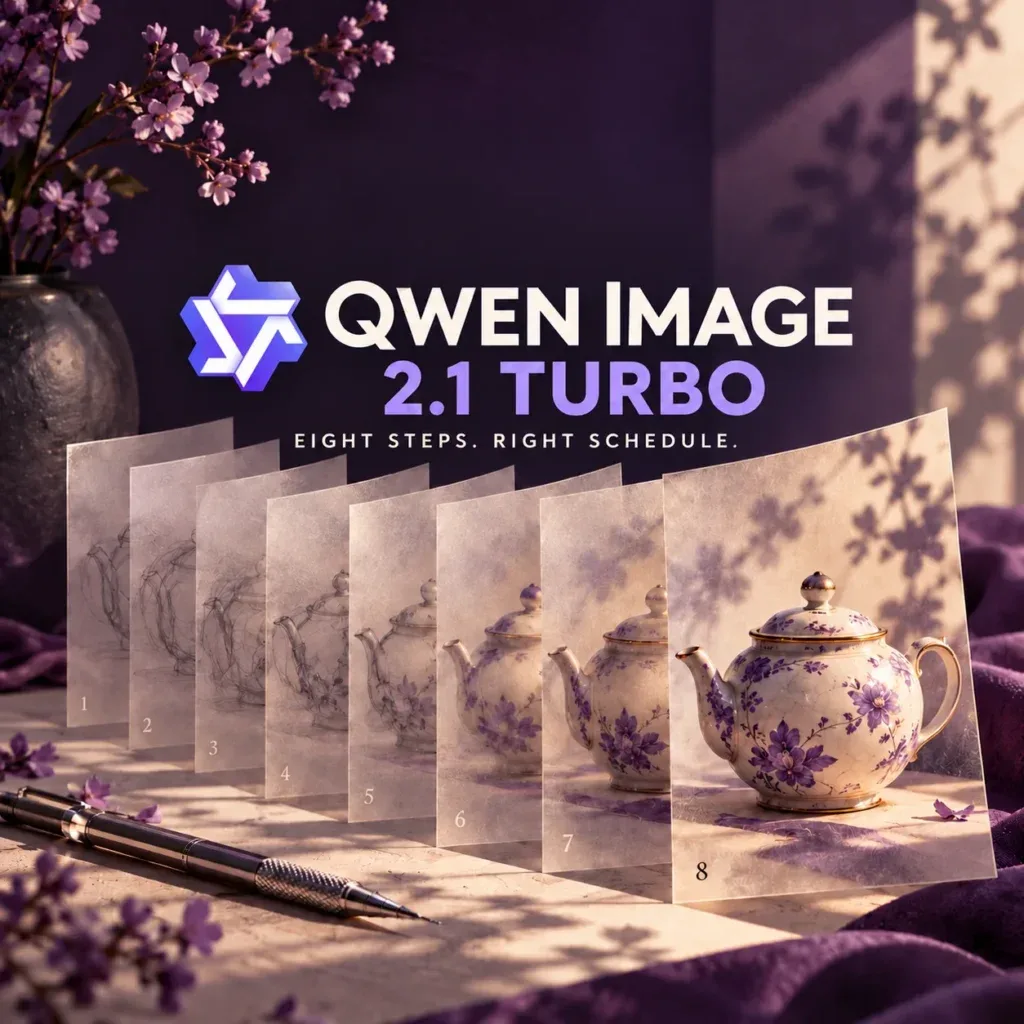

Qwen-Image-2.1-Turbo is the official accelerated checkpoint for Qwen’s 7B image-generation architecture. It supports generation and editing with a saved eight-step denoising schedule and CFG 1 by default. Running it faithfully requires a compatible pipeline; reducing the step count in an older workflow is insufficient to reproduce the release’s configuration.
The official checkpoint is downloadable, but its weights carry the Qwen Research License. Research and evaluation are permitted under that agreement; commercial use requires a separate license from Qwen. Check this before building a paid service around the local model.
The schedule is part of the checkpoint
Denoising steps are positions along a noise schedule. Eight steps placed at different noise levels can produce different results even when the count, prompt and seed match. Qwen stores the recommended schedule with Turbo so that QwenImage21Pipeline can load it automatically.
The Diffusers change that adds fixed sampling sigmas explains the relevant implementation boundary: pipeline configuration can supply a sampling schedule, with explicit call-time sigmas taking precedence. Qwen’s model card says setting num_inference_steps alone does not override Turbo’s saved schedule. Other schedules have not been evaluated for this checkpoint by the publisher.
This is especially important when a UI presents a familiar step-count slider. Verify the pipeline version and the actual schedule used by the run. A successfully loaded weight file does not prove the front end is honoring its sampling configuration. Distinguish the official Turbo checkpoint from earlier third-party acceleration adapters when saving a workflow.
A minimal run preserves the supplied defaults
The release instructions require current Diffusers source support and Transformers 5.17 or newer, together with a CUDA-compatible PyTorch installation. The example below keeps the checkpoint’s sampling defaults rather than introducing a custom schedule:
import torch
from diffusers import QwenImage21Pipeline

pipe = QwenImage21Pipeline.from_pretrained(
    "Qwen/Qwen-Image-2.1-Turbo", dtype=torch.bfloat16
).to("cuda")

result = pipe(
    prompt="A ceramic teapot on a linen-covered table, soft window light",
    width=2048, height=2048, use_kv_cache=True,
    generator=torch.Generator("cpu").manual_seed(42),
)
result.images[0].save("turbo-teapot.png")
This is a documentation-based starting point, not a benchmark performed by EyesTech. The official repository provides the installation and editing recipes. Pin the working library revision when preserving an experiment, since a source installation can change between dates.
Prefix KV caching reuses the text and reference-image context across denoising steps. It reduces repeated context processing; it does not eliminate image-token computation, text encoding, decoding or file output. Editing also has input-media preparation costs. Measure those stages rather than attributing every second to the denoiser.
Compare time per usable output
Eight steps are not an eightfold end-to-end speed claim. A useful comparison separates fixed overhead from repeated work. As an illustration, suppose preprocessing and decoding take one second, each denoising step takes 0.2 seconds, and a reference setup uses 32 steps. Total time would be 7.4 seconds for that setup and 2.6 seconds for eight steps: about 2.85 times faster. These are assumed values, not measured Qwen timings.
Then count rejected images. If half the faster run’s outputs need regeneration while the slower run’s outputs all pass, effective time per accepted image doubles for the faster configuration. Typography accuracy, reference fidelity, transparent edges and required object counts are useful acceptance criteria. Preserve failed outputs and use several seeds; selecting one attractive sample after the fact gives no rejection-rate estimate.
For a controlled local trial, keep resolution, hardware, precision, prompts and reference images fixed, but use each checkpoint’s intended sampling recipe. Report both denoising and complete request time, peak memory, cold-start behavior and accepted-output rate. The official showcase is evidence of supplied examples, not a substitute for that workload measurement.
Turbo’s appeal is fewer denoising evaluations within an inspectable local workflow. Its actual value depends on correct schedule support, output acceptance and deployment rights. Those three checks are more useful than a step-count comparison alone.
Prepared with AI assistance from the cited primary sources. Cover: AI-generated editorial illustration. The sample workflow has not been executed for this article.