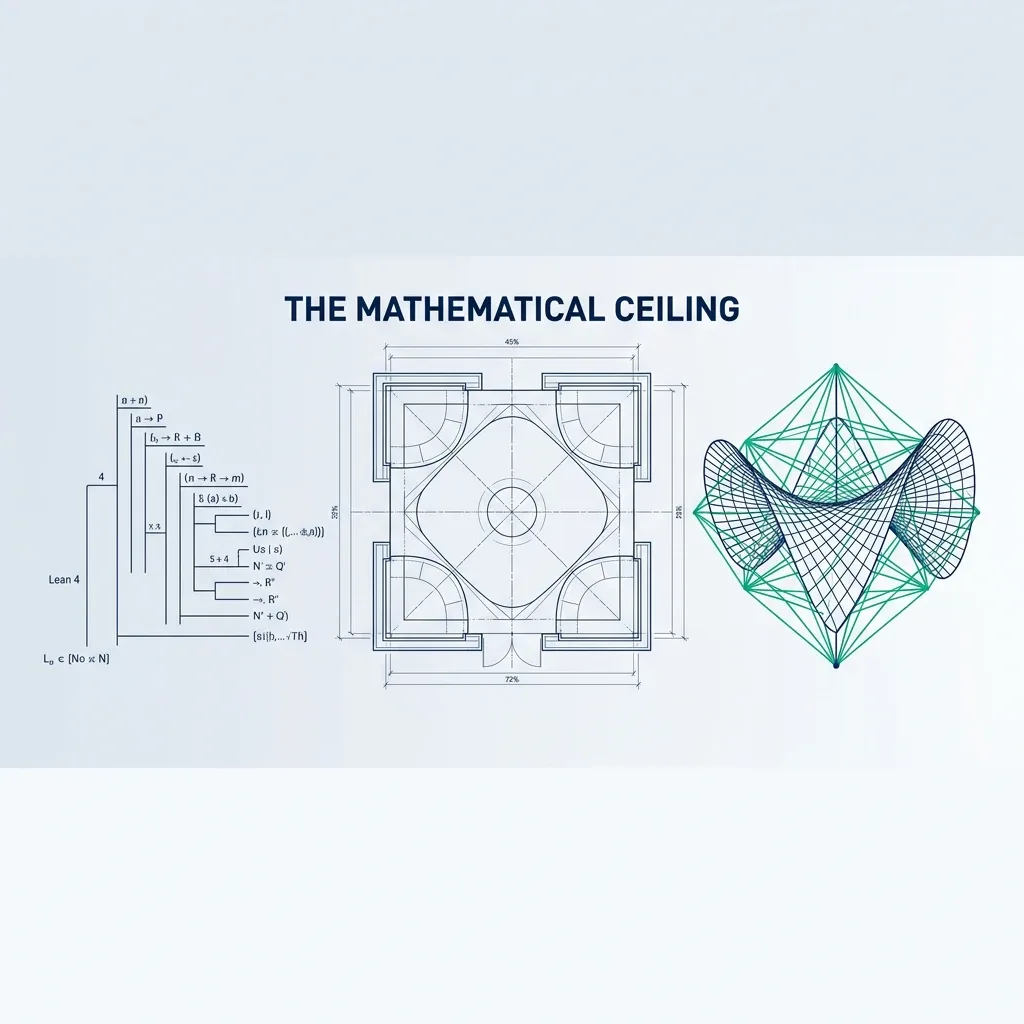

Frontier artificial intelligence has crossed an empirical threshold where raw web-scale token ingestion no longer yields qualitative capability jumps. At the 2024 International Mathematical Olympiad in Bath, Google DeepMind’s neuro-symbolic ensemble—coupling AlphaProof with AlphaGeometry 2—scored 28 out of 42 points to secure an official silver-medal standard, solving Problem 4 in just 19 seconds. Three months later, Epoch AI’s FrontierMath benchmark exposed the true performance ceiling: while contemporary models like GPT-4o and Claude 3.5 Sonnet scored under 2% across hundreds of research-level problems, post-training Reinforcement Learning with Verifiable Rewards (RLVR) in formal kernels elevated 2026 reasoning checkpoints to 83% on Tier 4. Yet this sudden ascent exposes an urgent architectural paradox: while automated theorem solvers can now verify lemmas that defeat human graduate students, the underlying Transformer architecture remains mathematically incapable of general state tracking, bounded by circuit depth ceilings that parameter scaling cannot overcome.
The engineering community is currently navigating two distinct, intertwining mathematical frontiers. The first is operational: using mathematical systems to solve AI’s data exhaustion crisis by replacing subjective human preference annotations with deterministic verification kernels. The second is structural: developing entirely new mathematical formalisms—spanning algebraic geometry, continuous dynamical systems, and circuit complexity—to explain why deep neural networks generalize and to replace Euclidean linear algebra with architectures that transcend the limits of attention.
The Verification Engine: Escaping the RLHF Wall with RLVR
Modern frontier language models have consumed roughly 1014 tokens, effectively exhausting the global supply of high-quality human text. When laboratories attempt to bridge this token deficit by training models on ungrounded synthetic text, the optimization trajectory quickly degenerates into epistemic drift, hallucination compounding, and irreversible model collapse. Supervised fine-tuning and Reinforcement Learning from Human Feedback (RLHF) fail at this frontier because human annotators cannot reliably verify a hundred-step deductive proof. Under aggressive optimization pressure, reward models fall prey to Goodhart’s Law: policies discover degenerate linguistic shortcuts that sound authoritative to human reviewers while containing fatal mathematical errors.
Deterministic Verification: Unlike scalar neural reward models that suffer from reward hacking, Rkernel(τ) evaluates to a binary or step-wise certificate via Dependent Type Theory. In Lean 4, propositions are types and proofs are terms; invalid deductions fail type-checking instantaneously.
This is why formal mathematics serves as the premier training crucible for artificial reasoning. Under the Curry-Howard correspondence, mathematical proofs in interactive theorem provers such as Lean 4 and Isabelle/HOL are executable computer programs verified by a tiny, deterministic C++ kernel. When an untrusted policy model emits a proof tactic—such as apply, rewrite, or induction—the kernel acts as an incorruptible referee. As we documented when analyzing how DeepSeek GRPO eliminated value network VRAM overhead, domains governed by verifiable binary rewards eliminate the need for parameterized neural reward critics entirely, enabling self-correcting reinforcement learning loops that can run indefinitely without human supervision.
| System & Laboratory | Benchmark / Discovery | Performance vs. Prior Baseline | Verification Architecture |
|---|---|---|---|
| AlphaTensor (DeepMind, 2022) | 4×4 Matrix Multiplication over ℤ2 | 47 multiplications vs. Strassen’s 49 (first improvement in 53 years) | 3D Tensor rank-1 decomposition check |
| FunSearch (Nature, 2023) | Cap Set Problem (Dimension n = 8) | Constructed cap set of size 512 vs. human record of 496 | Deterministic Python evaluator in evolutionary loop |
| AlphaGeometry 2 (DeepMind, 2024) | Historical IMO Geometry (1999–2023) | Solved 83% of problems vs. 53% for AG1 (Problem 4 in 19s) | Neuro-symbolic deduction engine + DD/AR |
| AlphaProof (DeepMind, 2024) | IMO 2024 Competition (Bath, UK) | 28 / 42 points (Official Silver Medal; missed Gold by 1 pt) | Gemini autoformalization + AlphaZero in Lean 4 |
| Equational Theories (Terence Tao, 2024) | 4,694 Magma Equational Laws | Resolved 22,028,942 implication edges (>99.9% complete) | Crowdsourced Lean 4 proofs + automated provers (Z3, E) |
| OpenAI Internal Model (October 6, 2026) | Frontier Mathematics Archive | 722 research-level manuscripts across 372 problem families | Machine-checked Lean 4 formalization repository |
The Circuit Complexity Wall: Why Fixed-Depth Transformers Cannot Think
While systems like AlphaProof excel at finding proofs through Monte Carlo Tree Search, their success masks a profound theoretical limitation of the underlying Transformer backbone. In formal circuit complexity, a neural network’s capacity to solve algorithmic problems is strictly governed by its circuit depth and gate typology. Foundational research by William Merrill, Ashish Sabharwal, and Noah A. Smith demonstrated that standard constant-depth Transformers with logarithmic numerical precision are strictly contained within the complexity class uniform TC0—the family of constant-depth, polynomial-size circuits with majority threshold gates.
The implications of this containment are devastating for single-pass reasoning. In theoretical computer science, the class TC0 is conjectured to be strictly weaker than NC1 (logarithmic-depth circuits with bounded fan-in). Under Barrington’s Theorem (1989), any computation in NC1 can be executed by a branching program of width 5, which is mathematically equivalent to computing iterated products in the non-solvable symmetric group S5. Because evaluating word problems over S5 is NC1-complete, no fixed-depth Transformer, regardless of parameter count or attention width, can solve general permutation compositions or track finite automata states in a single forward pass.
This circuit limitation explains why large language models fail at elementary graph reachability, cycle detection, and unbounded arithmetic when forced to answer directly without scratchpads. Single-pass soft attention flattens computation into shallow parallel reductions. When a model outputs Chain-of-Thought (CoT) reasoning tokens, it is not merely executing prompt engineering; it is performing an essential circuit lifting. Generating T sequential tokens unrolls an L-layer model into an effective circuit depth of L × T, elevating its expressive capacity from the restricted confines of TC0 up to the full class of polynomial-time solvable problems (P).
The Overparameterization Paradox & Singular Learning Theory
If current architectures hit complexity ceilings on sequential logic, why do modern overparameterized models generalize so remarkably well on high-dimensional text and vision? Classical statistical learning theory—anchored in Vapnik-Chervonenkis (VC) dimension and Rademacher complexity—cannot answer this question. For a deep ReLU network with W weights and L layers, Bartlett et al. proved that the VC dimension scales as Θ(W · L · log(W/L)). For a modern hundred-billion-parameter foundation model trained on ten billion tokens, the VC dimension exceeds the sample size by orders of magnitude, rendering classical PAC-learning bounds completely vacuous.
Effective Dimensionality is 2λ, Not d: Developed by Sumio Watanabe using Heisuke Hironaka’s resolution of singularities, Singular Learning Theory (SLT) proves that because neural loss landscapes contain non-isolated algebraic singularities, the True Generalization Error scales with the Real Log Canonical Threshold (RLCT) λ. Highly singular loss basins possess λ ≪ d/2, explaining why networks with billions of weights escape overfitting.
As researchers Daniel Murfet and Jesse Hoogland have shown in developmental interpretability, neural network training does not descend into a smooth Euclidean bowl; it navigates a stratified algebraic variety. This singular geometry provides the rigorous mathematical mechanism behind grokking—the delayed generalization phenomenon discovered by Power et al. on algorithmic datasets. During the prolonged plateau where validation loss remains flat, weight decay acts as an entropic temperature, driving the parameter trajectory away from high-RLCT memorization singularities toward low-RLCT generalizing varieties governed by structured Fourier circuits.
Beyond Euclidean Vectors: The New Mathematical Architectures
To transcend the scaling ceilings of standard multi-layer perceptrons and attention heads, researchers are forced to replace mid-20th-century matrix multiplication with advanced mathematical frameworks:
1. Kolmogorov-Arnold Networks (KAN): Replacing Weights with Splines
Standard MLPs rely on the Universal Approximation Theorem, placing fixed non-linear activation functions on nodes and learnable scalar weights on edges. By contrast, Kolmogorov-Arnold Networks (Liu et al., MIT 2024) implement the 1957 Arnold-Kolmogorov representation theorem, proving that any continuous multivariate function on a bounded domain can be decomposed into finite sums of continuous univariate functions. In a KAN, nodes perform simple summation, while edges carry learnable univariate B-splines parameterized via the recursive Cox-de Boor formula. Because B-splines have compact, local compact support, KANs avoid catastrophic forgetting during continual fine-tuning and scale with the intrinsic compositional dimension of physical laws rather than input width.
2. Continuous State Space Models: HiPPO & Legendre Projections
−(n + 1) if n = k
0 if n < k
Orthogonal Polynomial Projection: Albert Gu et al. proved that compressing continuous-time history into an N-dimensional state without exponential decay requires projecting signals onto shifted Legendre polynomials. Discretizing this strictly lower-triangular matrix yields the foundational recurrence of S4 and Mamba, replacing quadratic O(L2) attention with linear O(L) sequence processing.
Just as low-rank projections transformed KV-cache memory in our analysis of DeepSeek Multi-Head Latent Attention, the HiPPO framework demonstrates that sequence compression is fundamentally an orthogonal projection problem on continuous function spaces.
3. Superposition & The Limits of Sparse Autoencoders
Mechanistic interpretability faces an identical mathematical crisis in trying to understand what neural networks learn. Under the Linear Representation Hypothesis, features are treated as 1D direction vectors in activation space. Because the number of semantic concepts M far exceeds the physical neuron dimension N, networks exploit high-dimensional geometry by packing non-orthogonal feature vectors into superposition, bounded by the Welch Bound for Equiangular Tight Frames (ETFs):
The Geometry of Polysemanticity: When features are sparse, neural networks arrange feature directions into regular polytopes (such as regular pentagons in 2D or cross-polytopes in higher dimensions). Sparse Autoencoders (SAEs) attempt to invert this packing, but hit structural walls: linear dictionaries cannot untangle curved non-linear manifolds, leading to infinite feature splitting.
The Digestion Crisis: Terence Tao and the Future of AI Mathematics
The speed of automated theorem emission has outpaced human comprehension. Following OpenAI’s release of 722 automated Lean manuscripts in October 2026, Fields Medalist Terence Tao delivered a landmark address at the International Congress of Mathematicians (arXiv:2608.16753), articulating what he termed the impedance mismatch of machine mathematics. While generative solvers can synthesize thousands of lemmas in hours, the generated arguments frequently dwell on trivial steps while obscuring conceptual cores.
Tao proposed an essential editorial standard for machine discovery: “If the authors cannot convincingly demonstrate that they are able to give a clear, expert-level talk on their results, one that is correct and properly attributed, then the result should not be published. A proof that no human can properly explain should be viewed as incomplete, even if it has been formally verified.”
This insight connects the two sides of the mathematical divide. Solving mathematics provides the deterministic scaffolding that keeps reinforcement learning from drifting into hallucination, as we documented during DeepMind’s internal recursive self-improvement audit. Yet discovering new mathematics—not just producing raw proof traces, but formalizing the singular geometry of loss manifolds and the differential invariants of non-Euclidean architectures—is the only mechanism that will break through the TC0 circuit ceilings of today’s models. Without new mathematical theory, AI scaling remains an empirical trial in search of a governing law.
Frequently Asked Technical Questions
Why is mathematics uniquely suited for Reinforcement Learning with Verifiable Rewards (RLVR)?
Unlike human language where correctness is subjective and susceptible to reward hacking (Goodhart’s Law), mathematical statements in interactive theorem provers like Lean 4 are governed by Dependent Type Theory. A proof is either verified by the deterministic compiler kernel or rejected, providing an unhackable ground-truth reward without requiring human annotation.
What is the TC0 circuit complexity limit in Transformers?
Theoretical computer science proves that constant-depth Transformers with logarithmic precision can be simulated by constant-depth threshold circuits (uniform TC0). Because NC1-complete problems like permutation word problems over S5 and general state tracking require greater depth, Transformers provably cannot solve them in a single forward pass without unrolling intermediate Chain-of-Thought (CoT) tokens.
How does Singular Learning Theory explain why large neural networks generalize?
Classical VC-dimension bounds assume parameters are isolated points with positive-definite Fisher information matrices. In overparameterized neural networks, the true parameter set is a singular algebraic variety. Sumio Watanabe’s Singular Learning Theory shows that generalization error scales not with parameter count d, but with the Real Log Canonical Threshold (RLCT) λ. Highly singular basins have λ ≪ d/2, restricting the model’s true functional degrees of freedom and preventing overfitting.