

Qwen3.8-Flash-Next is the most revealing Qwen release in years—not because it is simply “bigger,” but because it previews a different way to build a long-context agent. Qwen describes it as an open-weight, multimodal preview of the Qwen4 architecture: a 125B-parameter main model with only about 6B parameters activated per token, plus a 51B n-gram embedding table and a 4B multi-token-prediction (MTP) module.
That combination creates a model that can be cheap to serve once the software is tuned, yet surprisingly demanding to run locally. It also creates a naming trap: some people call the full configuration “176B,” while Qwen’s headline model size is 125B. Both numbers can be correct, depending on whether the embedding and MTP components are included.
Our quick verdict
- Best at: agentic coding, tool use, office-style workflows and multimodal experiments.
- Most important idea: a 3:1 mix of Gated DeltaNet (GDN) layers and Qwen Sparse Attention (QSA) layers, instead of dense attention everywhere.
- Biggest practical catch: the open-weight model has 262,144 native context; reaching one million tokens requires YaRN and a runtime that supports the sparse-attention path.
- Local reality: the Hugging Face repository is roughly 360GB before you account for KV cache, runtime overhead and quantization metadata. This is not a normal laptop download.
- Our recommendation: test the hosted Qwen3.8-Flash service first for production. Use Flash-Next locally when privacy, customization or high-volume economics justify the engineering work.
What exactly is Qwen3.8-Flash-Next?
Qwen calls Flash-Next an “early preview” of Qwen4, not the final Qwen4 release. It is open-weight and multimodal, with text-and-vision input and a default reasoning mode. The main transformer has 48 layers, a 2,560-wide hidden state, 512 experts, and activates 10 routed experts plus one shared expert for each token. Qwen also exposes a one-layer MTP module to help a serving engine predict several future tokens and improve decode efficiency.
The model-card numbers are therefore worth reading as a configuration, not as one marketing headline:
| Component | What Qwen reports | Why it matters |
|---|---|---|
| Main MoE | 125B total; about 6B active per token | Compute per token is closer to a much smaller model, while total weights still affect memory. |
| N-gram embeddings | 51B additional parameters | Fast local-pattern lookup; memory can be offloaded to host RAM and prefetched. |
| MTP | 4B module; one MTP layer | Can raise decode throughput when the serving stack supports it. |
| Context | 262K native; up to 1M with YaRN | Long-context claims depend on scaling settings and runtime support. |
| License | qwen-community-1.0 on the checkpoint | Do not assume Apache-2.0 rights; review terms before commercial deployment. |
The architecture: why sparse attention is the story
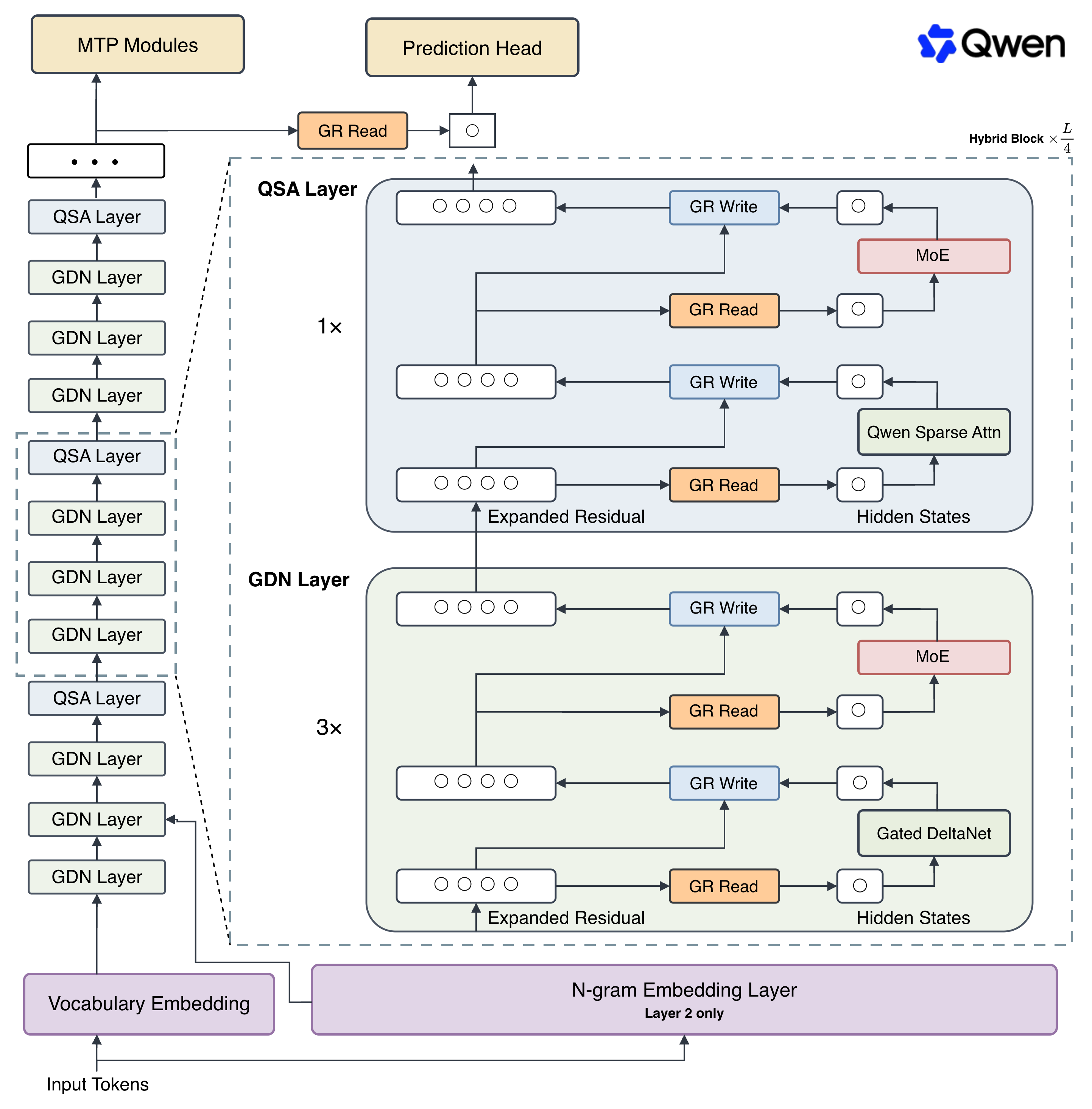
Three GDN layers, then one global QSA layer
Three out of every four blocks use Gated DeltaNet. Instead of carrying a full quadratic attention map through the entire sequence, GDN compresses history into a fixed-size recurrent state. Every fourth block uses Qwen Sparse Attention: a lightweight indexer divides the sequence into micro-blocks and selects the regions most likely to matter.
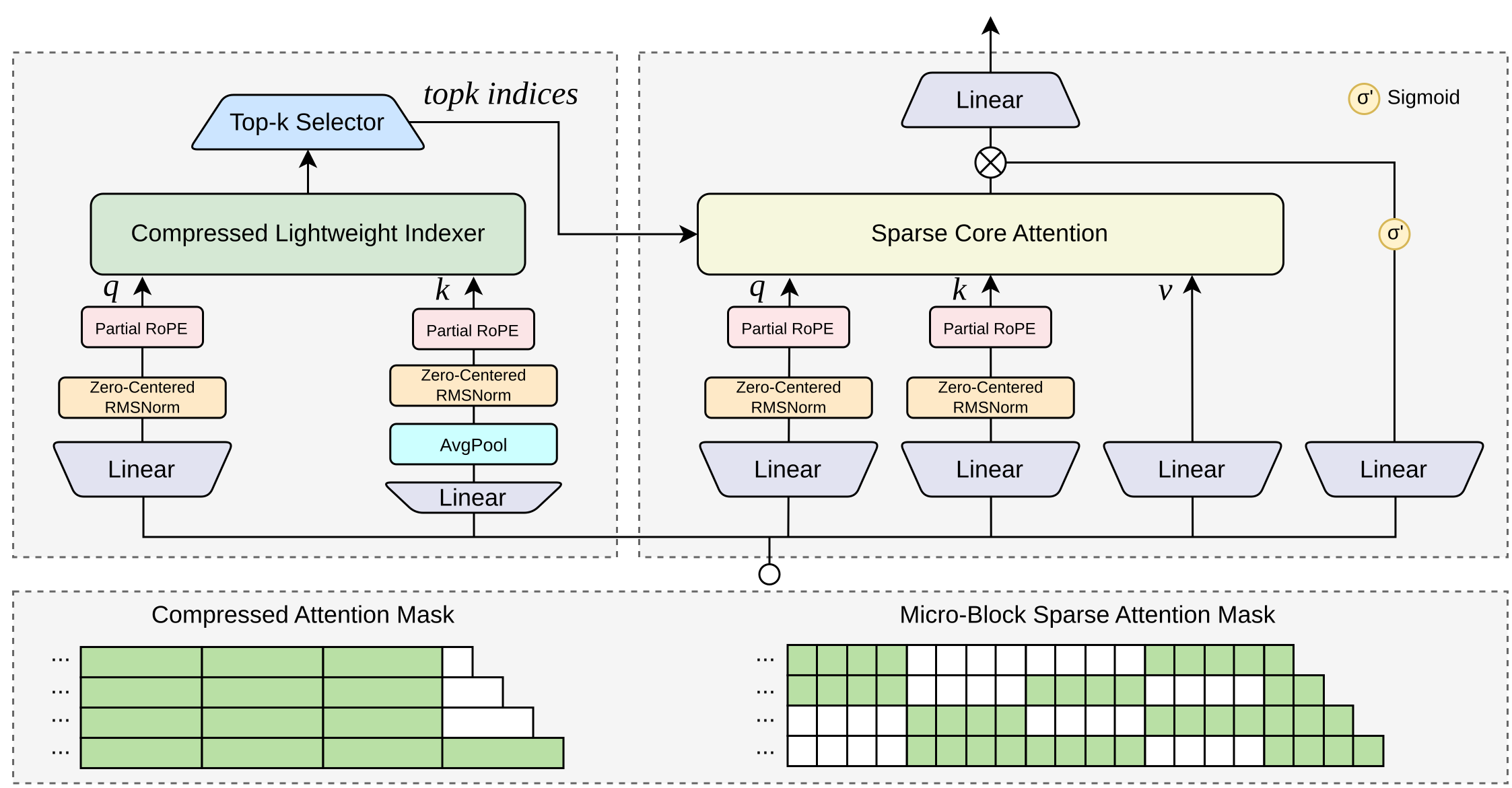
Qwen reports up to a 7.6× prefill and 4.9× decode speedup for the QSA kernel at one-million-token context. In a separate high-cache-reuse serving test with a 90% prefix-cache hit rate, the company reports 8.6× the prefill throughput of Qwen3.7-Plus. Those are useful signals, but they are kernel and vendor-serving measurements—not a promise that every GPU, quantization or prompt will see those multipliers.

Our analysis: QSA moves the bottleneck from pure attention FLOPs to indexer quality, memory locality and runtime integration. If the indexer selects the wrong blocks, a model can be fast and confidently incomplete. That is why the serving implementation matters almost as much as the checkpoint.
Gated residuals and the 51B memory table
Flash-Next widens the residual stream into four branches. A dynamic element-wise read gate and a per-branch scalar write gate decide which information should flow forward. Qwen says an FP8 residual state can reduce memory traffic. The second unusual choice is the 51B n-gram embedding component: a deterministic local-context lookup that can be placed in host memory and asynchronously prefetched.
This is a clever trade: local patterns do not need to consume the same expensive attention bandwidth as long-range reasoning. But it also means a “6B active” label does not describe the complete memory system. Host-RAM bandwidth, NUMA placement, PCIe transfers and page faults can decide whether the theoretical efficiency survives in a real server.
Qwen3.8-Flash-Next benchmarks: where it wins and where it does not
The scores below come from Qwen’s model card. They are important, but they are not an independent lab ranking: harnesses, prompts, tool wrappers and re-evaluation rules differ. Read the pattern across tasks rather than treating one number as a universal IQ score.
| Benchmark | Qwen3.8-Flash-Next | What the result suggests |
|---|---|---|
| DeepSWE 1.1 | 58.7 | Strong long-horizon software-agent performance; above Qwen3.7-Plus (16.5) and DeepSeek-V4-Flash (54.4) in Qwen’s table. |
| SWE-bench Pro | 62.5 | Competitive with Claude Opus 4.6 Max (53.4) in the published comparison, though harnesses are not identical. |
| SWE-bench Multilingual | 81.0 | Promising for teams maintaining codebases across several languages. |
| CoWorkBench | 73.9 | Strong office and tool-use signal; above DeepSeek-V4-Flash (45.1) in Qwen’s table. |
| JobBench | 55.7 | Useful evidence for multi-step workplace tasks, not a guarantee of autonomous reliability. |
| NL2Repo-Bench | 48.1 | A clear weak spot versus DeepSeek-V4-Flash (54.2); repo-level synthesis remains difficult. |
| Humanity’s Last Exam | 35.9 | Below the strongest frontier result in Qwen’s comparison; broad knowledge and hard reasoning are not solved. |
| OSWorld 2.0 | 19.4 binary / 52.3 partial | Multimodal computer use is improving, but full task completion is still fragile. |
| AndroidWorld | 84.5 | Encouraging mobile-agent result, especially when paired with vision and tool calls. |
| LiveCodeBench v6 | 91.9 | Excellent coding score, but saturated coding benchmarks should be read with task-level evidence. |
The most interesting contrast is between DeepSWE and NL2Repo. Flash-Next looks excellent when an agent can iterate, call tools and repair a concrete task. It is less dominant when the job is to infer an entire repository from a natural-language specification. In other words, the model’s advantage may be its control loop—not just its raw code completion.
What YouTube testing adds that benchmark tables miss
We reviewed the public descriptions and chapter lists of several 27 August 2026 hands-on videos. The videos are community experiments, not controlled benchmarks, so we use them to identify practical friction and capability themes—not to replace the model card.
- Execute Automation: the creator runs Unsloth GGUF quantizations through
llama.cppon Apple Silicon, with separate chapters for a 1-bit setup and a 4-bit run. That is a useful reality check: quantization and backend support are the first hurdles before “local Qwen4 preview” becomes a usable workflow. Watch the test. - Bijan Bowen: the hands-on sequence covers a browser/OS task, a C++ racing game, Blender and Godot work, a local Q4 Subway FPS test and a 3D scene. These demos suggest the model is comfortable moving between code, visual context and creative tools, but demos do not provide reproducible pass rates. Watch the multimodal tests.
- AI with Eric: this is the most important implementation clue. The creator uses an unmerged SGLang branch called
qwen4-main-squashedand tunes the sparse-attention indexer budget after observing hallucinations. That supports our view that QSA runtime maturity is a current bottleneck, not a footnote. See the sparse-attention investigation. - Fahd Mirza: the video walks through local installation, serving, VRAM considerations, HTML generation and reasoning tests. It includes a paid GPU-rental promotion, so treat hardware numbers as anecdotal rather than a lab result. Watch the install and test.
The practical takeaway from YouTube: the model can be impressive before it is convenient. Community testers are already exploring Apple Silicon, GGUF, llama.cpp, Unsloth and SGLang, but the best results depend on quantization choice, sparse-indexer settings and backend versions. A screenshot of tokens per second without those variables is not a useful comparison.
Can you run Qwen3.8-Flash-Next locally?
Yes, but “can run” and “runs well” are very different claims. Qwen documents support for Transformers, vLLM, SGLang and TokenSpeed, while llama.cpp, mlx-vlm and Unsloth provide more experimental local routes. The official serving examples use tensor parallelism across four devices for vLLM or SGLang.
A rough memory sanity check explains the scale. Storing 176B parameters at 16-bit precision is about 352GB before overhead; 8-bit is about 176GB; 4-bit is about 88GB. These are arithmetic estimates, not measured requirements. Add the 51B embedding table, KV cache, activations, vision components, runtime buffers and context length, and a single consumer GPU is not a sensible target for the full model.
The Hugging Face repository is listed at roughly 360GB. A practical local setup therefore looks like a multi-GPU workstation, a large unified-memory Apple system with an efficient quantization, or a rented server. Apple Silicon experiments are valuable for learning the stack, but do not confuse a successful Q4 demo with production throughput.
A reproducible local test recipe
- Record the exact model revision, quantization format and runtime commit.
- State whether the run uses native 262K context or YaRN scaling.
- Report indexer budget, KV-cache format, tensor-parallel size, prompt length, time-to-first-token and decode tokens per second.
- Run the same coding, vision and tool-use prompts three times and report task completion—not just speed.
- Keep a separate result for a warm prefix-cache hit and a cold prompt; Qwen’s 8.6× throughput result assumes a 90% cache-hit scenario.
Flash-Next versus the production Qwen3.8-Flash API
Do not treat the open-weight preview and the hosted API as identical products. Qwen’s production Qwen3.8-Flash service advertises one-million-token context by default and includes official tool integrations. Flash-Next is the architecture preview you can inspect and run yourself; its native context is 262K, with one million available through YaRN and compatible software.
Qwen’s launch material lists a target API price of $0.16 per million input tokens and $0.47 per million output tokens. That makes the hosted route attractive for prototypes and bursty workloads. Local weights become more compelling when data cannot leave your environment, requests are steady enough to amortize hardware, or you need to fine-tune the model.
Who should use it?
Use Flash-Next first if you are building: coding agents that can inspect, edit and test a repository; office agents that call several tools; multimodal browser or mobile workflows; or private AI infrastructure where open weights matter.
Wait or choose another model if you need: a lightweight one-GPU deployment, deterministic repository generation, guaranteed GUI task completion, or a permissive license you can treat as Apache-2.0 without review. The OSWorld binary score of 19.4 and the weaker NL2Repo result are reminders that impressive agentic scores do not equal universal reliability.
Bottom line
Qwen3.8-Flash-Next is best understood as an engineering preview of where Qwen4 is going: recurrent state for cheap history, sparse global retrieval for long context, MoE routing for compute efficiency, and extra memory systems for local patterns. The benchmark table says it is already a serious agentic coder. The YouTube evidence says the next challenge is making that intelligence predictable across quantizations and runtimes.
Our view is simple: Flash-Next is a high-upside preview, not a finished drop-in replacement for every frontier model. Hosted users should measure cost and task completion against their current API. Local builders should start with a controlled 4-bit experiment, document the sparse-attention settings, and treat every speed claim without a reproducible recipe as provisional.
Qwen3.8-Flash-Next FAQ
Is Qwen3.8-Flash-Next the final Qwen4?
No. Qwen labels it an early architecture preview. It gives developers a look at Qwen4-era ideas, but it is not a promise that every component or score will carry over unchanged.
Why do some posts call it a 176B model?
The main MoE is 125B, while the configuration also includes 51B n-gram embeddings and a 4B MTP module. Counting all components gives roughly 180B; many discussions round the 125B + 51B configuration to “176B” and exclude or separately count MTP. Always state which components you counted.
Does it really support one million tokens?
The open-weight checkpoint has 262K native context. Qwen documents up to one million with YaRN; whether that works depends on the runtime, memory budget and quality at your workload.
Can it run on a 16GB graphics card?
Not as an unquantized, self-contained model. Quantization and offloading can make experiments possible, but the full configuration is far larger than 16GB once weights, cache and runtime memory are included.
Is the license Apache-2.0?
The Hugging Face checkpoint currently lists qwen-community-1.0. Read the repository’s license and your compliance requirements before using it commercially.
Sources and methodology
Technical specifications, benchmark values and pricing were checked against Qwen’s launch post, the Hugging Face model card and the official GitHub README. Hardware-serving context was cross-checked with NVIDIA’s GB300 NVL72 experiment. YouTube notes are linked in the field-notes section and are explicitly labeled as community evidence. This article does not present creator demos as independent benchmark results.