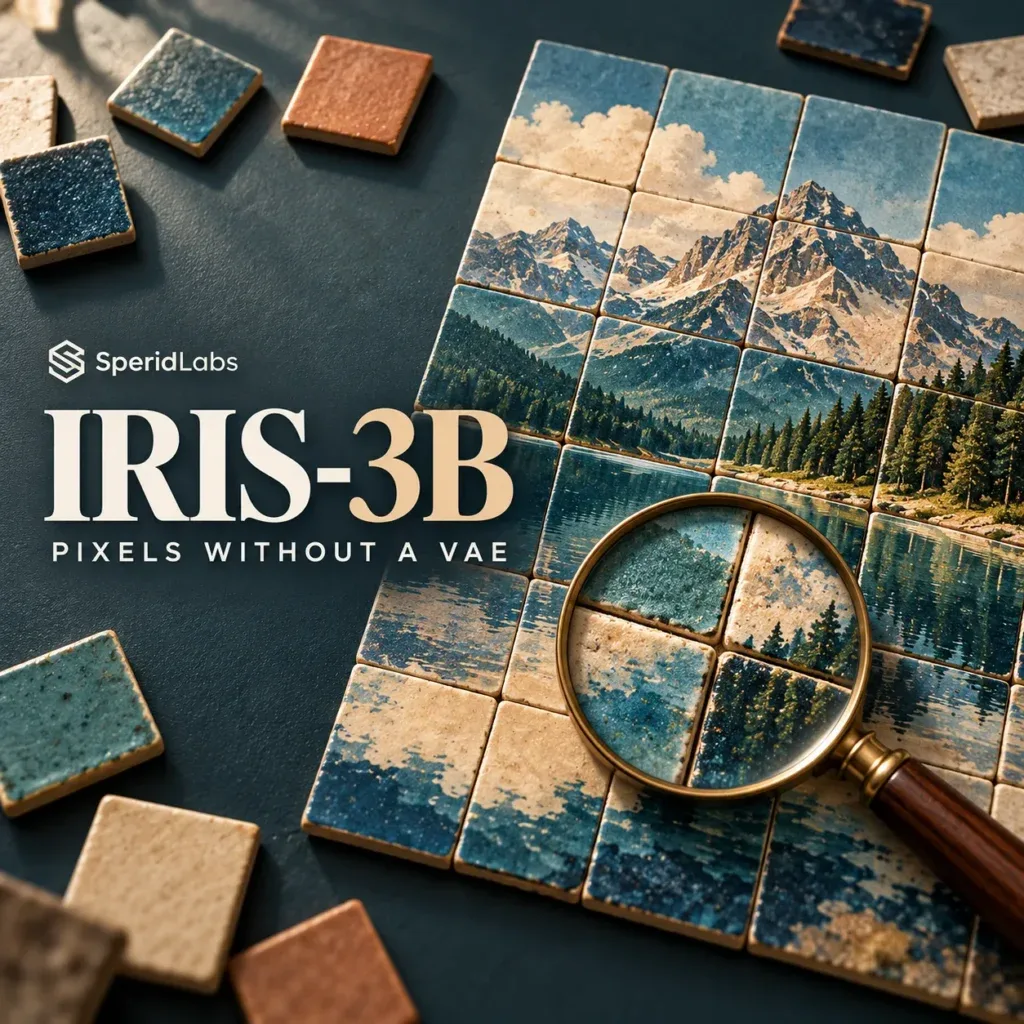

SperidLabs’ Iris-3B generates images directly in pixel space and ships separate fine-tunes for monocular depth and image restoration. Its research report finds no clear downstream advantage over the evaluated latent models. The release is useful because it tests a plausible architecture claim and documents where the expected benefit did not appear.
The motivation is straightforward: a latent diffusion model compresses an image through a variational autoencoder, or VAE. Detail lost in that representation can limit dense predictions. Removing the codec avoids that particular bottleneck, but introduces other design and training choices. Better preservation in principle is not a measured improvement in depth or restoration.
Pixels still pass through patches
The Iris-3B paper describes 16×16-pixel input patches, eight dual-stream blocks, sixteen single-stream blocks and a four-block pixel-transformer head. A 1024×1024 image becomes a 64×64 grid—4,096 patch tokens. The model ultimately produces RGB pixels without a VAE, although those pixels are processed through a patch-based representation.
That distinction explains an observed failure mode. Adjacent patches can disagree at their boundaries. The researchers measured faint grids in raw depth maps, using curvature near 16-pixel patch borders relative to curvature elsewhere. Iris-3B’s ratios range from 1.61 to 2.25 on the reported datasets, while the latent comparison is near one. Removing a lossy codec has not removed every spatial artifact.
The result suggests a concrete research direction: output heads that mix neighboring pixels across patch boundaries. It does not establish that a VAE is always preferable. The paper identifies overlapping receptive fields as a way to test whether the new boundary artifact can be reduced.
The comparisons have different levels of control
For depth, the researchers fine-tuned Iris-3B, latent FLUX.2 Klein and a pixel-space conversion of Klein under one 10,000-step recipe. Across five zero-shot datasets, mean absolute-relative error is 0.071 for Iris and 0.072 for latent Klein; the converted pixel model reaches 0.081. Those numbers support broadly similar aggregate performance for Iris and the latent model, rather than a decisive win.
The downstream comparison section is unusually explicit about confounds. Iris has no latent twin pretrained on the same data and compute. Its comparison therefore mixes representation space with differences between models. The converted Klein does have a latent counterpart, but the conversion may leave it with a weaker generative prior. Each arm is one run, with no statistical significance test.
On restoration, the matched Klein comparison likewise gives no pixel-space advantage. Iris’s own restoration run differs in batch, schedule and inference processing, so its row cannot isolate architecture. The reported PSNR of 20.68 and LPIPS of 0.292 describe the chosen DIV2K degradation protocol, not performance on every damaged photograph.
These qualifications matter when choosing a backbone. A result can be useful without resolving the general pixel-versus-latent question. More decisive evidence would pair models trained on the same data and compute, repeat downstream runs and evaluate boundary artifacts alongside task accuracy.
The 3B label excludes a text encoder
The released code uses a frozen Qwen3-VL-4B-Instruct text encoder for generation. The image model’s 3B label excludes that encoder. The downloadable image checkpoint is about 12GB in FP32, while text-encoder files and runtime allocations add further requirements. BF16 autocasting during computation should not be confused with a guarantee that every stored weight occupies two bytes.
The model card documents NVIDIA CUDA inference, Python 3.11 or newer and PyTorch 2.7.1 or newer. Generation defaults to 100 denoising steps, CFG 3 and about one megapixel. Depth and restoration use separate task checkpoints and one forward pass with an empty prompt, without loading the text encoder. Their resource and latency profiles are consequently different from text-to-image generation.
Depth outputs are relative rather than metric distance. A colorized map cannot establish how many meters away a chair is without additional calibration. Restoration tiles large images into overlapping windows, so inspect seams and invented texture before treating an output as faithful recovery.
Iris-3B offers Apache-licensed weights and training code for investigating pixel-space priors. The strongest conclusion today is limited but valuable: generation works at this scale, while removing the VAE alone has not produced a demonstrated downstream advantage in these experiments.
Prepared with AI assistance from the cited primary sources. Cover: AI-generated conceptual illustration, not a model output or measured depth map. Results above are attributed to the release paper; EyesTech did not reproduce its evaluations.