
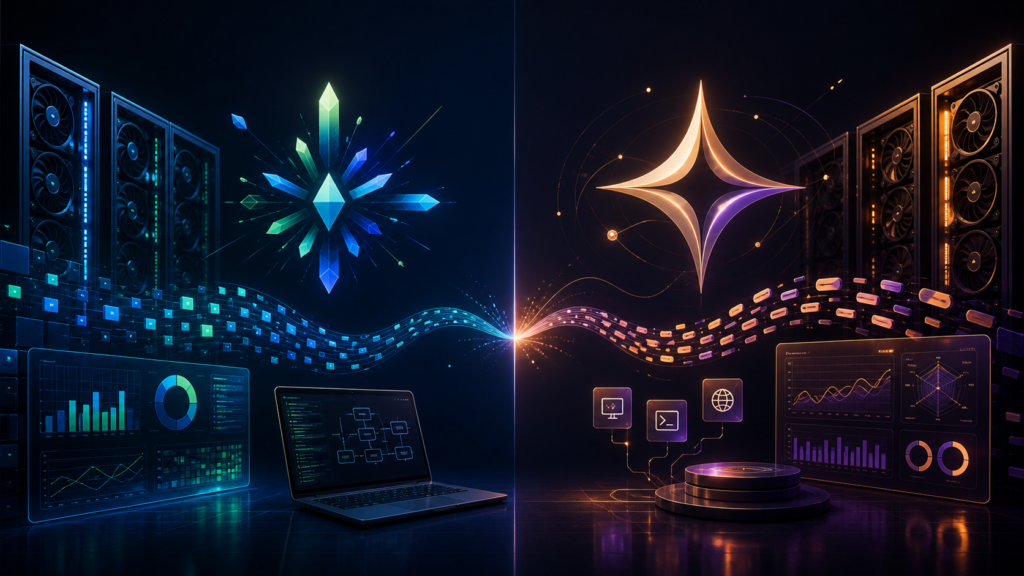

Gemini 3.7 Flash vs GPT-5.6 Luna: which model fits your workload? Both models aim to deliver useful reasoning quickly, but keep the cost of every agent step low. This comparison uses Google’s August 2026 Gemini 3.7 Flash model card and OpenAI’s current GPT-5.6 Luna API documentation—not marketing claims or mismatched benchmark screenshots.
Bottom line: choose Gemini 3.7 Flash when audio, video, multimodal analysis, or Google Antigravity workflows matter. Choose GPT-5.6 Luna for cost-sensitive, high-volume text-and-image workloads, OpenAI tool calling, computer use, and Codex/API pipelines. Neither model should be called “best” without naming the task.
Gemini 3.7 Flash vs GPT-5.6 Luna specifications
| Specification | Gemini 3.7 Flash | GPT-5.6 Luna |
|---|---|---|
| Positioning | Google’s fast workhorse with configurable thinking | OpenAI’s cost-sensitive, high-volume tier |
| Context window | Up to 1M tokens | 1.05M tokens |
| Maximum output | 64K tokens | 128K tokens |
| Knowledge cutoff | March 2026 overall; some domains may be older | February 16, 2026 |
| Inputs | Text, image, audio, video | Text and image; audio/video not supported by the model page |
| Reasoning controls | Customizable thinking configurations | none, low, medium, high, xhigh, max |
| Structured output / functions | Supported through Gemini API | Supported |
| Computer use | Measured through OSWorld-2.0 and desktop-agent evaluations | Listed as a supported Responses API tool |
Related reading: Gemini 3.8 Flash leak tracker for confirmed facts and unverified claims.
Price and token economics
For this Gemini 3.7 Flash vs GPT-5.6 Luna comparison, Google lists Gemini 3.7 Flash at $0.75 per million input tokens and $3.75 per million output tokens through December 31, 2026; the listed 2027 rates are $1.50 and $7.50. OpenAI lists Luna at $0.20 input, $0.02 cached input, and $1.20 output per million tokens.
| Illustrative request | Gemini 3.7 Flash | GPT-5.6 Luna | What it shows |
|---|---|---|---|
| 1M input + 100K output | $1.125 | $0.320 | Luna is about 72% cheaper on this mix |
| 100K input + 20K output | $0.150 | $0.044 | Short, high-volume calls favour Luna |
| 1M cached input + 100K output | Use Google’s cache terms | $0.140 | Luna’s cached-input discount matters in repeated agent loops |
On this workload mix, Luna costs about 72% less. Actual spend changes with reasoning tokens, tools, retries, and cache hits.
These are arithmetic examples, not a promise of per-task cost. Real usage includes hidden reasoning tokens, tool calls, retries, context growth, caching, and provider-specific accounting. “Thinking harder” can improve quality while consuming more tokens.
Published evaluation matrix
Google publishes a broad matrix comparing Gemini 3.7 Flash with Gemini 3.6 Flash, Claude Sonnet 5, GPT-5.6 Terra, and Muse Spark 1.2. OpenAI’s Luna model page publishes specifications, tools, pricing, and rate limits but does not publish a matching Luna score for every benchmark below. To avoid inventing data, Luna is marked not published rather than substituted with Terra.
| Benchmark / domain | Gemini 3.7 Flash | GPT-5.6 Terra (Google matrix) | GPT-5.6 Luna |
|---|---|---|---|
| Artificial Analysis Intelligence Index | 56 | 57 | Not published |
| FrontierCode 1.1 | 43.6% | 41.3% | Not published |
| DeepSWE v1.1 | 65.3% | 69.6% | Not published |
| Code Arena Web | 1588 Elo | 1523 Elo | Not published |
| Terminal-bench 2.1 | 85.8% | 87.4% | Not published |
| Terminal-bench 3.0 (general agents) | 14.9% | 20.8% | Not published |
| AutomationBench | 30.4% | 23.6% | Not published |
| GDPVal-AA v2 knowledge work | 1525 Elo | 1578 Elo | Not published |
| Harvey LAB-AA legal workflows | 90.7% | 85.2% | Not published |
| GDP.pdf document comprehension | 34.0% | 24.7% | Not published |
| CharXiv chart reasoning (no tools / tools) | 84.5% / 88.7% | 85.9% / not listed | Not published |
| LVBench long-video understanding | 85.4% | 78.9% | Not published |
| GDM-MRCR v2, 8-needle long context | 97.0% | 93.5% | Not published |
| OSWorld-2.0 computer use | 47.9% | 50.2% | Not published |
| Agent’s Last Exam desktop tasks | 26.3% | 28.0% | Not published |
| HLE-Verified expert reasoning | 53.6% | 51.1% | Not published |
| BioMysteryBench (human solvable / difficult) | 87.1% / 43.5% | 83.8% / 49.4% | Not published |
| LABBench2 biology research | 82.1% | 81.2% | Not published |
Visual score chart: published comparison
Higher is better. Blue bars show Gemini 3.7 Flash; violet bars show GPT-5.6 Terra in Google’s published matrix. GPT-5.6 Luna is not plotted because OpenAI has not published matching benchmark scores.
Native audio/video, chart reasoning, long-context retrieval, and stronger AutomationBench/LVBench results in the published matrix.
Lower published token prices and a broad Responses API tool surface; benchmark scores are not published on the Luna model page.
Use the matrix to shortlist models, then test your own documents, tools, latency budget, and retry policy.
Capabilities beyond coding
| Department / workload | Gemini 3.7 Flash | GPT-5.6 Luna | Practical choice |
|---|---|---|---|
| Research and knowledge work | Strong long-context synthesis; GDPVal-AA 1525; HLE 53.6% | Fast, cheap text reasoning; no matching public score | Luna for volume, Gemini for multimodal dossiers |
| Legal operations | Harvey LAB-AA 90.7% | Function calling, file search and structured outputs | Gemini benchmark edge; validate with your own matters |
| Science and biology | BioMysteryBench 87.1% human-solvable; LABBench2 82.1% | Tools support code interpreter, web/file search and MCP | Gemini for native multimodal science; Luna for orchestration |
| Documents and charts | GDP.pdf 34.0%; CharXiv with tools 88.7% | Image input, file search, structured outputs | Gemini for chart-heavy batches; Luna for cheaper extraction |
| Audio/video | Native audio/video input; LVBench 85.4% | Audio/video not supported on Luna model page | Gemini |
| Computer use | OSWorld 47.9%; desktop-agent pass rate 26.3% | Computer-use tool listed, but Luna score is not published | Benchmark your exact UI and add human approval |
| Agents and automation | Antigravity, configurable thinking, Teamwork orchestration | Responses API, hosted shell, apply patch, MCP, tool search | Antigravity for Google-native teamwork; Luna for API control |
Antigravity versus Codex usage
Google Antigravity: Gemini 3.7 Flash is available as a core reasoning model. Google’s plan documentation says quotas are workload-based, refresh on five-hour and/or weekly windows depending on plan, and can change with capacity. Antigravity’s shared Gemini pool is metered by the work performed—not simply by the number of prompts—so a long-running agent consumes more quota than a short request.
OpenAI Codex: Codex, ChatGPT Work, ChatGPT for Excel, and Workspace Agents can draw from a shared agentic allowance when available on a plan. Token-based billing uses the selected model and actual input, cached-input, and output tokens; local tasks run on the device while cloud tasks run in an OpenAI-managed environment. Code review uses GPT-5.3-Codex and auto review uses GPT-5.4, so selecting Luna does not make every Codex feature a Luna request.
API rate limits
| Service | Published limit model | Useful published numbers |
|---|---|---|
| Gemini API | Per-project RPM, input TPM, RPD, spend caps; active values shown in AI Studio | Tier 1 Gemini 3.7 Flash batch queue: 3M tokens; Priority defaults to 0.3× standard rate; limits are not guaranteed |
| GPT-5.6 Luna API | Usage tier; RPM, TPM, batch queue | Tier 1: 500 RPM / 500K TPM / 5M batch; Tier 5: 30K RPM / 180M TPM / 15B batch |
Recommendation
For a Google Workspace-heavy team, long video or audio analysis, chart extraction, and Antigravity’s multi-agent workflow, Gemini 3.7 Flash is the broader multimodal workhorse. For high-volume text/image classification, tool-driven API services, computer-use prototypes, and Codex-style developer workflows where every token matters, GPT-5.6 Luna is dramatically cheaper and offers a broad Responses API tool surface.
Do not pick from a benchmark headline alone. Run a 50–100 task holdout with your own documents, UI, retry policy, and prompts. Measure success per dollar, not just accuracy.