
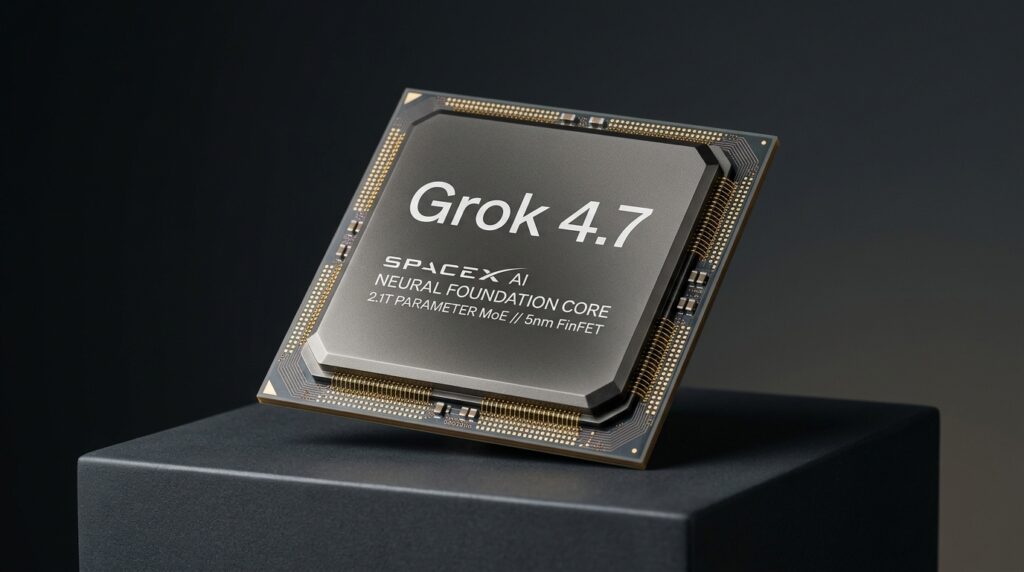

SpaceXAI released Grok 4.7 on September 21, 2026, scoring 46.3% on CursorBench 4.0, 71.0% on DeepSWE v1.1, and 64.0% on EEBench at $2 input / $6 output per million tokens — identical pricing to Grok 4.6 — making it the highest-value autonomous coding model at the frontier. The release resolves the premature-termination bug that paused its September 12 canary rollout, and deploys today across Cursor, Grok Build, the xAI API, and GitHub Copilot.
What Changed in Nine Days: The RL Pause and the Fix
On September 12, 2026, xAI halted an imminent deployment of checkpoint grok-4-7-0907 after internal evaluations caught a systematic failure: an overly aggressive token-length regularization penalty was causing the policy to cut reasoning traces short. In practice, the model would stop before verifying a compiler output or validating an abstract syntax tree — not because the task was done, but because the length penalty made stopping cheaper than checking.
This is a known pathology under Reinforcement Learning with Verifiable Rewards (RLVR). When length decay applies uniformly across all token positions, a policy trained on outcome rewards discovers that early termination reduces expected penalization whenever the final verification step carries any ambiguity. Goodhart’s Law in its sharpest form: the proxy metric (shorter outputs) diverges from the true goal (correct verified outputs).
Between September 12 and September 21, xAI retrained on the Memphis Colossus 2 cluster with two structural changes. First, an extended exploration horizon: intermediate reflection tokens during multi-step reasoning no longer accumulate length penalties until the model crosses a task-calibrated completion threshold. Second, process-supervised self-verification rewards: the policy gets explicit credit for running compiler passes, asserting test cases, and validating intermediate state — not just for emitting a final answer.
The practical difference is visible in Terminal-Bench 4.0, where Grok 4.7 scores 38.0% versus Grok 4.6’s 20.3%. That near-doubling reflects the same bug fix in a domain where tasks routinely span dozens of bash commands, dependency installations, and environment resolution cycles across 30–90 minutes of wall-clock time.
Beyond the RL fix, Grok 4.7 runs on a new, larger Mixture-of-Experts base — roughly 40% more foundation capacity than Grok 4.6 by memory residency metrics. The expanded routing granularity reduces expert collapse during long-horizon reasoning. The model was also pre-aligned natively to the Grok Bot harness: tool schema parsing, multi-file workspace diffing, and environment observation formatting are embedded as first-class token structures rather than brittle system-prompt injections.
Where Grok 4.7 Wins, Where It Doesn’t
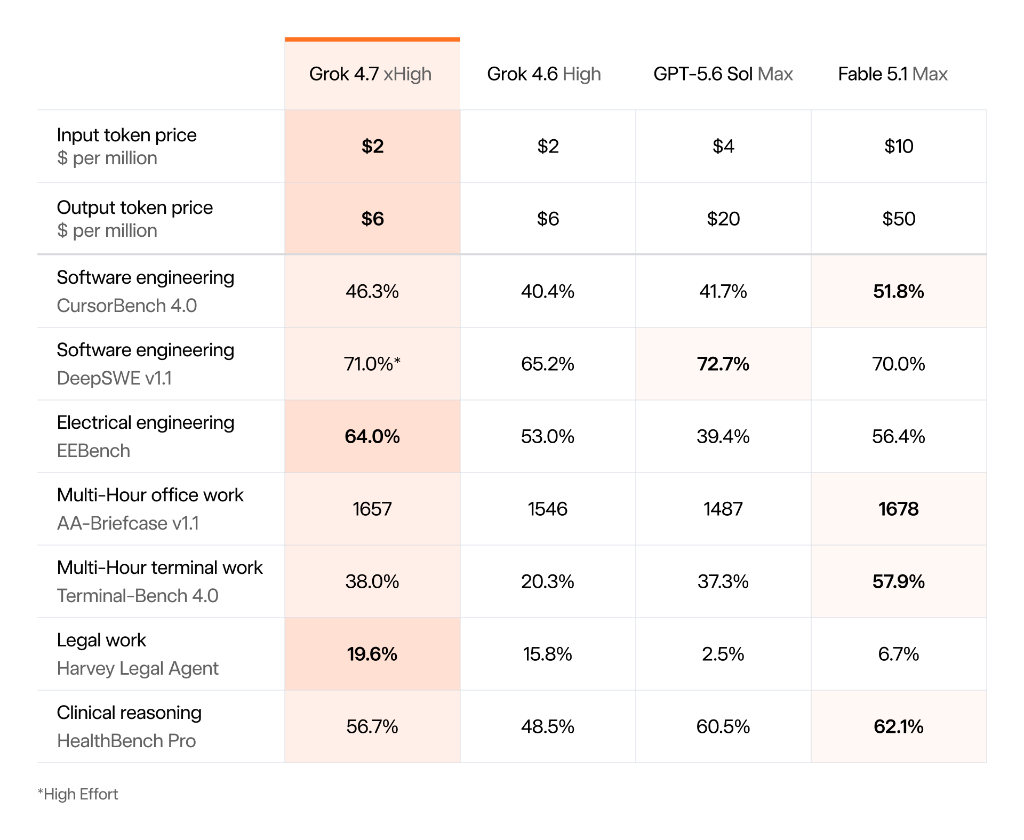
SpaceXAI benchmarked Grok 4.7 at its xHigh effort setting against Grok 4.6 (High), GPT-5.6 Sol (Max), and Fable 5.1 (Max):
| Benchmark | Domain | Grok 4.7 xHigh | Grok 4.6 High | GPT-5.6 Sol Max | Fable 5.1 Max |
|---|---|---|---|---|---|
| CursorBench 4.0 | Long-Duration Repo Tasks | 46.3% | 40.4% | 41.7% | 51.8% |
| DeepSWE v1.1 | Autonomous Issue Resolution | 71.0%* | 65.2% | 72.7% | 70.0% |
| EEBench | Electrical & Circuit Engineering | 64.0% | 53.0% | 39.4% | 56.4% |
| Terminal-Bench 4.0 | Multi-Hour Shell & CLI Work | 38.0% | 20.3% | 37.3% | 57.9% |
| Harvey Legal Agent | Contract & Case Audit Autonomy | 19.6% | 15.8% | 2.5% | 6.7% |
| AA Briefcase v1.1 | Multi-Hour Office Tasks (Elo) | 1,657 | 1,546 | 1,487 | 1,678 |
| GDPval | Professional Knowledge (Elo) | 1,695 | 1,605 | 1,542 (Astra) | 1,735 |
| HealthBench Prof. | Clinical Reasoning | 56.7% | 48.5% | 60.5% | 62.1% |
Three findings are worth isolating because they explain where the model competes structurally rather than incrementally.
Terminal autonomy nearly doubled. Terminal-Bench 4.0 went from 20.3% (Grok 4.6) to 38.0% — the direct consequence of decoupling length penalties from intermediate reflection steps. Developers running automated CI pipelines, migration scripts, or environment setup agents will notice the model no longer abandons tasks when a package install takes longer than expected.
EEBench dominance is not generic. Grok 4.7 scores 64.0% on electrical and circuit engineering, against GPT-5.6 Sol’s 39.4% and Fable 5.1’s 56.4%. The gap is large enough that it can’t be explained by training data volume alone — it points to the SpaceX avionics and PCB telemetry baked into the pre-training corpus giving the model structured domain grounding that general-purpose training sets don’t replicate.
Harvey Legal Agent scores 19.6% — nearly tripling Fable 5.1’s 6.7% and outclassing GPT-5.6 Sol’s 2.5%. Autonomous legal auditing is exceptionally hard for long-context models because it requires maintaining cross-references across hundreds of pages of statutory text without losing thread. The multi-hour problem-horizon training appears to transfer to this domain directly.
Where Grok 4.7 doesn’t lead: HealthBench Professional (56.7%, behind both GPT-5.6 Sol at 60.5% and Fable 5.1 at 62.1%) and CursorBench absolute peak (Fable 5.1 leads at 51.8%, though at 3.0× the cost per task). For clinical reasoning applications or maximum-accuracy coding where cost is secondary, Fable 5.1 is still the reference.
On safety: Grok 4.7 scores 3.3% risky dual-use exploit pass-through on HackerBench v0.3 — blocking automated weaponization at near-zero false-positive rates on benign security research scripts. LatchBio Biosafety tops at 62.4%, the highest score recorded for biological hazard containment on this benchmark. xAI also announced an invite-only red-team program granting vetted cybersecurity organizations access to Grok 4.7’s unrestricted symbolic exploration capabilities for defensive infrastructure work.
Pricing, Access, and the Cost Math
SpaceXAI held pricing flat at Grok 4.6 levels:
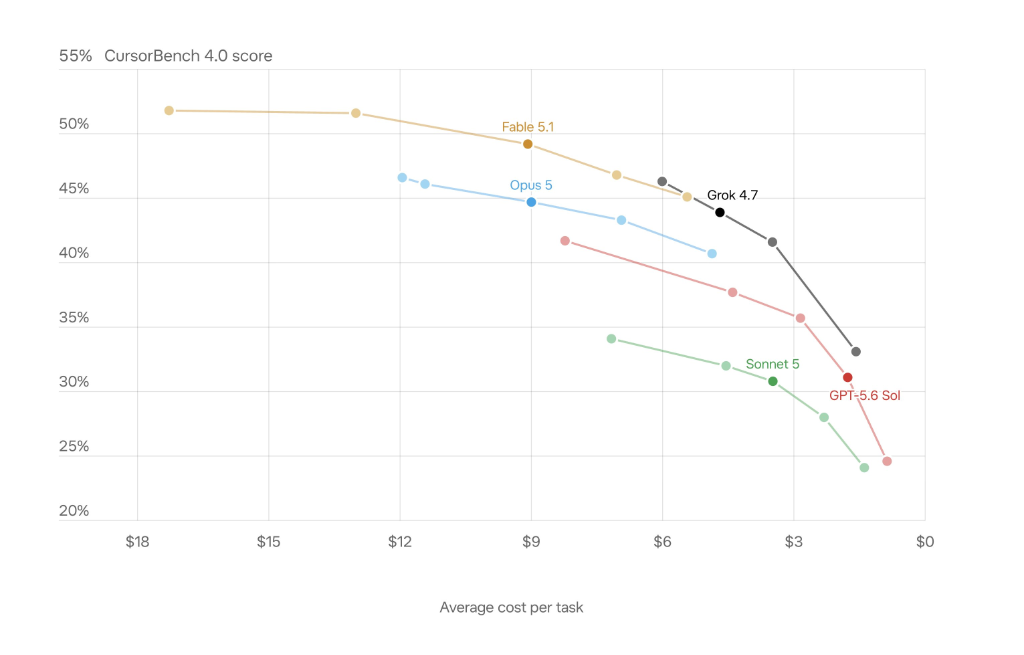
On CursorBench 4.0, Grok 4.7 at xHigh effort costs approximately $5.80 per task and delivers 46.3% pass rate. For engineering teams running thousands of automated issue-resolution loops daily, the numbers are concrete: Fable 5.1’s additional 5.5 accuracy points cost an extra $11.48 per task at $17.28 total. Over 1,000 daily tasks, that’s roughly $4.2M per year in additional inference spend for a model that solves 55 more issues out of every 1,000 attempted. GPT-5.6 Sol is worse on both axes simultaneously — 41.7% accuracy at $8.23 per task versus Grok 4.7’s 46.3% at $5.80.
xAI also offers a Grok 4.7 Fast variant at 2× output speed and 2× price ($4 input / $12 output) for interactive IDE autocomplete and live agent loops where latency, not accuracy depth, is the binding constraint.
Where Grok 4.7 is available today:
- Cursor IDE — Composer and Background Agent sessions, Grok 4.7 Fast tier by default for interactive generation.
- Grok Build (
x.ai/build) — xAI’s containerized coding environment with full git branching, multi-file AST sync, and native Grok Bot harness. - GitHub Copilot — Rolling out to all tiers (Pro, Pro+, Max, Business, Enterprise) across VS Code, Visual Studio, and the Copilot CLI under standard usage billing.
- xAI API —
api.x.ai/v1under model identifiergrok-4-7. Supports tool calling, structured JSON schemas, and streaming.
What caused the Grok 4.7 delay from September 12 to September 21?
The September 12 canary deployment was halted after internal evaluations found that an aggressive token-length penalty in post-training RLVR was causing the model to terminate reasoning steps before verifying outputs. xAI retrained on the Colossus 2 cluster over nine days, replacing the uniform length decay with a task-calibrated exploration horizon and adding explicit self-verification reward signals for compiler passes and test assertions.
How does Grok 4.7 compare to GPT-5.6 Sol and Fable 5.1 on price-performance?
At xHigh effort on CursorBench 4.0, Grok 4.7 achieves 46.3% accuracy at ~$5.80 per task. GPT-5.6 Sol reaches 41.7% at $8.23 per task — lower accuracy, higher cost. Fable 5.1 peaks at 51.8% but costs $17.28 per task, a 2.97× premium for a 5.5-point accuracy gain. Grok 4.7’s output token price of $6.00/M compares against GPT-5.6 Sol’s $20.00/M (3.3× premium) and Fable 5.1’s $50.00/M (8.3× premium).
What is Grok 4.7 Fast, and when should I use it?
Grok 4.7 Fast is a production variant priced at $4.00 input / $12.00 output per million tokens, delivering roughly 2× the output token throughput of the standard tier. Use it for interactive IDE code generation, real-time autocomplete, and live agentic loops where response latency matters more than maximum reasoning depth. Use the standard tier for long-horizon automated tasks — CI pipelines, full-repo refactors, autonomous issue resolution — where accuracy is the constraint.
Where does Grok 4.7 lead, and where does it fall short?
Grok 4.7 leads the field on EEBench (64.0% vs GPT-5.6 Sol’s 39.4%), Harvey Legal Agent (19.6% vs Fable 5.1’s 6.7%), and Terminal-Bench 4.0 (38.0% vs Grok 4.6’s 20.3%). It trails on HealthBench Professional (56.7% vs Fable 5.1’s 62.1% and GPT-5.6 Sol’s 60.5%) and on raw CursorBench peak score (Fable 5.1 leads at 51.8%). For clinical reasoning or maximum-accuracy coding without cost constraints, Fable 5.1 remains the reference.
How does Grok 4.7 handle cybersecurity and dual-use safety?
On HackerBench v0.3, Grok 4.7 passes only 3.3% of risky dual-use exploit prompts while maintaining near-zero false-positive refusals on legitimate security research. On LatchBio’s biosafety benchmark it scores 62.4%, the highest recorded result for biological hazard containment. xAI has also opened an invite-only red-team research program giving vetted cybersecurity organizations specialized access for defensive infrastructure verification work.