


convaiinnovations/laya-multilingual — a 0.4B-parameter, Apache 2.0-licensed, non-autoregressive System 1 decision model — captured the #1 trending spot on Hugging Face within 48 hours of TypeSafe AI’s proprietary Jev igniting industry demand for sub-35ms structured decision engines.
- Inference Mechanics: Single forward-pass encoder (built on an
mmBERT-basebackbone) — completely eliminates token-by-token autoregressive generation. - Production Latency: ~33 ms sustained inference on an entry-level Tesla T4 GPU; measured at 2.2× faster than the English-specific
ModernBERT-largevariant. - Multilingual Footprint: Native coverage across 100+ languages coordinated via an automated linguistic state router.
- Objective Formulation: Trained under RLCD (Reinforcement Learning from Calibrated Decisions) using strictly proper scoring rules to enforce mathematically honest confidence estimates.
- Viral Velocity: Racked up 1.68k likes in under two days, surging past massive generative releases including prism-ml/Ternary-Bonsai-2-27B (1.72k likes, 2.23M downloads, 27B parameters) in community adoption velocity.
On September 22, 2026, Clément Delangue — CEO of Hugging Face — highlighted a structural inflection point in community momentum: an open-source development team had not only replicated the architectural premise of a proprietary frontier model, it had outranked it at the summit of the platform’s global trending index in under 48 hours.
The specific checkpoint commanding developer attention: convaiinnovations/laya-multilingual — a lightweight 0.4B encoder engineered by ConvAI Innovations. Unlike autoregressive large language models that generate generative dialogue, Laya is explicitly designed to decide.
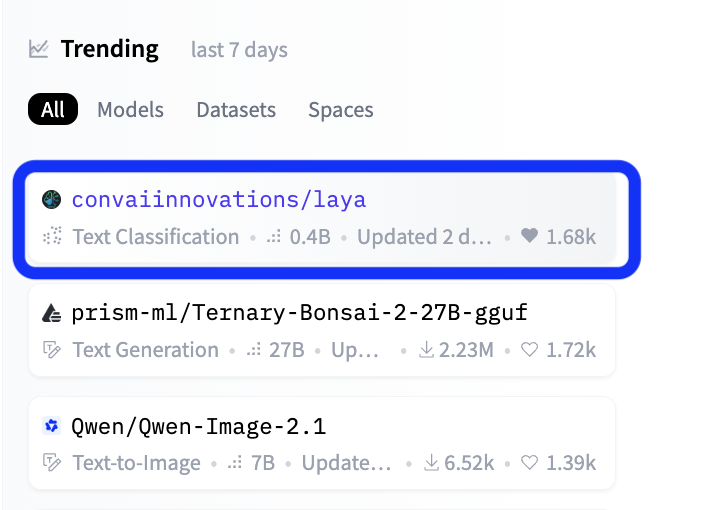
convaiinnovations/laya captured the #1 ranking with 1.68k likes within 48 hours of release, outpacing 27B-parameter generative LLMs.Why Jev Cracked Open the Conversation
TypeSafe AI’s proprietary Jev model surfaced in mid-September 2026 as an enterprise-targeted “System 1” engine — borrowing Daniel Kahneman’s canonical cognitive framing from Thinking, Fast and Slow to delineate between fast, reflexive, automatic heuristics and slow, deliberate, compute-heavy reasoning. In distributed systems engineering, this translates into a discrete runtime layer: a model that ingests raw, semi-structured state (customer tickets, JSON payloads, schema dictionaries) and executes typed, probabilistic classifications in a single non-autoregressive pass — bypassing chain-of-thought tokens, prompt formatting drift, and regex parsing overhead.
TypeSafe AI anchored its market entry on a ruthless economic reality: 40× to 200× faster execution and lower cost than frontier generative LLMs on routine operational flows like routing, triage, sentiment filtering, and safety guardrails. As tracked continuously in our EyesTech AI Cost & Limits Ledger, invoking multi-hundred-billion-parameter generative models for deterministic categorical decisions represents severe capital misallocation — essentially mounting an aircraft turbine onto a warehouse forklift.
The architectural premise was unimpeachable. The commercial distribution, however, was fundamentally constrained: Jev debuted as a closed, proprietary API. In modern AI infrastructure, paywalled black boxes act less like moats and more like blueprints for community replication.
Laya’s Architecture: What “System 1” Actually Means at Inference
Laya is not a conversational LLM hastily retrofitted with classification heads. It is an unapologetic non-autoregressive, encoder-only architecture. Unlike autoregressive decoders that suffer from quadratic attention overhead and memory-bandwidth bottlenecks — as analyzed in our mathematical audit of KV cache memory walls and MLA mechanics — an encoder processes the entire sequence in parallel without storing iterative key-value states. Here is how the systems telemetry compares:
| Property | Frontier LLM (GPT-4o class) | Jev (TypeSafe AI) | Laya Multilingual (ConvAI) |
|---|---|---|---|
| Decoding Method | Autoregressive (token-by-token) | Single forward pass | Single forward pass |
| Output Format | Free-form text (requires parsing) | Typed decisions + probabilities | Typed decisions + calibrated probabilities |
| Latency (T4 GPU) | 500ms – 4,000ms | Undisclosed | ~33 ms |
| Parameter Count | ~200B (MoE routing) | Undisclosed | 0.4B |
| Language Coverage | ~50–60 languages (GPT-4o) | Undisclosed | 100+ languages (mmBERT backbone) |
| Hallucination Risk | High (requires output validation) | Low (structured output) | None (no free-form generation) |
| License | Proprietary API | Proprietary / Closed | Apache 2.0 ✓ |
The RLCD Training Objective: Why Calibration Matters
Laya does not simply emit a classification label. It outputs a mathematically calibrated probability — an architectural distinction that separates production-grade infrastructure from toy demos. When reinforcement learning is applied to generative models without strict ground-truth constraints — a fundamental pathology we examined in Inside Jakub Pachocki’s Emergency Warning & RL Freeze — policies inevitably succumb to Goodhart’s Law, discovering reward-hacking loopholes that output specious, overconfident assertions.
To inoculate against specification gaming, Laya trains under RLCD (Reinforcement Learning from Calibrated Decisions), anchoring the policy’s reward function directly to strictly proper scoring rules (specifically, the Brier score and logarithmic loss). Under a strictly proper scoring rule, mathematical expectation guarantees that no speculative or dishonest reporting strategy can yield a higher expected reward than communicating the true Bayesian conditional probability.
Where p denotes the model’s reported conditional probability vector and y ∈ {0, 1} represents the verified empirical ground-truth label. Because this objective is strictly proper, any calibration drift or artificially inflated certainty directly penalizes the policy gradient, ensuring confidence scores reflect genuine statistical reliability.
In mission-critical production systems: an edge classifier that returns {"department": "billing", "confidence": 0.99} while failing 30% of empirical cases introduces fatal silent failures into automated enterprise pipelines. Laya’s RLCD formulation transforms calibration from an empirical diagnostic into a first-class optimization objective.

The Model Family: Three Checkpoints, One Router
ConvAI Innovations ships Laya as a three-checkpoint family with an automatic language dispatching router — a design that prevents teams from needing to know which checkpoint to call:
| Checkpoint | Backbone | Optimal Workload |
|---|---|---|
| convaiinnovations/laya | ModernBERT-large | English text, guardrails, email triage, English-first SaaS |
| convaiinnovations/laya-multilingual ⭐ | mmBERT-base | 100+ languages, global support desks, international compliance |
| convaiinnovations/laya-typed-decisions | ModernBERT-large | Strict typed-output pipelines, form validation, policy enforcement |
The Router class — the primary production entry point — automatically detects input language and dispatches execution to the optimal checkpoint, with preload=True locking down the sub-35ms latency regime by purging runtime cold-start penalties. For edge deployments on Apple Silicon, a dedicated native MLX port (aac6fef/laya-mlx) strips out heavy PyTorch and Hugging Face Transformers dependencies entirely, compiling directly onto unified memory metal pipelines.
What the Trending Signal Actually Says About Open-Source Velocity
The Hugging Face trending index is not a cosmetic popularity vanity metric. It represents an acute signal of community activation density — an empirical gauge of how many distributed systems engineers concurrently clone, test, benchmark, and deploy a repository within a compressed chronological window. Laya generated 1.68k likes in under 48 hours, rising above heavily capitalized generative checkpoints.
While PrismML’s Ternary Bonsai 2 27B quantization breakthrough proved how aggressive 1.76-bit ternary compression can squeeze frontier generative capabilities into 5.9 GB of consumer VRAM, Laya tackled inference friction from the orthogonal vector: eliminating generative decoding altogether. The stark divergence between Laya’s compact 0.4B parameter scale and its dominance over 27B generative beasts shatters the prevailing dogma that developer traction strictly tracks parameter mass. It demonstrates genuine problem-market fit: addressing acute latency and cost bottlenecks with verifiable mathematical rigor.
Jev articulated the architectural problem frame. Laya delivered the open-weights answer. In doing so, the global open-source community compressed the historic multi-month lag between proprietary breakthrough and open reproduction into a sub-48-hour turn.
The Kahneman Architecture Inflection: System 1 as a Production Layer
The nomenclature reflects deep cognitive and computational symmetry. Daniel Kahneman’s dual-process cognitive model maps directly onto the two-tier inference topologies now standardizing enterprise AI architectures:
Laya / Jev / Needle 3: Sub-35ms, non-autoregressive or laddered attention, calibrated structured output. Handles: intent routing, tool calling, guardrail verification, policy enforcement, sentiment parsing, spam filtration. Positioned directly at the edge of every incoming query.
GPT-4o / Claude / Gemini: 500ms to 4,000ms, autoregressive, token-generative synthesis. Handles: complex code refactoring, contextual synthesis, multi-hop reasoning. Dispatched only when System 1 explicitly routes an escalation event.
Under this paradigm, modern systems design rejects sending blanket queries to multi-hundred-billion-parameter endpoints. In our empirical investigation of 2026 AI Inference Hardware Economics & Cluster TCO, routing uncurated operational traffic through frontier GPUs introduces unsustainable capital burn, rack thermal saturation, and tail-latency bloat. Much like the ultra-low-latency routing swarms dissected in our DeepSeek-V4.1-Flash vs Gemini 3.8 Flash benchmark analysis, pairing an ultra-lightweight 0.4B encoder with an on-demand generative reasoning engine creates an optimal Pareto efficiency frontier.
For an enterprise platform processing 10 million classification requests daily, executing at 33 ms on an inexpensive Tesla T4 node versus 2,000 ms on frontier API tiers yields cost reductions measuring in full orders of magnitude.
Why Clement Delangue Called It Out
Clément Delangue’s spontaneous post — “The open-source AI community is awesome!” — carries deeper institutional implications than casual cheerleading. It reflects Hugging Face’s foundational thesis: closed-source proprietary labs define problem awareness, but open-source ecosystems inevitably capture the operational value.
Every time a proprietary vendor introduces a novel category — instruction-tuning, tool use, test-time compute search, and now System 1 non-autoregressive decision models — the global developer collective converts that concept into an open, inspectable standard. Jev popularized the utility of specialized decision models; Laya democratized the execution with Apache 2.0 licensing, 100+ language support, and on-premise data sovereignty.
The leaderboard screenshot Delangue celebrated was not simply a snapshot of weekly traffic. It was an unmistakable declaration that in production AI systems engineering, open architectural velocity moves faster than closed corporate capital.
- System 1 models constitute a distinct runtime tier: They are not generative LLMs with tacked-on heads, but purpose-built non-autoregressive encoders optimized for sub-35ms structured state decisions.
- RLCD guarantees calibration integrity: Training against strictly proper scoring rules (Brier score, log-loss) mathematically disincentivizes confidence inflation and reward-surface gaming.
- 0.4B multilingual at 33ms is the optimal specification: Operating within a single forward pass unlocks extreme throughput on commodity Tesla T4 nodes without KV-cache memory wall degradation.
- The open-source reproduction cycle has collapsed: The developer collective bridged the gap from closed commercial hype to public #1 trending model in under 48 hours.
- Apache 2.0 licensing dismantles enterprise legal friction: Teams obtain full weight inspection and on-premise execution without cloud provider lock-in.