

For four years, if an engineer needed to run a 70-billion or 120-billion parameter model on a battery-powered laptop without offloading tensors to a remote server cluster, there was exactly one machine to buy: a high-tier Apple MacBook Pro with unified memory. Traditional x86 laptops paired desktop-class mobile GPUs with fast GDDR6 VRAM, but that buffer topped out at 16 GB or 24 GB. The moment a local agent pipeline exceeded that threshold, weights spilled across a narrow PCIe bus into system DRAM, collapsing generation speeds to an unusable fraction of a token per second.
That monopoly ended in San Francisco when Microsoft CEO Satya Nadella, Windows and Devices chief Pavan Davuluri, and NVIDIA CEO Jensen Huang took the stage to announce the Microsoft Surface Laptop Ultra.
Core Hardware Architecture at a Glance
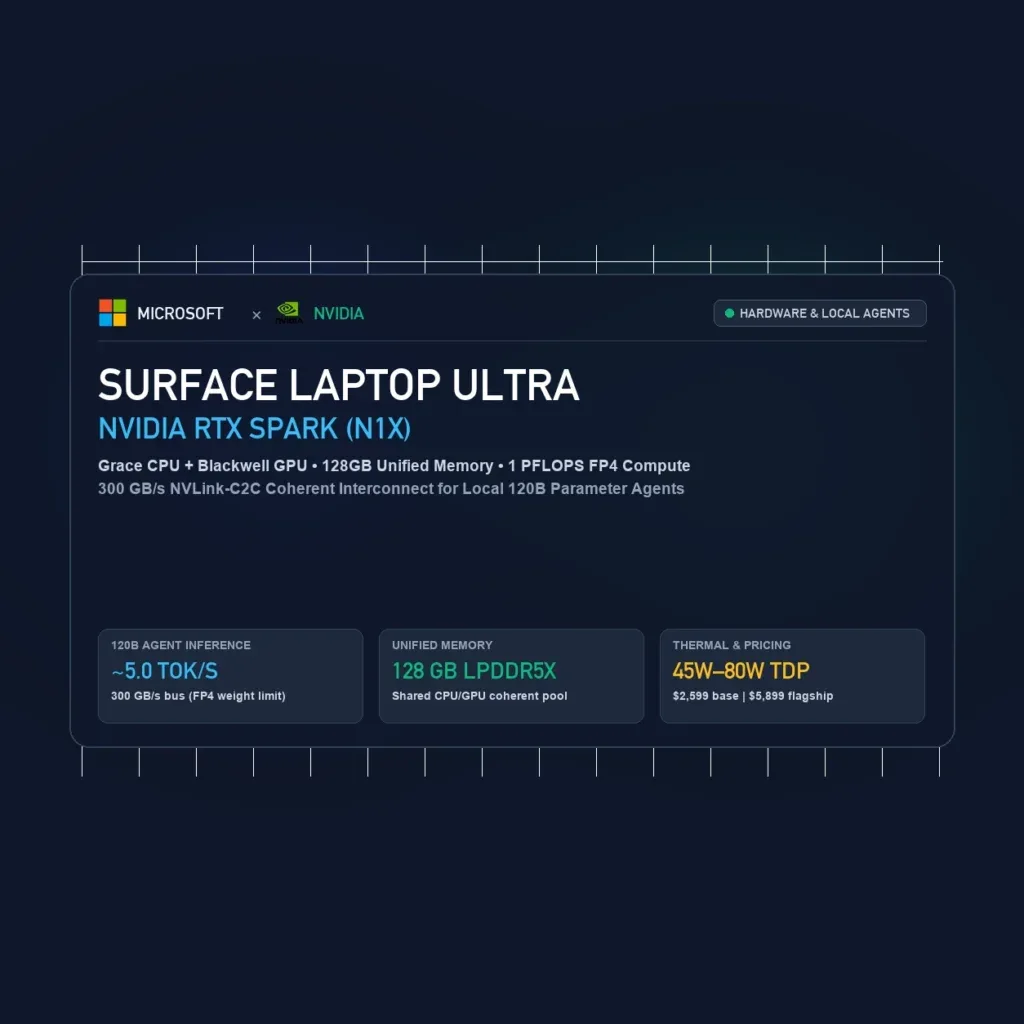
- Silicon Platform: NVIDIA RTX Spark (codenamed N1X), co-developed with MediaTek on an advanced 3nm-class foundry node.
- Compute Complex: Up to 20 Arm Neoverse Grace CPU cores paired with a Blackwell-architecture RTX GPU packing 6,144 CUDA cores.
- Interconnect & Memory: 300 GB/s bidirectional NVLink-C2C interconnect sharing up to 128 GB of unified LPDDR5X memory across CPU and GPU at 300 GB/s system bandwidth.
- AI Throughput: Up to 1 PFLOPS (1,000 TFLOPS) at FP4 precision with native Tensor Core micro-scaling.
- Form Factor & Power: 15-inch Mini-LED PixelSense Ultra display (3:2, 120Hz, 2,000 nits peak HDR) in an 18mm aluminum chassis operating at 45W–80W configurable TDP.
- Pricing & Availability: Pre-orders open now starting at $2,599 for the 24GB configuration, reaching $5,899 for the 128GB developer flagship; retail shipping begins October 16, 2026.
Microsoft is positioning the machine as an uncompromising local agent workstation capable of running models exceeding 120 billion parameters directly on device. It is even backing the launch with a direct $1,000 trade-in bounty targeting existing Apple MacBook Pro owners.
Yet before running out to trade in your Apple Silicon workstation or ordering a unit for your homelab, developers need to look past the marketing deck. What does 300 GB/s of memory bandwidth actually mean for 120B inference speeds? Where does Windows on Arm introduce friction in the CUDA toolchain? And what is the real financial cost of getting enough memory to run autonomous agents offline?
The Silicon Blueprint: Inside NVIDIA’s RTX Spark (N1X)
The engine driving the Surface Laptop Ultra is not an Intel or AMD x86 processor paired with a discrete mobile GeForce board. It is the NVIDIA RTX Spark (platform codename N1X), a bespoke System-on-Chip (SoC) co-engineered between NVIDIA and MediaTek.
Unlike conventional mobile workstation architectures where the CPU and GPU reside on separate physical dies communicating over an external PCIe Gen 4 or Gen 5 link, the RTX Spark integrates both processing elements onto a single package connected via NVLink-C2C (Chip-to-Chip).
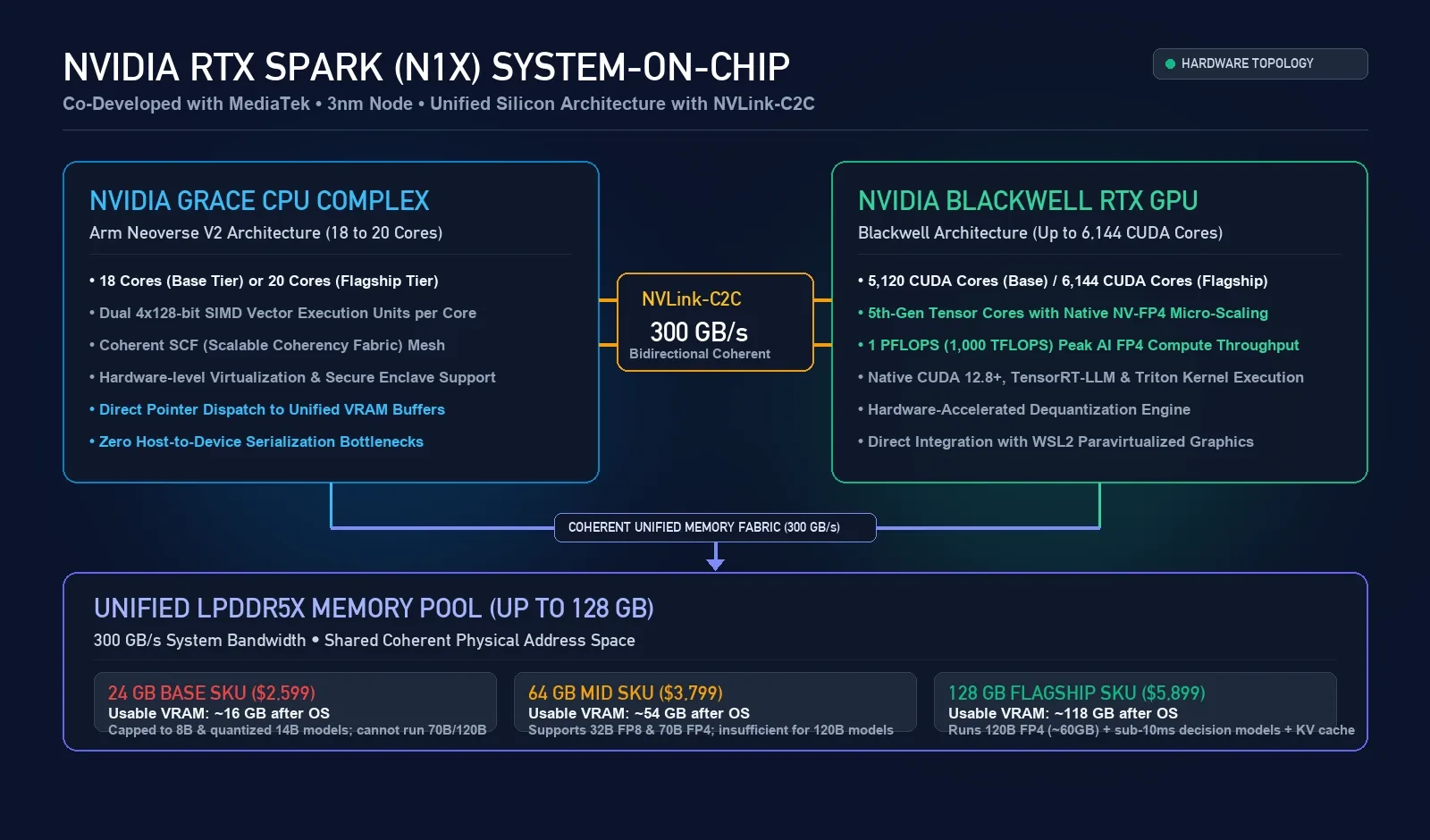
NVLink-C2C provides 300 GB/s of bidirectional, cache-coherent bandwidth between the Grace CPU and the Blackwell GPU. This eliminates the standard host-to-device memory copies (cudaMemcpy) that bog down heterogeneous computing. When an agent framework runs Python orchestrators on the CPU, it can inspect, modify, and pass tensor pointers directly into GPU memory buffers without PCIe serialization overhead.
NVIDIA offers the silicon in two distinct configurations:
- The Base N1X Tier: 18 Grace CPU cores and a Blackwell GPU configured with 5,120 CUDA cores.
- The Flagship N1X Tier: 20 Grace CPU cores and a Blackwell GPU configured with the full 6,144 CUDA cores.
By integrating the memory controller directly into the SoC fabric, NVIDIA provides a single unified pool of up to 128 GB of LPDDR5X memory running across a wide bus to deliver an aggregate 300 GB/s of system memory bandwidth.
The Memory Bandwidth Math: What 120B Models Actually Do at 300 GB/s
NVIDIA and Microsoft have repeatedly emphasized the keynote claim: "Up to 1 PFLOPS of AI compute capable of running 120B parameter models locally."
To understand what running a 120-billion parameter model on a laptop actually feels like, we must mathematically separate peak compute (prompt evaluation / prefill throughput) from memory bandwidth (token generation decode speed).
1. The Decode Bottleneck (Autoregressive Token Generation)
During the autoregressive token generation phase of large language models, memory access patterns are almost completely memory-bandwidth bound at batch size 1. For every single token produced, the GPU must stream every single active parameter from RAM through its processing cores.
The theoretical upper bound on token generation velocity is governed by fundamental memory bus physics:
Let’s calculate the real-world throughput limits across model sizes and quantization formats on the RTX Spark’s 300 GB/s bus:
| Model Size & Precision | Weight Footprint | RAM Required (+ 8GB OS/KV) | Fits in 64GB SKU? | Fits in 128GB SKU? | Theoretical Max Decode Speed |
|---|---|---|---|---|---|
| 32B Dense (FP8) | 32.0 GB | ~40.0 GB | Yes | Yes | 9.38 tok/s |
| 32B Dense (FP4 / INT4) | 16.0 GB | ~24.0 GB | Yes | Yes | 18.75 tok/s |
| 70B Dense (FP8) | 70.0 GB | ~82.0 GB | No | Yes | 4.28 tok/s |
| 70B Dense (FP4 / INT4) | 35.0 GB | ~47.0 GB | Yes | Yes | 8.57 tok/s |
| 120B Dense / MoE (FP8) | 120.0 GB | ~132.0 GB | No | Exceeds RAM | N/A (OOM) |
| 120B Model (FP4 Quantized) | 60.0 GB | ~74.0 GB | No | Yes | 5.00 tok/s |
These mathematical derivations reveal two essential realities:
- A 120B parameter model in FP4 consumes approximately 60 GB for weights. Across the 300 GB/s bus, streaming those weights yields a theoretical maximum sustained decode rate of 5.0 tokens per second (dropping to roughly 3.8 to 4.2 tok/s under driver and memory controller overhead).
- Running a 120B model in 8-bit precision requires 120 GB just for weights, which immediately triggers Out-of-Memory (OOM) crashes once the Windows OS (taking 6–8 GB) and KV-cache buffers are allocated.
- Consequently, FP4 is not an optional quantization experiment on RTX Spark; it is a mathematical prerequisite. Without FP4, 120B local inference is impossible on this hardware.
2. The Prefill Advantage: Where 1 PFLOPS Actually Matters
While single-stream autoregressive token generation is capped by the 300 GB/s memory bandwidth, prompt ingestion (prefill) is massively compute-bound.
In autonomous agent loops, models spend substantial time ingesting large context blocks: reading source files, parsing API schemas, and scanning execution histories before selecting a tool call. Evaluating a 16,000-token context on an Apple Silicon M4 Max using INT4/FP16 matrix coprocessors incurs a noticeable ingestion pause.
On the RTX Spark, the Blackwell GPU’s 5th-generation Tensor Cores deliver up to 1 PFLOPS of FP4 compute with native 2-bit/4-bit micro-scaling. Because matrix-matrix multiplication during prompt evaluation saturates tensor compute rather than memory bandwidth, the Surface Laptop Ultra processes multi-thousand token contexts with near-instantaneous prefill. In iterative agent loops where an agent calls tools dozens of times, rapid prefill dramatically cuts loop latency.
Breaching the MacBook Pro Moat: RTX Spark vs. Apple Silicon
Since the release of the M1 Max in 2021, Apple’s unified memory architecture has enjoyed an uncontested monopoly among machine learning developers seeking a portable machine with high memory capacity.
The Surface Laptop Ultra is designed specifically to break that monopoly. Here is how the two flagship platforms compare across silicon architecture, hardware specifications, and software ecosystems:
| Dimension | Microsoft Surface Laptop Ultra (RTX Spark N1X) | Apple MacBook Pro 16" (M4 Max) |
|---|---|---|
| CPU Architecture | 20-core NVIDIA Grace (Arm Neoverse V2) | 16-core Apple Silicon (12 Performance + 4 Efficiency) |
| GPU Cores & Architecture | 6,144 CUDA cores (Blackwell RTX architecture) | 40-core Apple GPU (Dynamic Caching) |
| Unified Memory Pool | Up to 128 GB LPDDR5X | Up to 128 GB LPDDR5X |
| Memory Bandwidth | 300 GB/s | 410 GB/s (up to 546 GB/s on Ultra chips) |
| Native FP4 Tensor Hardware | Yes (Blackwell 5th-Gen Tensor Cores) | No dedicated FP4 micro-scaling hardware |
| Peak AI Compute | 1,000 TFLOPS (1 PFLOPS) @ FP4 | ~150–200 TFLOPS (FP16/INT8 matrix estimate) |
| Software Toolchain | Native CUDA 12.8+, TensorRT-LLM, WSL2, vLLM | Apple Metal (MPS), MLX framework, llama.cpp |
| Chassis & Display | 15" Mini-LED PixelSense 3:2 (2,000 nits, touch) | 16.2" Liquid Retina XDR 16:10 (1,600 nits, non-touch) |
| 128GB Configuration MSRP | $5,899 | $4,699 – $5,099 |
Where Apple Still Leads: Raw Memory Bandwidth
The MacBook Pro M4 Max retains a clear advantage in memory bus width: 410 GB/s versus the RTX Spark’s 300 GB/s.
That 36% bandwidth advantage means that for pure autoregressive generation at INT4 or GGUF quantization, a 70B parameter model runs at ~9.5 to 11.5 tokens per second on an M4 Max, compared to ~7.0 to 8.5 tokens per second on the Surface Laptop Ultra. If your workload consists solely of streaming raw tokens out of a single quantized model into a chat window, Apple Silicon still pushes tokens across the bus faster.
Where NVIDIA Flips the Script: The Native CUDA Ecosystem
The historical friction point of Apple Silicon has always been its proprietary software stack.
Modern machine learning infrastructure is written in CUDA. When engineering teams build production agent pipelines utilizing cutting-edge optimizations—such as FlashAttention-3, custom Triton kernels, DeepGEMM, native FP4 micro-scaling, TensorRT-LLM execution graphs, and continuous batching schedulers—running on a Mac requires porting those kernels to Apple’s Metal Performance Shaders (MPS) or adapting them to the MLX framework.
For enterprise engineering teams, that translation layer introduces immense friction. Code developed and tested on an Apple laptop cannot be containerized and deployed 1:1 into an NVIDIA H100 or Blackwell B200 cloud cluster without rewriting execution harnesses.
The Surface Laptop Ultra changes that equation completely. Because the RTX Spark runs native Blackwell GPU hardware, it supports standard NVIDIA drivers, the CUDA 12.8+ Toolkit for ARM64, and TensorRT-LLM. A model optimized locally in FP4 on a Surface Laptop Ultra uses the exact same tensor layout and kernel execution paths as an enterprise cluster of DGX servers.
The Local Agent Control Plane: Zero-WAN Architecture
The strategic rationale behind the Surface Laptop Ultra becomes unmistakable when examined alongside Microsoft’s software platform moves over the preceding 48 hours.
Just yesterday, Microsoft unveiled Microsoft-Decision-1, a 9B cloud decision model designed to score agent choices with an 85-millisecond median latency on Azure. As analyzed in our prior coverage, cloud decision APIs face a severe structural friction: the WAN network tax. When an autonomous agent makes dozens of decision calls in an execution loop, adding 50 to 100 milliseconds of round-trip network transit to each routing step degrades responsiveness.
Teams seeking fast, zero-latency execution have increasingly turned to local edge decision models like Laya and the Unsloth Local Decision API, running compact sub-0.5B models directly on local hardware in under 35 milliseconds.
With the Surface Laptop Ultra, Microsoft provides the physical hardware to run an entire multi-tier agent architecture completely offline:
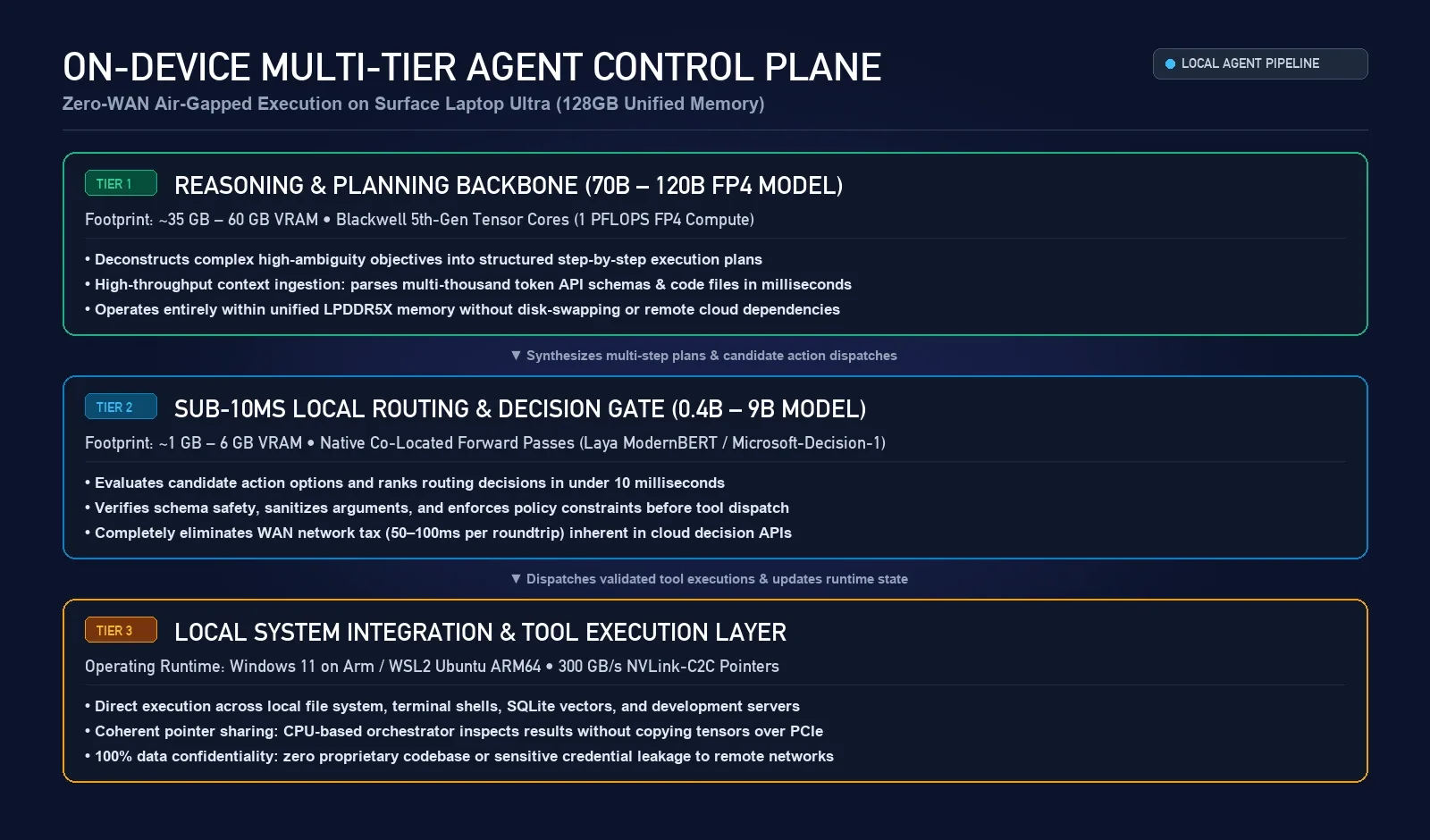
Because 128 GB of unified memory accommodates both a 60 GB 120B reasoning model and a lightweight 2 GB routing model simultaneously, an agent pipeline can alternate between deep reasoning and rapid classification without swapping weights to disk. For developers building air-gapped coding assistants, legal analysis tools, or financial reasoning agents handling sensitive proprietary data, this architecture eliminates data leakage risks and cloud API token bills.
The Usability Reality Check: Software, Thermals, and Pricing Friction
As compelling as the hardware specifications appear on paper, running production AI on a Windows on Arm laptop comes with practical friction points that every buyer should evaluate before placing an order.
1. The Windows on Arm & WSL2 Toolchain Realities
The Surface Laptop Ultra runs Windows 11 on Arm. While Microsoft’s Prism emulation layer handles standard x86 productivity software transparently, running machine learning development under emulation severely degrades performance.
To achieve native GPU acceleration, developers must ensure they use native aarch64 Windows binaries and native ARM64 Python wheels. In practice, the primary development environment for AI engineers will be Windows Subsystem for Linux 2 (WSL2) running an Ubuntu ARM64 image with NVIDIA’s Linux driver paravirtualization. While NVIDIA’s CUDA drivers for Linux on ARM64 are mature from years of Jetson and Grace server development, packaging inconsistencies in community libraries (such as older PyTorch wheels compiled without ARM64 NEON or Blackwell compute capability support) can cause friction during environment setup.
2. Thermal Dissipation in an 18mm Chassis
The Surface Laptop Ultra operates within a configurable system thermal design power (TDP) between 45W and 80W.
Dissipating 80 watts of heat through a chassis measuring less than 18mm in thickness requires significant active airflow. Microsoft has engineered a custom dual-fan vapor chamber cooling system, but physical thermodynamics cannot be circumvented: running a 120B model through a continuous, multi-hour batch evaluation or local fine-tuning run will push the cooling system to its acoustic limits. If internal temperatures reach junction thresholds, power throttling can derate GPU clocks by 20% to 35%, dropping memory bus frequency and reducing token generation speeds accordingly.
3. The "$2,599" Pricing Trap
Microsoft’s launch headline boasts an entry price of $2,599. However, developers looking to run large local models must read the specification matrix carefully:
- The $2,599 Base SKU: Ships with the 18-core CPU, 5,120 CUDA cores, and only 24 GB of unified memory. With 24 GB of RAM, you cannot run a 70B model, let alone a 120B model. Once Windows 11 reserves its 6 to 8 GB operating footprint, you are left with ~16 GB of usable VRAM—enough for an 8B model or a heavily quantized 14B model, but far short of the advertised agent workstation capability.
- The 64GB Mid-Tier SKU: Priced at $3,799, this configuration comfortably handles 32B models and heavily quantized 70B models, but still cannot load a 120B model with context buffers.
- The 128GB Flagship SKU: To run the 120B local models highlighted in Microsoft and NVIDIA’s marketing materials, buyers must purchase the 128 GB memory configuration, which carries a retail price of $5,899.
At nearly $5,900, the Surface Laptop Ultra is not a mass-market laptop; it is a specialized mobile workstation that costs more than a similarly configured 128GB Apple MacBook Pro M4 Max (which retails between $4,699 and $5,099).
Editorial Verdict: Who Should Buy the Surface Laptop Ultra?
The Microsoft Surface Laptop Ultra represents the most significant architectural evolution in Windows hardware since the launch of the Surface line. By partnering with MediaTek and NVIDIA to bring the Grace+Blackwell SoC onto an Arm platform with 128GB of coherent unified memory, Microsoft has finally delivered a Windows workstation that can compete directly with Apple Silicon’s memory architecture while retaining the vast advantages of the native CUDA ecosystem.
Buy the Surface Laptop Ultra If:
- You are an AI researcher or developer building autonomous agent workflows who requires a portable 128GB unified memory buffer to run 70B to 120B models completely offline.
- Your workflow relies heavily on native CUDA kernels, TensorRT-LLM, FlashAttention, and standard enterprise container stacks that are difficult to adapt to Apple’s Metal/MLX framework.
- You need high-throughput prompt ingestion (1 PFLOPS FP4 compute) for processing long context documents and iterative tool-calling loops on device.
Stick with Your Current Setup If:
- You already own a 128GB Apple MacBook Pro M4 Max and your workload is well-supported by MLX or
llama.cpp. The Mac offers higher raw memory bandwidth (410 GB/s vs 300 GB/s) for faster single-stream autoregressive token generation at lower retail pricing. - You do not need mobility. For the $5,899 price of the 128GB Surface Laptop Ultra, you can build a dedicated desktop workstation equipped with dual desktop GPUs offering substantially higher memory bandwidth and sustained cooling.
- Your budget limits you to the $2,599 base tier. A 24GB unified memory pool does not deliver the agent capabilities advertised in Microsoft’s launch presentations.
The Surface Laptop Ultra begins retail shipping on October 16, 2026. As customer units land in developer hands, empirical benchmarks on sustained thermal throttling, Linux WSL2 driver stability, and real-world FP4 token velocities will determine whether the Grace+Blackwell mobile platform establishes a lasting foothold in the local AI landscape.