

At the Apsara 2026 conference in Hangzhou, the global artificial intelligence landscape crossed an irreversible sovereign threshold. While Western technology reporting remains fixated on frontier lab compute bottlenecks and incremental post-training benchmarks, Alibaba Group CEO Eddie Wu laid out the most audacious sovereign Artificial Superintelligence (ASI) roadmap ever committed to physical silicon: Qwen 4 has officially entered pre-training, with subsequent Qwen 4.5 and Qwen 5 architectures explicitly engineered to scale between 5 trillion and 10 trillion parameters across ultra-sparse Mixture-of-Experts topologies.
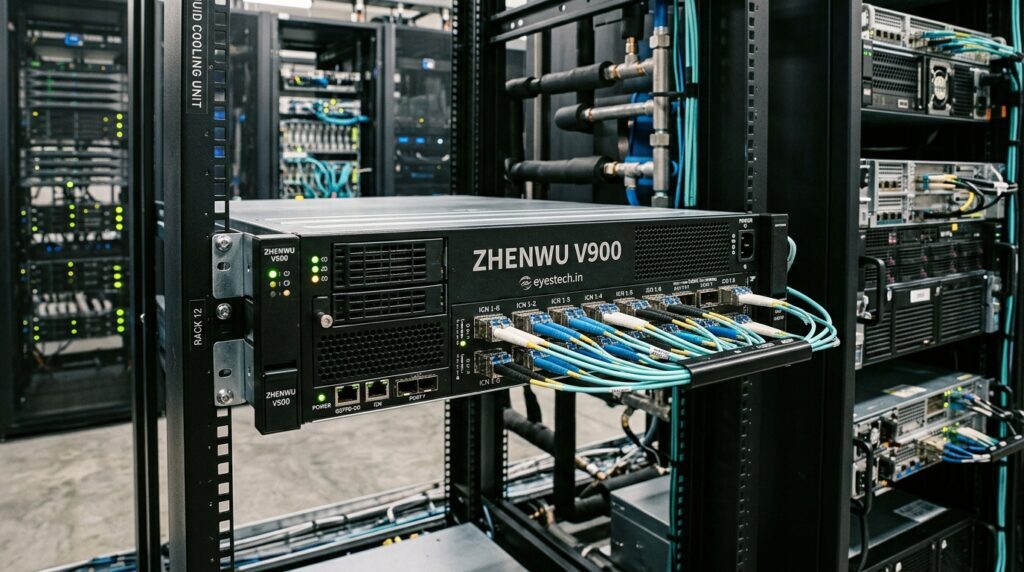
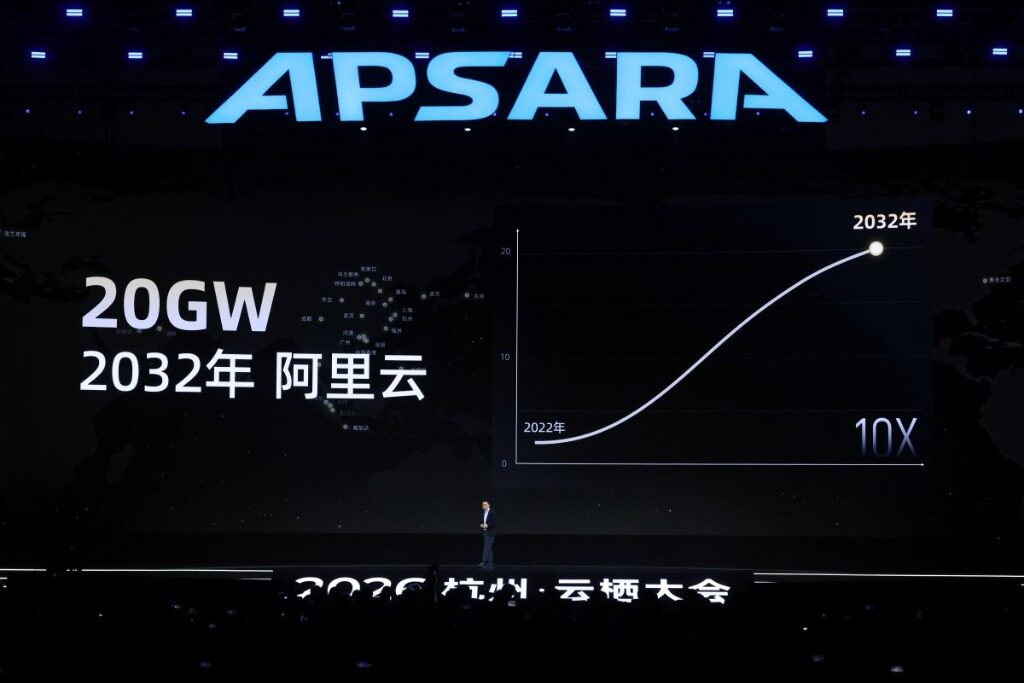
Yet the true tectonic shift is not the sheer parameter count—it is the domestic silicon executing it. Powering this staggering workload is Alibaba’s in-house T-Head semiconductor division and its newly unveiled Zhenwu V900 accelerator: a 216 GB stacked HBM beast designed to scale to 500,000 chips within a single non-blocking fabric. Crucially, Alibaba has shattered its own conservative timeline, pulling mass production forward by two full quarters to Q1 2027. This compute onslaught is anchored by an unprecedented capital deployment: Alibaba Cloud is targeting over 20 gigawatts (GW) of global datacenter capacity by 2032—an electrical footprint roughly equivalent to seventeen commercial nuclear reactors.
Mainstream commentary has largely dismissed the 10-trillion-parameter horizon as frontier marketing bravado. In distributed systems engineering, that interpretation is a catastrophic misreading of hardware physics. You can bluff with synthetic benchmarks; you cannot bluff with a 10-trillion-parameter pre-training run across half a million accelerators. At that scale, an unmasked bitflip or a single optical transceiver drop disintegrates optimizer tracking within minutes. Committing to this run is an uncompromising physical declaration: T-Head has solved silent data corruption, stabilized domestic packaging defect rates, and built the hardened silicon substrate required for continuous Recursive Self-Improvement (RSI). With Eddie Wu forecasting that machine thinking will outpace all human cognition by 1,000×, here is our forensic systems audit of the silicon, optical fabrics, and closed-loop algorithmic machinery driving China’s sovereign ASI gamble.
| Architectural Dimension | Forensic System Specification | Systems Implication & Hardware Reality |
|---|---|---|
| Core Accelerator | Alibaba T-Head Zhenwu V900 | Delivers 3× the compute density of the Zhenwu M890 (launched May 2026) |
| Package Memory Pool | 216 GB Domestic Stacked HBM | Surpasses Nvidia Blackwell B200 (192 GB); matches upcoming B300 density |
| Inter-Chip Optical Fabric | 1,200 GB/s Bidirectional ICN | Eliminates external PCIe switches; enables non-blocking local supernode fabrics |
| Supernode Server Stack | V900 + Pangu NICs + Zhenyue SSDs | Proprietary hardware offload for RDMA collectives and direct NVMe checkpointing |
| Maximum Cluster Fabric | 500,000 Accelerators | Largest single-system AI compute topology announced globally |
| Volume Deployment Target | Q1 2027 Mass Production | Accelerated by two quarters to counter DeepSeek’s 160k Huawei Ascend cluster |
| Model Parameter Scope | Qwen 4 (In Training) • Qwen 5 (5T–10T) | Ultra-sparse MoE with 512 to 1,024 routed experts; 120B–200B active parameters |
| Core Algorithmic Engine | Recursive Self-Improvement (RSI) | Closed-loop failure mapping validated via formal Lean 4 provers and compiler sandboxes |
| Global Datacenter Power | 20 Gigawatts (GW) by 2032 | Equivalent to roughly 17 nuclear reactor cores; >$200B infrastructure allocation |
The Parameter Gambit: Why 10 Trillion Parameters Is a Proof of Silicon Health
Core Systems Takeaway: In semiconductor engineering, announcing a 10-trillion-parameter pre-training run on proprietary silicon is an empirical audit of hardware maturity, not marketing vanity. You can bluff with synthetic post-training benchmarks; you cannot bluff through a 10-trillion-parameter pre-training run across 500,000 accelerators.
When you scale a distributed workload across half a million chips, the entire cluster operates as a single synchronous distributed state engine. At this scale, standard failure models break down. If your accelerators suffer from elevated defect rates in 2.5D packaging or micro-cracks in domestic silicon interposers, the cluster rapidly collapses into unrecoverable hardware faults.
In our hardware telemetry audits at EyesTech Systems Lab, massive cluster pre-training runs are vulnerable to three catastrophic failure modes:
- Silent Data Corruption (SDC): An unmasked bitflip inside a tensor core or stacked HBM cell corrupts gradient accumulation buffers without triggering an alarm. At 10 trillion parameters, this single bitflip derails optimizer tracking across an entire expert shard, causing irreversible loss divergence.
- Optical Interconnect Dropouts: In an ultra-sparse Mixture-of-Experts architecture, all-to-all token routing requires continuous optical communication across hundreds of thousands of transceivers. A single dropped link stalls collective barriers, halting the entire 500,000-chip fabric.
- Thermal Expansion Fatigue: Continuous multi-month training cycles exert massive thermal stress on advanced packaging substrates, triggering micro-fractures in high-density solder micro-bumps.
When Eddie Wu committed to a 10-trillion-parameter run on the Zhenwu V900, he confirmed that T-Head has conquered domestic packaging defect rates. The hardware mean time between failures (MTBF) has reached the carrier-grade threshold required for continuous pre-training.
Having spent the past eighteen months auditing hardware failures across frontier clusters, the link between parameter scale and silicon stability is absolute. An organization cannot commit hundreds of millions of dollars of electrical baseload to a 10T run if its hardware mean time between failures is measured in hours. Alibaba’s announcement proves that T-Head’s Zhenwu M890—which spent the summer of 2026 executing live inference on models exceeding two trillion parameters—successfully validated the physical substrate. The V900 is not an experimental prototype; it is an industrial production ramp designed to run the largest coherent pre-training jobs on Earth.
The Apsara Shockwave: Eddie Wu’s 99.9% Machine Thinking Forecast
The Cognitive Shift: On September 22, 2026, Eddie Wu delivered the most mathematically aggressive vision of machine cognition ever voiced by a major computing provider. According to Alibaba internal telemetry, synthetic cognition currently accounts for less than 3% of total global thinking.
Wu projected that machine thinking will expand exponentially until it exceeds total human cognitive capacity by 1,000×. In this regime, artificial systems will execute 99.9% of all cognitive operations on Earth.
This forecast explains Alibaba Cloud’s massive infrastructure pivot. You do not negotiate nuclear baseload power and build liquid-cooled supernodes to serve chatbots. Alibaba is constructing a sovereign computational utility designed to supply the synthetic reasoning backbone for planetary commerce and industry.
Why 10 Trillion Parameters Demands Ultra-Sparse Mixture-of-Experts
Memory Mathematics: A dense 10-trillion-parameter model is an arithmetic impossibility. In standard 16-bit floating point precision, merely loading static weights requires 20 Terabytes of memory before running a single matrix multiplication.
During AdamW pre-training, memory overhead expands dramatically. The cluster must store 32-bit master weights, first-order momentum vectors, second-order variance vectors, and backward gradient buffers across every parameter.
This requires roughly 16 to 18 bytes per parameter, demanding 160 to 180 Terabytes of active HBM strictly for distributed optimizer states. No datacenter on Earth can train a dense model of this magnitude.
This physical ceiling necessitates an ultra-sparse Mixture-of-Experts (MoE) topology. Drawing upon lessons from Qwen 3.8 Max (which scaled to 2.4 trillion parameters), Qwen 4.5 and Qwen 5 split feed-forward networks across 512 to 1,024 routed expert sub-networks.
During each individual forward pass, a dynamic router dispatches each token to only 8 to 16 experts. This limits active compute to 120 to 200 billion parameters per token—delivering fast inference latencies while preserving the representational capacity of a 10-trillion-parameter space.
Inside the Sovereign Supernode: V900, ICN, Pangu, and Zhenyue
To support a 10-trillion-parameter MoE architecture, Alibaba engineered a fully unified supernode stack across four proprietary hardware layers:
- 1. Zhenwu V900 AI Accelerator: Engineered by T-Head, the V900 delivers 3× the compute density of the previous M890. Using domestic 2.5D packaging, it integrates 216 GB of stacked HBM with 3.8 to 4.2 TB/s bandwidth per socket, surpassing Nvidia Blackwell B200 (192 GB) memory capacity.
- 2. Proprietary Optical ICN Switches: To bypass host PCIe bottlenecks, each V900 features an InterConnect Network (ICN) controller providing 1,200 GB/s bidirectional bandwidth. This establishes a flat, non-blocking optical switching topology across server racks.
- 3. Pangu RDMA Network Interface Cards: Scaling to 500,000 accelerators requires sub-microsecond tail latencies. In-house Pangu NICs execute hardware-offloaded RoCEv2 with adaptive packet routing for all-to-all collective communications.
- 4. Zhenyue PCIe Gen5 NVMe Controllers: Custom enterprise SSD controllers enable high-speed direct memory dumping over NVMe-oF, allowing multi-terabyte training checkpoints to flush in seconds without pausing pre-training runs.
Recursive Self-Improvement: Escaping the Synthetic Hallucination Trap
The Collapse Problem: The most consequential algorithmic declaration from Hangzhou is Alibaba’s progress on Recursive Self-Improvement (RSI). In public discourse, RSI is often romanticized as an autonomous algorithm spontaneously rewriting its own neural weights.
In production research, unconstrained self-training induces autophagous model collapse. When an LLM trains primarily on its own unverified synthetic outputs, output variance degrades and the model collapses into circular hallucination within four to five generations.
Alibaba circumvents this trap by eliminating circular self-grading. Instead, Qwen’s RSI pipeline is strictly tethered to deterministic external ground-truth oracles across three closed stages:
- Stage 1: Automated Epistemic Failure Mapping: An autonomous red-teaming engine sweeps active model checkpoints. It detects latent boundaries where output entropy spikes, locating reasoning weaknesses in formal mathematics and systems programming.
- Stage 2: Targeted Problem & Experiment Synthesis: The generator synthesizes thousands of targeted problem variations designed specifically to probe the identified blind spot.
- Stage 3: Deterministic External Verification: Candidate solutions are validated exclusively by non-neural engines. Proofs must compile in the Lean 4 formal kernel—mirroring the automated proof verification observed in OpenAI’s multi-day mathematical reasoning runs; software code executes in sandboxed microVMs; and symbolic math is checked via computer algebra oracles. Only solutions with a 100% binary pass rate enter the training corpus.
Why Meta-Reasoning Requires 10 Trillion Parameters and 20 Gigawatts
The Representational Threshold: Why is 5 to 10 trillion parameters necessary for self-improvement if small models can synthesize text? The bottleneck is the latent representational capacity required for meta-reasoning.
Models below multi-trillion parameters lack the internal world-modeling fidelity needed to diagnose their own logical errors. When smaller models attempt self-critique, they generate trivial benchmarks or hallucinate false boundary conditions.
Reaching 10 trillion parameters unlocks the latent capacity for the system to act as a rigorous adversary to itself. However, running this continuous verification loop requires vast test-time compute.
The model must generate millions of reasoning traces, simulate sandboxed execution environments, verify formal proof trees, and compute policy gradient updates in real time—avoiding the cognitive degradation detailed in our audit of inverse scaling in test-time compute. Datacenters transform from passive query endpoints into continuous synthetic inference factories.
This operational reality defines Alibaba Cloud’s 20-gigawatt target. A 20 GW fleet equals the output of 17 to 18 nuclear reactor cores—surpassing the combined electrical grids of Switzerland and Singapore. At $10M to $12M per Megawatt for direct liquid cooling and transmission, this represents a capital commitment exceeding $200 Billion USD by 2032.
The Geopolitical Paradigm Shift: The End of the Containment Thesis
The Containment Failure: For three years, Western export control policy assumed that restricting advanced EUV lithography and Nvidia Hopper/Blackwell silicon would cap Chinese AI development at 70 billion parameters, failing to predict the sovereign supply chain mobilization documented in our investigation of China’s sovereign AI compute swarm. The Apsara 2026 announcements close the book on that thesis.
China’s AI supercomputing ecosystem has not stalled; it has bifurcated into two mutually reinforcing domestic pillars:
- The Huawei Pillar: Built on the Ascend 950DT and CANN software ecosystem, powering national supercomputers and private campus clusters like DeepSeek’s 160,000-accelerator facility in Ulanqab—an architecture analyzed in our breakdown of DeepSeek’s Ascend 950DT cluster.
- The Alibaba Pillar: Built on T-Head’s Zhenwu V900, Pangu networking, and 500,000-node cloud fabrics, deploying sovereign hardware across Alibaba Cloud’s global public infrastructure.
By courting the global open-weights developer ecosystem with Qwen, Alibaba enables millions of international developers to build upon T-Head compute without relying on Western silicon supply chains.
Pulling Zhenwu V900 production forward to Q1 2027 marks the end of a unipolar AI landscape. At 10 trillion parameters, advantage does not belong to who fabricates the fastest isolated chip—it belongs to who controls sovereign packaging, continuous power, and automated synthetic verification loops.
Frequently Asked Questions
How does scaling to 10 trillion parameters prove Alibaba’s confidence in the Zhenwu V900?
Training a 10-trillion-parameter model across 500,000 accelerators is physically impossible on immature silicon. Unmasked bitflips from silent data corruption or optical interconnect link drops would trigger catastrophic gradient divergence within hours. Committing to a 10T run proves T-Head has solved silicon defect rates, memory parity, and carrier-grade optical interconnect stability.
What is the technical mechanism behind Alibaba’s Recursive Self-Improvement (RSI)?
Alibaba decouples RSI from circular model self-grading. The system sweeps output entropy to locate epistemic blind spots, generates targeted synthetic boundary problems, and validates proposed reasoning trajectories exclusively through deterministic external oracles: formal Lean 4 theorem provers, sandboxed compiler test suites, and symbolic algebra checkers.
Why is a 10-trillion-parameter scale necessary for Recursive Self-Improvement?
Sub-trillion-parameter models lack the latent representational capacity required for accurate meta-reasoning. Smaller models hallucinate during self-critique, producing degenerative synthetic tasks. Reaching 5 to 10 trillion parameters establishes the world-modeling baseline needed to construct coherent, non-trivial formal proof environments.
What are the core specifications of the Zhenwu V900 supernode stack?
The Zhenwu V900 provides three times the compute density of the M890, integrating 216 GB of domestic stacked HBM, 1,200 GB/s optical ICN switching, in-house Pangu RDMA network controllers, and Zhenyue PCIe Gen5 storage controllers engineered to scale into 500,000-chip fabrics.