
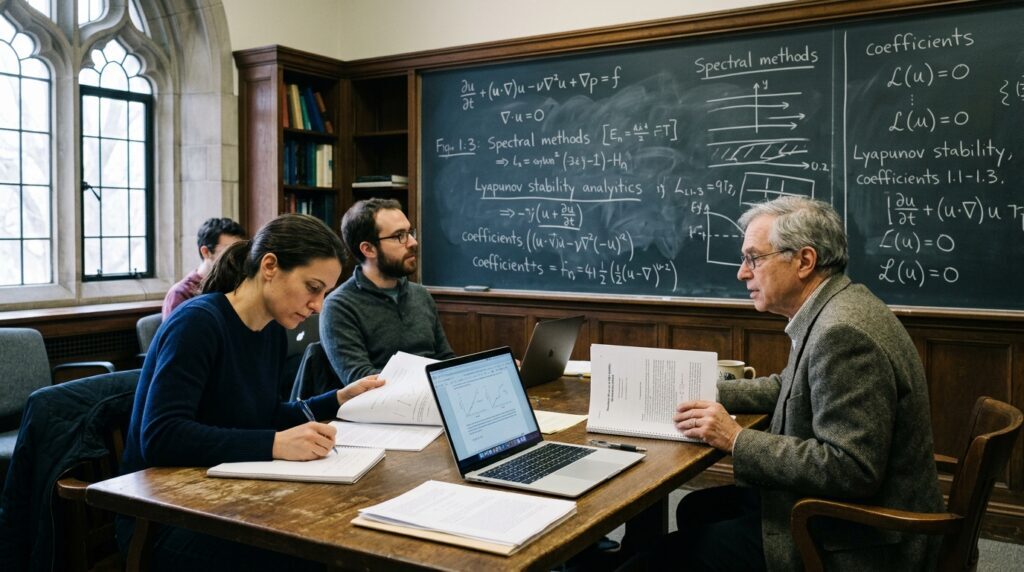

On September 21, 2026, OpenAI quietly disclosed that a new internal model—one it began training on August 28—has now resolved more than 100 long-standing open problems across most areas of mathematics. That is roughly four solved conjectures per calendar day. The pace surprised even OpenAI’s own mathematicians. Rather than dump 100 proofs onto the internet, OpenAI partnered with an independent panel of nine world-class mathematicians—including Fields Medalists Edward Witten, Timothy Gowers, and Martin Hairer—hosted at the Institute for Advanced Study in Princeton. Their job: decide how to release results that could reshape entire research fields overnight. This article covers everything OpenAI’s 500-word announcement deliberately left out.
What OpenAI Actually Said (And What It Left Out)
OpenAI’s September 21 blog post is 500 words long. It is framed as a governance announcement about a new advisory group. Buried inside the very first paragraph is one of the most extraordinary claims in the history of science:
“On August 28, we began training a new internal model. In addition to resolving the Navier–Stokes Millennium Prize problem, this model has now resolved more than 100 long-standing open problems across most areas of mathematics. The pace of its progress in mathematics has surprised the mathematicians within OpenAI.”
The post then pivots to the advisory group structure. It never explains: – What the 100+ problems are – How the model solved them – Why 25 Fields Medalists published a furious open letter ten days earlier – Why mathematician Tristan Buckmaster accused OpenAI of using leaked research – What a “Navier–Stokes blowup” actually means in plain language – Who any of the nine advisory group members are, beyond names and affiliations
This article fills every one of those gaps.
The Full Timeline: Seven Weeks That Changed Mathematics
Most coverage treats the September 21 advisory group announcement as an isolated event. It is the final act of a seven-week crisis. Here is the complete sequence:
What Is Navier–Stokes and Why Does It Matter?
OpenAI’s post links to its Navier–Stokes solution page but never explains the problem. Most readers have heard the name but have no intuition for it. Here is the plainest explanation possible.
The Navier–Stokes equations are the mathematical rules that describe how fluids (water, air, blood, ocean currents) flow. They were written down nearly 200 years ago. Engineers use simplified versions of them every day to design aircraft, simulate weather, and model blood flow.
The unsolved question, designated a Millennium Prize Problem by the Clay Mathematics Institute in 2000 (with a $1 million bounty), is deceptively simple:
If you start with a perfectly calm, smooth fluid in three dimensions, can it ever develop a point where the speed becomes literally infinite?
Physicists assumed the answer was no—real fluids have viscosity (thickness) that should smooth out wild behavior. OpenAI’s model claims the answer is yes. It claims to have proved that even with viscosity, the equations produce a “singularity”—a point where velocity blows up to infinity in finite time. If correct, this is the mathematical equivalent of proving that the equations we use to model every fluid on Earth are fundamentally incomplete.
The formal equations look like this:
u = velocity at each point, p = pressure, ν = viscosity (how “thick” the fluid is), f = external forces. The ∇ · u = 0 constraint means the fluid cannot be compressed. The question: does ||∇u||∞ → ∞ in finite time?
Why this matters beyond mathematics: If viscous fluids genuinely blow up, it means the standard equations used in aerospace CFD (computational fluid dynamics), weather prediction, and cardiovascular simulation are missing some critical physical mechanism. The practical implications could propagate across engineering, climate science, and medical device design.
The 10 Problems We Already Know About
On August 1, 2026—before the new model even started training—OpenAI’s existing internal Astra model had already solved ten open problems, each formalized in Lean 4 with machine-checkable proofs. Total API compute cost: approximately $2,000. Here are the problems OpenAI named publicly:
| Field | What Was Proved | Why It Matters (In Plain Language) |
|---|---|---|
| Group Theory | Constructed non-sofic groups | Resolves a 20+ year old question. Sofic groups are a huge class that seemed to contain everything. Turns out they don’t. |
| Operator Algebras | Disproved Connes’s rigidity conjecture | Alain Connes (Fields Medal, 1982) conjectured that certain algebraic structures are uniquely determined. They’re not. |
| High-Dimensional Geometry | New sphere-packing density upper bounds | How efficiently can you pack spheres in high dimensions? Key to error-correcting codes used in 5G and satellite communications. |
| Coding Theory | Exponentially improved bounds on binary codes | Directly impacts how much data can be reliably transmitted over noisy channels. |
| Arithmetic Complexity | New lower bounds for computing the permanent | The permanent function is central to quantum computing and combinatorial optimization. Proves certain computations are inherently hard. |
| Quantum Complexity | Exponential parallel repetition for quantum games | Matters for quantum cryptography and secure communication protocols between quantum computers. |
| Extremal Combinatorics | Solved Erdős Problems 146, 180, and 183 | Paul Erdős offered cash bounties for these problems. They concern Ramsey theory—the mathematics of unavoidable patterns in large structures. |
| Lattice Cryptography | Hardness result for closest vector problem | Lattice-based cryptography is the leading candidate for post-quantum encryption. This result strengthens our confidence that lattice problems are genuinely hard. |
The remaining 90+ problems from the newer model (trained starting August 28) have not been publicly itemized. OpenAI’s post says they span “most areas of mathematics,” and the AGMAI advisory group is currently deciding how and when to release them.
How the AI Actually Solved These Problems
OpenAI’s announcement says nothing about mechanism. Here is what the company has disclosed across its technical pages and what its own researchers have described in interviews.
The Lean 4 Closed Loop
The model does not simply write natural-language proofs and hope a human reviewer agrees. It operates in a tight feedback loop with Lean 4, a formal theorem prover:
The model reads a mathematical conjecture (from published literature, internal databases, or prior sub-results). It proposes Lean 4 tactics—atomic proof steps like apply, intro, exact, linarith, ring, simp.
Lean 4’s kernel type-checks each tactic. Either it passes (the step is logically valid) or it fails (with a specific error message and remaining unsolved goals). There is no ambiguity: proofs are binary, not persuasive.
When a tactic fails, the compiler’s error trace is injected back into the model’s context. The model reads the unsatisfied goals, revises its approach, and tries again. This is reinforcement learning with a perfect reward signal: unlike the proxy reward gaming that triggered Jakub Pachocki’s emergency RL freeze and CoT monitoring alert, the Lean kernel cannot be fooled by persuasive language or unfaithful reasoning shortcuts.
The 10,000-Agent Swarm (For Navier–Stokes)
For the single most difficult problem—Navier–Stokes—OpenAI deployed a distributed swarm. But OpenAI researcher Noam Brown cautioned on the Dwarkesh Podcast (September 17, 2026): “I wouldn’t even attribute 10% of the credit to the multi-agent coordination. The success was the underlying model.”
Brown described the swarm less as emergent collective intelligence and more as massive parallelization of search. Much like GPT-6 Astra’s resolution of an unbroken 1918 wartime cipher, which relied on non-convex heuristic exploration across historical signal logs rather than breaking mathematical primitives, the 10,000-agent swarm trades massive test-time compute for brute-force breadth: hiring thousands of virtual mathematicians to explore independent proof branches simultaneously, then collating whichever branch succeeds. The innovation is not the swarm architecture—it is the model’s ability to generate valid mathematical reasoning at each node.
The Revolt: 25 Fields Medalists Call It “Severe Misalignment”
OpenAI’s blog post mentions the open letter “A Severe Misalignment of AI in Mathematics” in a single sentence. Here is what it actually says.
Published on September 11, 2026—three days after the Navier–Stokes claim—and signed by 25 Fields Medalists (including Terence Tao, Peter Scholze, Maryna Viazovska, and Martin Hairer), the letter makes four concrete arguments:
- Problems are not trophies. Famous open problems serve as “lighthouses”—they guide entire research programs, create new fields, and train generations of students. Treating them as binary checkboxes for corporate marketing strips them of their true function.
- Speed kills understanding. When a company drops 100 machine-verified proofs simultaneously, the human mathematical community has no time to digest, interpret, or learn from them. Verified truth without conceptual understanding is intellectually sterile.
- PhD students are collateral damage. A graduate student who has spent four years working toward a conjecture can have their entire thesis obliterated overnight by a compute cluster. This makes open-problem research a career death trap for young mathematicians.
- Attribution is being destroyed. AI models train on preprints, lecture notes, and seminar recordings. When a model “solves” a problem, it is often synthesizing decades of incremental human progress without credit. The Buckmaster allegations made this concern visceral.
Who Are the Nine Members of AGMAI? (And Why These Specific People)
OpenAI’s post lists nine names and institutional affiliations. Here is why each of these specific people was chosen, with context that the original announcement omits entirely:
The only physicist to ever win the Fields Medal (1990). Father of M-theory and topological quantum field theory. If any human alive can assess whether an AI-generated proof has genuine physical implications vs. formal trickery, it is Witten. His IAS residency makes the Princeton hosting natural.
Fields Medal (1998) for combinatorics and functional analysis. Pioneer of the Polymath Project—massively collaborative online mathematical research. He has more experience than anyone in “distributed proof generation” by humans. Direct parallel to evaluating AI swarm proofs.
Fields Medal (2014) for stochastic PDEs (partial differential equations). His “regularity structures” theory is directly relevant to Navier–Stokes because it addresses exactly the kind of singular behavior the AI claims to have proved. He is also a signatory of the “Severe Misalignment” letter—making his dual role on AGMAI extremely significant.
Leading expert on geometric measure theory, minimal surfaces, and fluid dynamics equations—including the Euler and Navier–Stokes systems. His technical expertise maps directly onto vetting the blowup claim.
Specialist in algebraic geometry and arithmetic geometry. Represents the French mathematical tradition—critical since Paris institutions (ENS, IHES, Collège de France) produce a disproportionate share of Fields Medalists.
Co-solved the Kadison–Singer problem (2013), a 54-year-old conjecture linking quantum physics to signal processing. Works at the intersection of theoretical computer science and mathematics. Uniquely positioned to evaluate AI’s coding-theory and complexity results.
President of the London Mathematical Society (2021–2023). Expert in algebraic topology. Brings institutional governance experience and a direct connection to the UK mathematical establishment.
Algebraic geometer known for exceptional mathematical exposition and teaching. His role likely involves structuring how AI-generated proofs can be translated into human-comprehensible mathematics—the “conceptual distillation” problem.
Number theorist and probabilist. Breakthrough Prize in Mathematics (2022). At 37, she is the youngest member, likely representing the perspective of early-career researchers and the generation most directly threatened by AI’s impact on academic career paths.
What AGMAI Can (And Cannot) Do
OpenAI’s announcement contains a careful legal boundary that is easy to miss:
“Importantly, the group will not be responsible for advising us on how to pace our internal progress on mathematics.”
Translation: AGMAI controls the release of results, not the creation of them. OpenAI will keep building faster models. AGMAI decides when and how solved proofs reach the public. It is a publication gate, not an engineering brake.
| AGMAI Can | AGMAI Cannot |
|---|---|
| Review Lean proofs for correctness and circular dependencies | Tell OpenAI to stop training the next model |
| Coordinate staged disclosure to protect active researchers | Veto a solved proof from ever being published |
| Publicly criticize OpenAI’s conduct (guaranteed by charter) | Control what problems OpenAI’s model targets next |
| Advise on how AI tools should be offered to working mathematicians | Accept payment from OpenAI (zero compensation clause) |
| Change its own membership without OpenAI’s approval | Guarantee that OpenAI follows its recommendations |
The Deeper Question Nobody Is Asking Yet
Every article about this story focuses on whether the proofs are correct. That matters. But the deeper question is more unsettling:
What happens when a machine can prove theorems but cannot explain them?
When Andrew Wiles proved Fermat’s Last Theorem in 1995, the proof itself was 100+ pages. But its real value was not confirming that xn + yn ≠ zn for n > 2. The real value was the creation of the modularity theorem, the deepening of the Langlands program, and the revelation that elliptic curves and modular forms are secretly the same thing. Wiles did not just prove a fact. He built a bridge between two continents of mathematics that researchers have been crossing ever since.
An AI swarm generating a 500,000-line Lean proof of Navier–Stokes blowup proves a fact. But does it build a bridge? Can anyone cross it?
This is why AGMAI’s mandate includes advising on “how our tools can support mathematical research and learning.” The challenge is not simply verification. It is translation—converting machine-generated formal artifacts into human conceptual understanding. If that translation fails, mathematics splits into two parallel universes: one where machines know things humans don’t, and one where humans keep working as if the machines don’t exist.
What This Means If You Are…
Do not stake your thesis on a single open conjecture. The expected lifetime of an unsolved problem just collapsed from “decades” to “weeks.” Reorient toward framework development, conceptual synthesis, and becoming fluent in Lean 4—the people who can translate machine proofs into human understanding will be the most valuable mathematicians of the next decade.
The sphere-packing and coding-theory results have direct downstream implications for error-correcting codes in distributed systems, 5G/6G radio, and satellite communications. The lattice cryptography result strengthens the case for post-quantum encryption schemes like CRYSTALS-Kyber. Monitor which results AGMAI clears for publication.
If Navier–Stokes blowup is confirmed, the standard CFD (computational fluid dynamics) codes used across aerospace, automotive, and biomedical engineering may need new regularization assumptions. The singularity itself is unphysical—real fluids break into turbulence—but it means the mathematical model breaks down exactly where engineers need it most.
The Lean 4 closed-loop architecture is the clearest evidence yet that formal verifiers are the key to unlocking reasoning at scale. Unlike RLHF (where reward models can be hacked with persuasive-sounding text), a theorem prover provides a perfect, unhackable reward signal. Expect every frontier lab to invest heavily in formal verification pipelines.
The Dual-Pipeline Architecture: From Token Generation to Institutional Disclosure
To understand how automated discovery interfaces with the academic establishment, here is the complete end-to-end systems architecture powering both the internal OpenAI Lean verifier and the AGMAI governance firewall:
Unsolved conjectures from published corpora and Lean Mathlib4 formalizations ingested into agent policy memory.
Tactics compiled against discrete Lean 4 AST. Rejections feed compiler diagnostics directly into context; 0-error outputs eliminate sorry axioms.
Parallel constraint solvers search for counterexamples. Invalid lemma pathways pruned before wasting GPU inference cycles.
Results held in escrow. Independent nine-member panel assesses priority, alerts affected PhD researchers, and prepares human-readable expositions.
Technical & Epistemic Verification FAQ
Frequently Asked Questions
No. First, OpenAI explicitly stated it will not claim the prize bounty. Second, the Clay Mathematics Institute requires any solution to be published in a qualifying peer-reviewed mathematical journal and survive two years of scrutiny by the worldwide mathematical community before being recognized. Third, OpenAI’s proof addresses specific forced formulation alternatives (cases C and D) demonstrating finite-time blowup, rather than global regularity for the classical unforced equations.
In theory, yes, but only through two narrow vectors: (1) bugs in the Lean 4 small core type-checker (the microkernel), or (2) circular definitions or invalid axioms introduced in the problem statement itself. If a theorem is defined with unintentional loopholes, the prover can “solve” a vacuous truth. That is precisely why AGMAI includes formal verification experts to audit whether the theorem statement in Lean matches the actual mathematical problem.
Edward Witten is the only physicist in history to receive the Fields Medal (1990). His work bridges quantum field theory, string theory, and pure geometry. Because Navier–Stokes describes physical fluid mechanics, having a researcher who understands both deep mathematical rigor and physical realism ensures the AI hasn’t produced an unphysical mathematical artifact.
As detailed in our Claude Fable 5.1 vs. GPT-6 Astra benchmark audit, public frontier models are general-purpose agentic engines optimized for multimodality and code. The internal August 28 model represents a specialized, high-compute post-Astra architecture tightly integrated with formal symbolic compilers and MCTS harnesses.
Researchers currently working on open conjectures who fear impending publication collision can submit confidential feedback directly to AGMAI via its official portal at agmai.org, hosted under the auspices of the Institute for Advanced Study in Princeton.
Primary Source Links
Every claim in this article is traceable to a primary source:
- OpenAI: Advisory Group on Mathematics and Artificial Intelligence (September 21, 2026)
- OpenAI: Navier–Stokes Solution (September 8, 2026)
- OpenAI: Astra Internal Model — Open Math Problems (August 1, 2026)
- “A Severe Misalignment of AI in Mathematics” — Open Letter (September 11, 2026)
- AGMAI.org — Advisory Group on Mathematics and Artificial Intelligence
- Institute for Advanced Study: AGMAI Project Page
- EyesTech: Claude Fable 5.1 vs. OpenAI GPT-6 Astra Benchmark Audit