
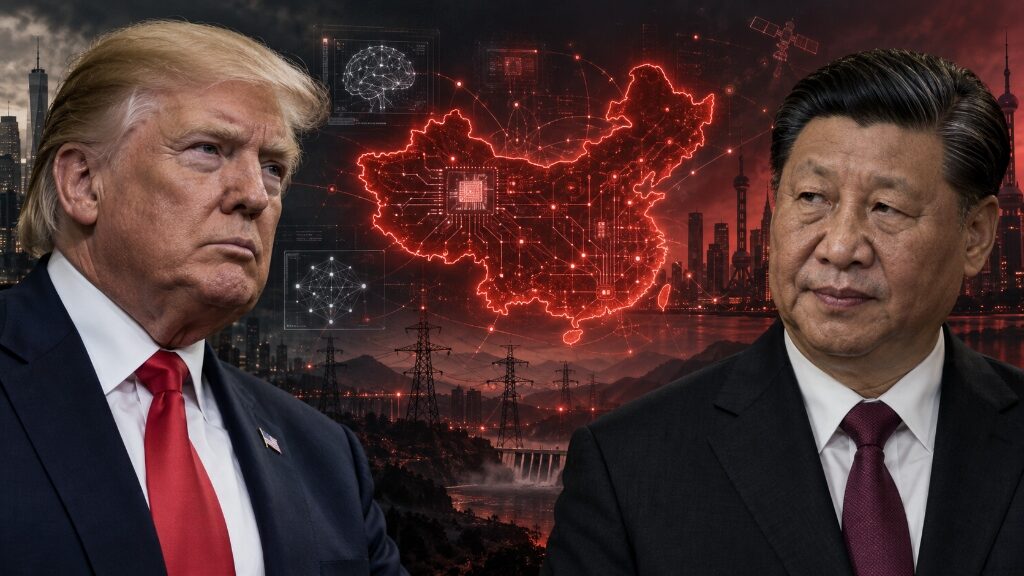

Donald Trump’s warning that “whoever wins AI wins everything” was treated in Washington as an industrial rallying cry for $100 billion megaclusters. In Beijing, it was received as a permanent operational doctrine. While the United States preserves a distinct six-to-twelve-month lead on raw frontier reasoning models, China has deployed an overwhelming open-weight swarm. Backed by a 9,450 TWh electric grid producing energy at one-third the cost of Western utilities, an alliance of Chinese labs—DeepSeek, Alibaba Qwen, Zhipu AI, MiniMax, Xiaomi, Moonshot, Tencent, and Baidu—is shipping world-class open models at industrial velocity, systematically commoditizing Silicon Valley’s closed APIs.
The Strategic Divergence: Closed Fortress vs. The Open Swarm
When the history of the semiconductor and artificial intelligence rivalry is written, the central strategic error of Western policymakers will not be that they underestimated Chinese talent. It will be that they misunderstood the asymmetry of technological containment. Washington calculated that cutting off access to Nvidia’s flagship Blackwell and Hopper accelerators would freeze Chinese capabilities inside a 2022 performance envelope. If China could not legally buy the silicon required for dense 100,000-GPU superclusters, the logic went, American frontier labs would enjoy an unassailable multi-generation monopoly.
That assessment accurately captured the silicon bottleneck, but it completely misjudged the structural response. Cut off from Western wafer fabs, Beijing did not surrender the frontier. Instead, Chinese institutions recognized the exact terms laid out by Donald Trump’s zero-sum framing: if winning AI dictates the geopolitical balance of the 21st century, relying on foreign technology was an existential vulnerability. China mobilized its entire industrial apparatus to build an alternative path.
The result is the most pronounced structural divergence in the history of software. The United States built a Closed Fortress: three to four heavily capitalized titans—OpenAI, Anthropic, and Google DeepMind—locking their frontier checkpoints behind subscription paywalls, restrictive APIs, and multi-billion-dollar hyperscaler agreements. They maintain a visible six-to-twelve-month lead on bleeding-edge reasoning and autonomous agent orchestration. But outside that gated garden, China deployed an Open-Weight Swarm. Across Hangzhou, Beijing, Shanghai, and Shenzhen, at least eight premier research institutions and corporate champions are releasing open, self-hostable models that match closed Western baselines at 95% lower operational cost.
| Structural Vector | United States (Closed Frontier Fortress) | China (The Open-Weight Swarm) | Geopolitical & Systems Reality |
|---|---|---|---|
| Frontier Capability Horizon | 6 to 12 Months Ahead: Superior multi-step reasoning, theorem proving, and frontier alignment (o1/o3, Claude 3.5 Sonnet) | Rapid Fast-Follower Parity: Matches 95% of practical benchmarks across coding, tool use, and multimodal generation | The raw reasoning lead exists, but the enterprise utility gap has collapsed |
| Primary Lab Density | 3 to 4 Oligopolists: OpenAI, Anthropic, Google DeepMind, and Meta (Llama) | 8+ Hyper-Competitive Labs: DeepSeek, Alibaba Qwen, Z.AI, MiniMax, Xiaomi, Moonshot, Tencent, Baidu | China’s domestic competition produces relentless, multi-vector weekly releases |
| Distribution Architecture | Proprietary closed APIs, usage metering, and walled enterprise clouds | Permissive Open Weights: Apache 2.0 / open research licenses on Hugging Face and ModelScope | Global developers adopt open weights to avoid vendor lock-in and US export risk |
| Underlying Grid Capacity | ~4,300 TWh generation; 5-to-7-year transmission queues; $0.12/kWh industrial power | 9,450+ TWh generation; ±1,100kV UHV transmission; $0.033/kWh compute tariffs | China turns surplus electrons into cheap inference tokens at scale |
| Hardware Economics | Unconstrained Nvidia B200 access, but burdened by $50B+ cluster Capex | Sanctioned; forced to innovate in Mixture-of-Experts (MoE) and low-rank latency | Scarcity forced Chinese software to operate with 90% higher memory efficiency |
Interactive Dashboard: China’s Geographic AI Hubs vs. The US Frontier
The interactive scroll visualization below exposes the structural asymmetry confronting the West. As you scroll through the section, observe how China’s distributed energy grid mobilized eight concurrent open-weight champions (from DeepSeek and Qwen to Z.ai, MiniMax, and Xiaomi), counterbalancing the four concentrated closed pillars of America’s frontier fortress.
The Asymmetric Arena: 8-Lab Open Swarm vs. 4 Closed Titans
Scroll through to observe how China’s distributed energy grid mobilized eight concurrent open-weight champions, counterbalancing the four concentrated pillars of America’s closed frontier.
Flooding global repositories with open weights (DeepSeek-V4.1, Qwen 3.8-Max, Z.ai GLM-5.3) to drive compute margins to zero and force Western models into defensive commoditization.
Maintains a proprietary reasoning lead (OpenAI GPT-6 / o3, Claude Sonnet 5, Grok 4.7) monetized through exclusive cloud APIs and hyperscaler clusters.
How the 8 Champions Are Dismantling the Closed Software Moat
What makes China’s AI offensive lethal to Silicon Valley’s business model is not that any single Chinese lab has eclipsed OpenAI or Anthropic in isolation. It is that the collective division of labor across eight institutions covers every commercial surface area simultaneously. While American executives debate whether to release open weights, Chinese labs operate with zero hesitation, using open models as an asymmetric wedge to destroy Western pricing power.
On the mathematical and reasoning front, DeepSeek and Moonshot AI (Kimi) shattered the assumption that test-time reasoning required tens of thousands of Blackwell GPUs. DeepSeek’s invention of Multi-Head Latent Attention and DualPipe MoE compressed memory overhead by over 90%, proving that models like DeepSeek-V3 and R1 could match OpenAI’s frontier reasoning for under $6 million. Concurrently, Moonshot’s Kimi K3 and k1.5 pioneered native million-token context windows and multimodal reinforcement learning from verifiable rewards, enabling enterprises to analyze entire technical codebases without paying proprietary cloud token taxes.
In developer workflows and agentic synthesis, Alibaba Cloud’s Qwen team established what is now the undisputed global standard in open-weights engineering. With Qwen 2.5-Coder and the 2.4-trillion-parameter Qwen 2.5-Max flagship, Alibaba produced architectures that independent benchmarks confirmed match Claude 3.7 Sonnet and OpenAI o3 across HumanEval and repository refactoring—while providing fully accessible open weights for self-hosting. By underwriting the open developer backbone for millions of engineers globally, Alibaba has turned Western closed coding subscriptions into an increasingly uncompetitive luxury.
In visual synthesis and multimodal interaction, the Western advantage eroded even faster. While OpenAI kept Sora barricaded behind closed waitlists and prohibitive compute bills, Zhipu AI (Z.ai) and MiniMax (Hailuo) open-sourced GLM-5/CogVideoX and released consumer diffusion architectures like MiniMax H3 (Hailuo 3) that deliver photorealistic physical simulation at scale. Simultaneously, Zhipu’s GLM-4-Voice and GLM-5.3 series delivered sub-200-token-per-second reasoning and native omni-modal execution, providing open alternatives to Western closed cloud suites months ahead of market expectations.
Finally, at the physical and industrial endpoints, Xiaomi, Tencent, and Baidu anchored the deployment pipeline. Xiaomi’s MiMo-V2.6 architecture pushed compressed omnimodal neural engines directly into hundreds of millions of HyperOS smartphones and electric vehicle cockpits, achieving sub-50ms local inference without pinging cloud servers. Meanwhile, Tencent’s Hunyuan Hy4 (770B MoE) and Baidu’s ERNIE 5.1 omni-modal foundation absorb billions of daily enterprise queries across domestic finance, e-commerce, and public infrastructure, hardening the national compute stack against external disruption.
The Energy Engine: Why China Can Sustain the Open Blitz
Western observers frequently ask how Chinese AI labs can afford to give away frontier-grade weights for free while American startups bleed billions in venture capital. The answer is not merely state subsidies; it is the physical architecture of the Chinese electric grid.
Artificial intelligence is fundamentally an energy conversion mechanism: it turns electrical watt-hours into probabilistic tokens. In 2024–2025, China generated over 9,450 Terawatt-hours of electricity—more than double the 4,300 TWh produced by the United States. In solar energy alone, China installs more generating capacity annually than the United States has built in its history. But China’s decisive engineering advantage is not just generation; it is transmission.
In the United States, datacenters in Northern Virginia or Texas face four-to-seven-year interconnection queues. American utilities cannot easily move power across regional boundaries due to fragmented grid operators (PJM, ERCOT, CAISO) and regulatory logjams. Hyperscalers are forced to purchase entire nuclear plants just to energize upcoming clusters, paying industrial electricity rates between $0.08 and $0.16 per kilowatt-hour.
China bypassed this constraint through its state-owned Ultra-High Voltage (UHV) DC grid (±800kV and ±1,100kV lines). Under the national “East Data, West Computing” (东数西算) initiative, stranded solar, wind, and hydro power from western hubs like Xinjiang and Inner Mongolia is transmitted over 3,000 kilometers with less than 3% line loss directly to gigawatt-scale datacenter parks. Datacenter operators in Ulanqab pay 0.24 to 0.35 RMB/kWh ($0.033 to $0.048/kWh) with immediate state substation connectivity.
Because electricity is cheap and abundant, Chinese labs can absorb the electrical cost of continuous model pre-training and test-time reasoning loops that would bankrupt an unsubsidized Western startup. They do not need to monetize every generated token immediately through an API toll booth. They can afford to release open weights, capture global developers, and shift the competition to hardware ecosystems where China holds unmatched manufacturing dominance.
The Geopolitical Inversion: Washington’s Unintended Consequence
Donald Trump’s thesis was simple: whoever dominates artificial intelligence will command the commanding heights of global economic and military power. By imposing sweeping technology controls, the United States sought to ensure that dominance by weaponizing the semiconductor supply chain.
Yet the paradox of containment is that extreme pressure breeds extreme adaptation. Had Washington allowed China continued commercial access to Nvidia’s flagship silicon, Chinese tech giants would have happily remained dependent on American software stacks, paying billions to Santa Clara and building on CUDA for the next two decades. By taking Trump’s containment threats literally, Beijing forced its tech sector to build an independent, sovereign, and hyper-efficient computing stack.
The United States still possesses the world’s most capable single models. OpenAI and Anthropic remain six to twelve months ahead on the bleeding-edge reasoning frontier. But China has constructed something far more resilient to export controls: an open-weight swarm that makes intelligence a cheap, ubiquitous commodity. The West built the world’s most magnificent walled garden; China decided to flood the surrounding valley.
Frequently Asked Questions
Are US AI models still ahead of China?
Yes. American frontier labs like OpenAI, Anthropic, and Google DeepMind maintain a six-to-twelve-month lead on raw frontier reasoning, mathematical proof validation, and multi-step autonomous planning. However, Chinese labs have effectively closed the gap on practical application layers—dominating open-source coding, multimodal video, and on-device edge intelligence.
How does China’s energy advantage help its AI strategy?
China generates over 9,450 TWh of electricity annually (more than double the US total of 4,300 TWh) and connects western renewable power directly to compute parks at $0.03/kWh with zero interconnection queue delays, allowing Chinese labs to absorb the massive electrical cost of continuous test-time reasoning and open model pre-training.
Why is China releasing its best AI models as open weights?
Open weights function as an asymmetric strategic weapon. By open-sourcing models that match closed Western systems at near-zero marginal software cost, Chinese labs commoditize the software layer, capture global developers across Hugging Face, and neutralize the subscription pricing moats of US hyperscalers.
Which Chinese AI labs form the core of the open-weight swarm?
The primary vanguard consists of DeepSeek, Alibaba Cloud (Qwen), Zhipu AI (Z.AI), MiniMax (Hailuo), Xiaomi (MiMo), Moonshot AI (Kimi), Tencent (Hunyuan), and Baidu (ERNIE).