

Long-range Ukrainian one-way attack drones struck two of Yandex’s five primary national hyperscale data centers on October 8 and 9, 2026, knocking out 40% of the company’s operational compute footprint. The kinetic strikes hit facilities in Sasovo and Kaluga, disabling two of the three sovereign AI training supercomputers utilized for YandexGPT and the Alice conversational platform. Because Western export bans bar Russia from acquiring replacement Nvidia H100 accelerators and InfiniBand fabrics, physical infrastructure damage has triggered permanent computational depreciation.
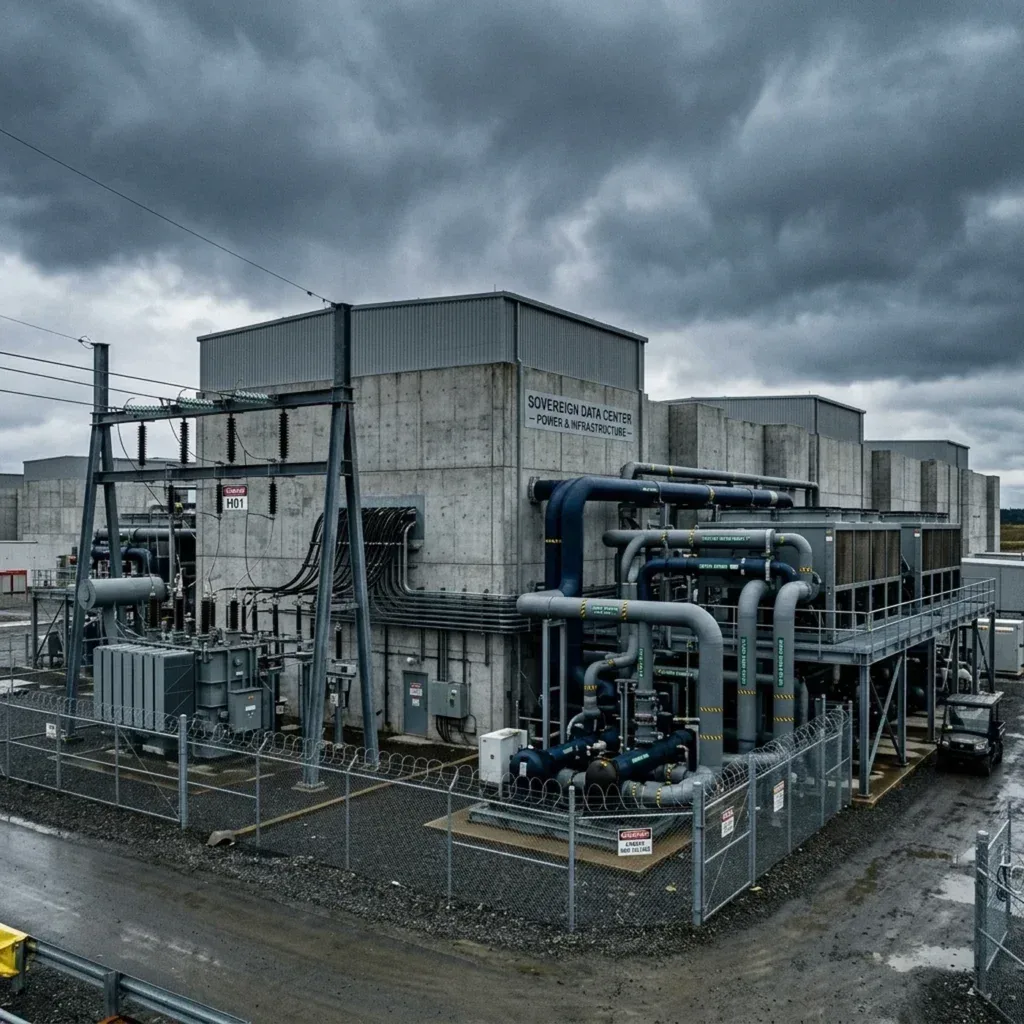
The attacks targeted the physical dependencies that hyperscale campuses cannot bury or armor: external electrical substations and roof-mounted chilled-water loop assemblies. At the Sasovo campus in the Ryazan region, loitering munitions struck the primary 110 kV step-down transformer yard and external chiller piping headers. Without active coolant circulation, high-density server racks housing liquid-cooled Nvidia A100 and H100 tensor core GPUs experienced immediate thermal runaway. Die temperatures crossed the 95°C silicon throttle ceiling within 45 seconds of circulating pump failure, triggering automatic emergency thermal shutdowns across more than 3,000 accelerator nodes.
The resulting service degradation severed critical enterprise operations across the Russian Federation. Outages struck Yandex Cloud Infrastructure-as-a-Service, Yandex Go autonomous fleet dispatch, Yandex Music, and consumer search indexing. Cascading API failures disrupted external third-party systems that depend entirely on Yandex Cloud, including Russian Railways ticketing platforms and cellular carrier MegaFon.
The Single Point of Failure in Chilled-Water Topologies
Modern AI training clusters operate at power densities that expose fatal architectural compromises. While standard enterprise web-hosting racks dissipate between 8 kW and 15 kW, high-density AI accelerator pods housing Nvidia HGX H100 systems demand between 40 kW and 100 kW per rack. At this thermal scale, air cooling is physically inadequate; facilities must rely on closed-loop liquid-to-air cooling manifolds connected to rooftop evaporative chillers or dry coolers.
When tactical munitions compromise external cooling loops, redundant multi-zone power distribution cannot protect the silicon. An HGX H100 chassis containing eight SXM5 GPUs generates approximately 10.2 kW of localized heat flux. In a typical liquid-cooled pod, cooling distribution units (CDUs) pump treated water at 25°C to 30°C through micro-channel cold plates directly attached to the GPU lids. The fluid absorbs heat, rising to 45°C before exiting the building to rooftop cooling towers.
If shrapnel punctures outdoor manifold piping, hydraulic pressure collapses across the secondary loop. Even if backup diesel rotary uninterruptible power supplies (DRUPS) keep the server logic boards energized, the loss of fluid pressure triggers hardware-level interlocks. Silicon thermal sensors embedded in the GPU cores detect the instantaneous loss of heat dissipation capacity and initiate hardware thermal trip interrupts (THERMTRIP#) to prevent physical die cracking from thermal shock.
Standard cloud availability architectures assume that hardware failures occur at the server, rack, or top-of-rack (ToR) switch layer. Cloud providers mitigate these events through Multi-Availability Zone (Multi-AZ) replication and automated workload migration. However, Multi-AZ topologies fail when coordinated kinetic strikes hit multiple regional data centers within a 24-hour operational window. Workloads scheduled to failover from the Sasovo facility to Kaluga encountered a second kinetic strike, overwhelming remaining capacity at the Moscow and Vladimir campuses.
The Sanctions Asymmetry: Irreplaceable Compute Attrition
The critical difference between peacetime infrastructure disasters and kinetic strikes under wartime trade embargoes is the irreversibility of component loss. In Western hyperscale facilities operated by AWS, Google, or Microsoft, a destroyed chiller yard or burned transformer substation is remediated through modular equipment replacement within days, with damaged server blades swapped from regional warehouse buffers.
For Yandex, the destroyed hardware cannot be lawfully imported or replenished. The A100 and H100 GPUs powering Yandex’s flagship supercomputers were acquired prior to comprehensive export controls or routed through high-cost, third-country grey-market conduits with severe latency and volume constraints.
High-speed interconnect hardware represents an even steeper bottleneck than the accelerator dies themselves. Distributed LLM pre-training across thousands of GPUs depends on non-blocking rail-optimized fabrics built with Mellanox Quantum-2 InfiniBand switches and optical transceivers capable of 400 Gb/s per port. When explosive detonations rupture fiber cable trays, bend liquid-cooling headers, and spray conductive soot into pressurized server halls, the damage extends beyond the chassis directly struck by munitions. Corrosive smoke particles deposit acidic chlorides across motherboard printed circuit boards (PCBs), causing dielectric breakdown and permanent signal integrity loss across high-speed PCIe 5.0 and NVLink copper traces.
While parallel defense architectures have attempted to shield frontline systems through autonomous counter-unmanned aerial systems—similar to the tactical verification layers analyzed in our teardown of NATO Drone Wall counter-UAS sensor grids—commercial data centers possess immense radar and thermal cross-sections that cannot be masked. Facilities spanning tens of hectares cannot deploy active kinetic air defense batteries without regulatory coordination and severe military resource trade-offs.
The Thermodynamics of Destruction
The vulnerability of modern hyperscale computing can be quantified through thermal dissipation kinetics. When liquid coolant circulation ceases, the thermal gradient across the accelerator stack follows the governing conduction and convection relationship:
Thermodynamic Failure Mode: For an Nvidia H100 SXM5 operating at PGPU = 700 W, steady-state liquid cooling maintains Tfluid at 35°C with combined thermal resistance of 0.080 °C/W, stabilizing die temperatures at 91°C. When external chiller manifolds rupture, coolant stagnation causes boiling within 8.2 seconds; vapor film insulation increases case-fluid resistance by 400%, pushing junction temperatures past 125°C and causing emergency hardware shutdown.
Under steady-state pumped flow at 1.5 liters per minute per cold plate, fluid temperature remains at approximately 35°C, holding GPU junction temperature at roughly 91°C. The moment external chiller manifolds rupture and fluid flow drops to zero (ṁ = 0), the stagnant coolant volume inside the copper cold plate (roughly 45 milliliters) reaches boiling temperature within 8.2 seconds. Once boiling occurs, vapor film insulation causes thermal resistance to surge, driving silicon junction temperatures past 125°C and triggering catastrophic thermal trip interrupts or irreversible junction delamination.
The Sovereign Compute Fork: Dispersal vs Gigawatt Centralization
The destruction of Yandex’s primary supercomputing nodes exposes a structural flaw in the trajectory of global AI infrastructure. Over the past three years, frontier AI labs and cloud hyperscalers have pursued massive centralized campuses—concentrating tens of thousands of accelerators into 50 MW to 100 MW facilities to minimize InfiniBand optical fiber run lengths and maximize inter-GPU all-reduce bandwidth.
As we explored in our forensic investigation of OpenAI’s 10 GW ASIC alliance, hyperscalers are planning multi-gigawatt power topologies to support frontier scaling. Yet high physical concentration transforms compute power into an asymmetric target. A single long-range loitering munition carrying a 20-kilogram shaped charge can incapacitate a 50 MW facility by severing its primary transformer bushings or chilled-water pumps, neutralizing hundreds of millions of dollars of compute capital in a single detonation.
Just as modern military forces discovered that wireless electronic warfare jammers fail against wired, non-radiating guidance systems—a vulnerability detailed in our technical breakdown of fiber-optic FPV drone guidance and jamming immunity—civilian data center operators are learning that software redundancy cannot substitute for physical survivability. When RF jammers prove ineffective, electromagnetic pulse weapons like those analyzed in DRDO Project SHIELD’s high-power microwave systems represent the outer envelope of facility defense, yet civilian installations remain completely unprotected.
For nations and enterprises operating under sanctions or conflict conditions, the era of massive centralized compute campuses is ending. The emerging doctrine demands sovereign compute dispersal: distributing training and inference workloads across geographically dispersed micro-clusters connected by low-latency optical rings, incorporating subterranean cooling reservoirs, and engineering model architectures that tolerate network-partitioned asynchronous gradient synchronization. Until those architectures mature, sovereign AI remains strictly as resilient as the exposed copper pipes on its data center roofs.
Frequently Asked Questions
Why did drone strikes on cooling systems force emergency shutdowns of Yandex’s AI supercomputers?
Modern Nvidia H100 GPU clusters generate upwards of 10 kW per server chassis and 100 kW per rack, making air cooling impossible. When kinetic strikes ruptured outdoor chilled-water piping and pumps at the Sasovo campus, cooling distribution units (CDUs) lost hydraulic pressure. Without fluid circulation, stagnant coolant inside micro-channel cold plates reached boiling temperature in seconds, causing thermal sensors to trigger automatic hardware thermal trip interrupts (THERMTRIP#) to prevent silicon die destruction.
How do Western sanctions convert physical data center damage into permanent compute loss?
In Western facilities, damaged equipment is replaced within 48 hours under OEM warranties. For Russian operators under comprehensive semiconductor embargoes, Nvidia A100/H100 GPUs and Mellanox 400 Gb/s Quantum-2 InfiniBand switches cannot be legally imported or replaced at scale. Grey-market replacement channels are prohibitively expensive and severely constrained in volume, turning physical hardware destruction into permanent compute capacity depreciation.
Why do Multi-Availability Zone (Multi-AZ) cloud failovers fail during coordinated drone strikes?
Multi-AZ cloud architectures assume isolated, uncorrelated component failures (such as a single power circuit or fiber cut). When long-range drones strike multiple regional facilities—such as Sasovo in Ryazan and the Kaluga campus within the same 24-hour window—workloads attempting to failover from one zone find the target zone equally disabled, cascading into national-scale cloud outages across transport, banking, and communications infrastructure.