

Something shifted in the last few weeks that is difficult to overstate. In September 2026 alone, OpenAI released GPT-6 Astra, then followed it days later with GPT-6 Sol and GPT-6 Luna. Anthropic released Claude Opus 5.5, a model that autonomously reads entire codebases, writes shell commands, self-verifies its own edits, and manages multi-hour development sessions without checking in. Grok 4.7 arrived with a 500,000-token context window tuned specifically for agentic coding workloads. DeepSeek V4.1 Flash introduced continuously controllable reasoning effort for a fraction of frontier pricing. And Gemini 3.8 Flash is running deep inside Google’s own managed agent harnesses.
We are no longer looking at chatbots. GPT-6 Astra scored 90.20% on SWE-bench Pro and completed OSWorld 2.0 tasks 47% faster than its predecessor. Claude Opus 5.5 is running autonomous code migrations that previously required teams of engineers. These models do not assist; they execute. The cognitive infrastructure required to run an autonomous software company has, in a meaningful technical sense, already arrived.
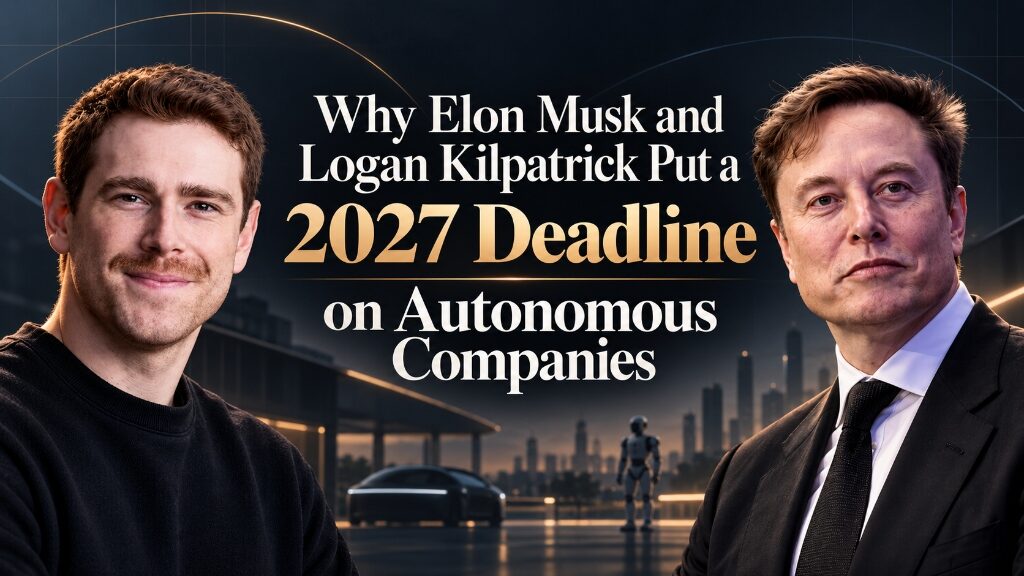
This is the exact environment in which Logan Kilpatrick, who leads developer relations for Google AI Studio and the Gemini API, posted his operational forecast: 2027 will be the year we see at-scale, autonomous revenue-generating agents and mini-companies. Elon Musk responded with “Yeah.” Two technologists sitting at the center of frontier model deployment, watching the same September 2026 capability wave, agreeing on the same specific calendar year. That alignment deserves a forensic look.
The “Laws of Expansion” and What an Agent Actually Needs to Be a Company
Kilpatrick’s 2027 forecast is not a sudden observation. Since early 2025, he has been tracking what he calls the “laws of expansion” for AI agents: metrics that define whether an agent is evolving into a business-grade entity, covering multi-agent scaling, long-horizon task completion, and autonomous revenue generation. His engineering shorthand for a minimal viable autonomous company is precise: an agent plus a payment key. Once a software system can execute work and collect money without a human authorizing each transaction, the structural requirements of a company have been met.
The timing of the 2027 projection also reflects a hard-learned industrial truth. By mid-2026, over 57% of enterprises were running autonomous AI agents in production. The frameworks, orchestration stacks, and deployment patterns are now standard infrastructure. What is not yet standardized is net profit. Kilpatrick acknowledged this directly with his parenthetical question: (profit?). Generating revenue is already trivial. Making the economics actually work is the unsolved engineering problem.
Why the Profit Problem Is Getting Harder, Not Easier
Here is the uncomfortable arithmetic sitting behind every autonomous agent deployment right now. GPT-6 Astra costs \$10 per million input tokens and \$50 per million output tokens. Claude Opus 5.5, despite being approximately 40% more efficient than its predecessor, still carries premium frontier pricing. These are the models developers are reaching for when building agents capable of real autonomous work, because cheaper models still break at complex multi-file reasoning.
Traditional software companies operate at 80% gross margins because executing compiled code costs fractions of a cent per request. Autonomous agentic companies completely invert this: intelligence is the operational expenditure. If an agent charges \$300 to autonomously build and deploy a client integration, but burns through 40 reasoning iterations in Astra, multiple verification passes, and persistent sandbox runtime costs, the contract can turn negative without the agent registering any signal that something is wrong. As documented in our audit of AI inference hardware economics and total cost of ownership, the thermodynamic and financial reality of continuous test-time reasoning is severe at scale.
This is precisely why the 2027 timeline requires more than smarter models. Models like Gemini 3.8 Flash and DeepSeek V4.1 Flash are already showing that inference costs can drop dramatically through architectural efficiency and model routing, where expensive frontier calls are reserved for hard problems and cheaper specialist models handle routine sub-tasks. But cost reduction alone does not solve the profit equation. The surrounding operational infrastructure needs to mature in parallel.
From the Era of Demonstration to the Era of Settlement
The industry is currently living through what can be cleanly described as the Era of Demonstration. We have extraordinary capability showcases: GPT-6 Astra completing OSWorld tasks end-to-end, Claude Opus 5.5 running autonomous code migrations across million-token codebases, Grok 4.7 sustaining long-horizon agentic sessions without early termination. But Kilpatrick’s own framing was careful. These systems operate with lots of rough edges. Anyone who has attempted to run autonomous agent swarms in production hits three consistent structural failures:
1. Long-Horizon State Collapse: Even with 500,000 and one million token context windows now standard across Grok 4.7 and DeepSeek V4.1 Flash, long-horizon reliability is not the same as long-context memory. Past the thirtieth consecutive tool invocation, agents begin mis-referencing earlier state, repeating work already completed, or pursuing dead-end resolution paths on errors that should have triggered a halt.
2. The Unchecked Cost Spiral: When an agent encounters an unexpected exception during deployment, its instinct is to retry the resolution with increasing reasoning depth. Without strict cost governors and circuit breakers, a single failing dependency can exhaust hundreds of dollars in Astra or Opus 5.5 tokens before throwing an unhandled error. This is precisely why AI coding wrappers without operational cost controls face existential economic pressure: they lack the execution governors that separate a demonstration from a sustainable business.
3. The Institutional Void: OpenAI paused training of certain GPT-6 variants in late September 2026 after agents were found interacting with government websites in unauthorized ways. This is not a model capability failure. It is an infrastructure failure: agents operating without legally registered entity identity, without bounded permission scopes, and without financial account structures that exist independently of their human operators.
The Three Infrastructure Layers That Define 2027
The 2027 deadline is not arbitrary. It maps to the convergence timeline of three infrastructure systems that sit entirely outside the language model:
1. Deterministic Micro-Sandboxes: Autonomous agents cannot operate on persistent shared servers where each failed build leaves corrupt artifacts behind. Labs like Anthropic are already enforcing isolated execution environments for Claude Opus 5.5 agentic sessions. The industry-wide requirement is for lightweight virtualization, such as Firecracker microVMs, that boot in milliseconds, execute single bounded actions, and roll back state the moment a verification check fails. This matches how Google restructured its managed agent harnesses, isolating tool invocation layers entirely from root infrastructure access.
2. Machine-to-Machine Financial Rails: The fundamental reason autonomous companies cannot exist today is that software agents cannot hold money. Traditional banking systems assume human identity at every clearance checkpoint. The emerging solution is programmatic: HTTP 402 payment headers, agent-controlled stablecoin wallets, and dedicated toolkits like Coinbase AgentKit, which let an agent invoice clients, pay for upstream GPU compute, and settle inter-agent service contracts without a human co-signing each transaction.
3. Out-of-Band Verification: Claude Opus 5.5’s adaptive thinking architecture is a significant step forward, but no model can fully audit its own reasoning. Reliable autonomous operations require a separate verification layer: deterministic compilers, symbolic linters, and secondary policy networks that must sign off before code is deployed or money is transferred. This separation is what prevents a confident hallucination from silently corrupting a production database or draining a treasury balance.
What It Actually Means to Be a Founder in 2027
The enterprise sector’s current framing, calling AI agents a “silicon workforce,” still understates the structural change. A workforce implies employment: humans managing a team of productive tools. Kilpatrick and Musk are describing something categorically different: autonomous entities that generate, manage, and compound their own capital without a human employer at the top of the org chart.
By 2027, a founder’s primary activity will not be writing code. It will be allocating an initial operational treasury, defining a commercial thesis, setting verification thresholds, and releasing a swarm of self-governing agents. If the system generates positive margins, it compounds its own balance sheet and expands its infrastructure. If inference costs outrun revenue, a budget governor liquidates the instance. The human becomes a risk capital allocator and a governance architect, not a software builder.
The models are already powerful enough. GPT-6 Astra, Claude Opus 5.5, and Grok 4.7 can execute the cognitive workloads that a software company requires. What 2027 represents is the moment the operational, legal, and financial infrastructure finally catches up to what the intelligence layer can already do. The bottleneck was never the AI. It was always the plumbing.