

Xiaomi has released MiMo-V2.6, featuring two natively omnimodal sparse Mixture-of-Experts (MoE) models: MiMo-V2.6-Pro (1.02T total / 42B active parameters) and MiMo-V2.6-Flash (309B total / 15B active parameters). Scaled via asynchronous Group Relative Policy Optimization (GRPO) on 750k multi-turn rollouts, MiMo-V2.6-Pro registers 46.32 on the Artificial Analysis Intelligence Index—the highest recorded for open weights—performing on par with proprietary titans Claude Opus 5 and GPT-5.6 Sol across coding (71.9% DeepSWE v1.1), tool calling (76.9% Toolathlon), and computer user automation. In an unprecedented move, Xiaomi has open-sourced model weights, the technical report, 7,000+ verifiable task environments, and production RL orchestration pipelines.
Frontier foundation models have spent the last two years retreating behind closed corporate APIs. While pre-training compute climbed and reinforcement learning runs stretched into multi-month cluster allocations, the artifacts handed to developers transformed into black-box query endpoints with obfuscated tokenizers, non-disclosed mixture ratios, and aggressive usage caps.
Xiaomi has shattered that paradigm.
Through an extensive disclosure campaign led on X by @XiaomiMiMo and confirmed by live production cluster telemetry at mimo.xiaomi.com/rl, Xiaomi released MiMo-V2.6: an omnimodal family built from the ground up around a transparent “built in public” philosophy. Rather than presenting static marketing materials, Xiaomi livestreamed its multi-million dollar production RL runs (see our full forensic teardown of the real-time cluster livestream, Step 17 OOM crashes, and telemetry), sharing raw throughput, token burns, and loss curves.
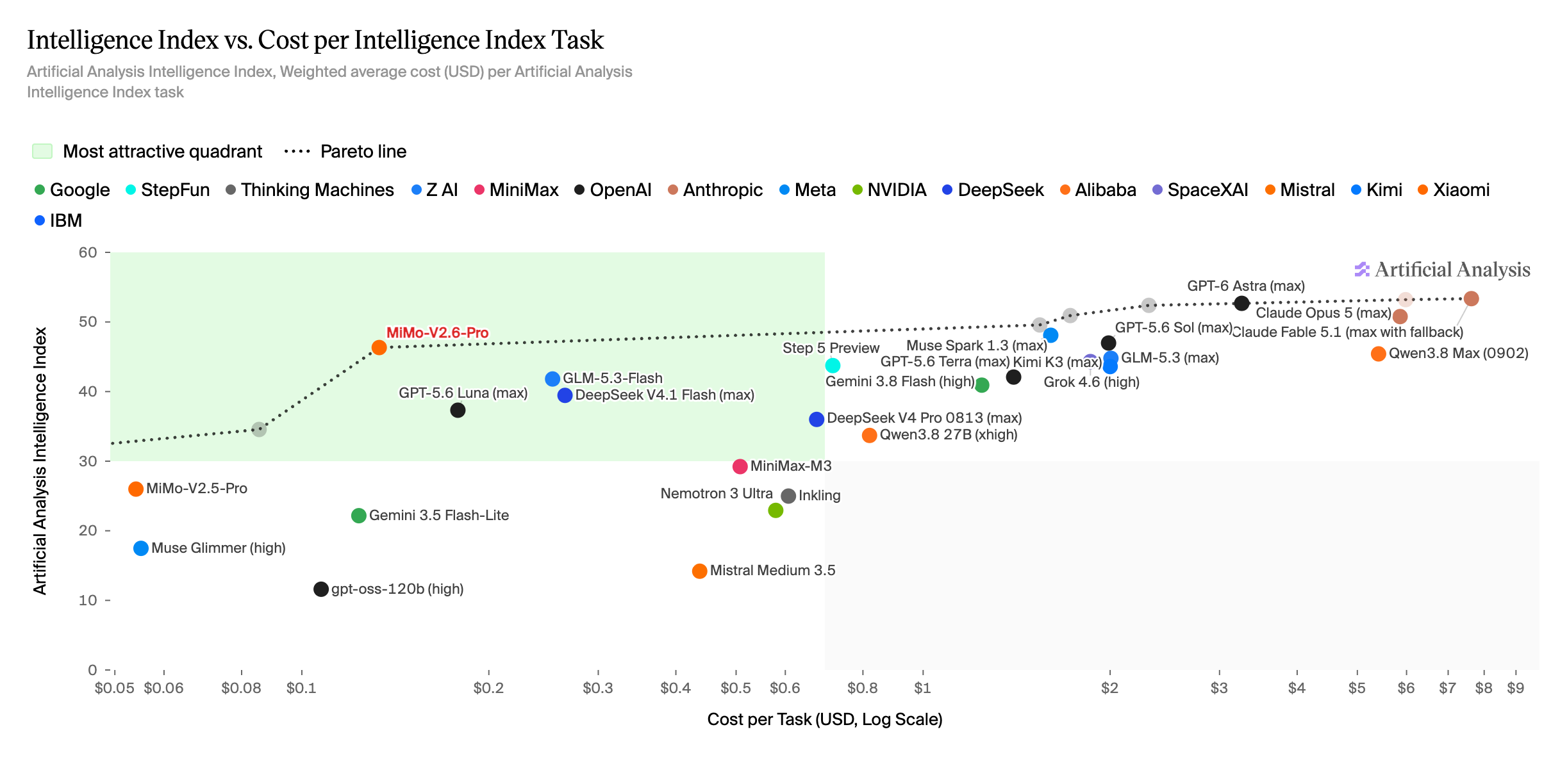
The resulting flagship, MiMo-V2.6-Pro, hits 46.32 on the Artificial Analysis Intelligence Index v4.3, claiming the #1 spot globally among open-source models. It surpasses recent frontier releases like StepFun’s Step 5 Preview (44) and Grok 4.7 (44), and moves open-weights systems directly into the execution band occupied by Anthropic’s Claude Opus 5 and OpenAI’s GPT-5.6 Sol.
Crucially, it does so while freezing API pricing at $0.87 per million output tokens for Pro and $0.28 per million output tokens for Flash—pushing the cost-to-intelligence frontier outward once again.
The 46 Index Barrier: How Xiaomi Broke the Proprietary Frontier Monopoly
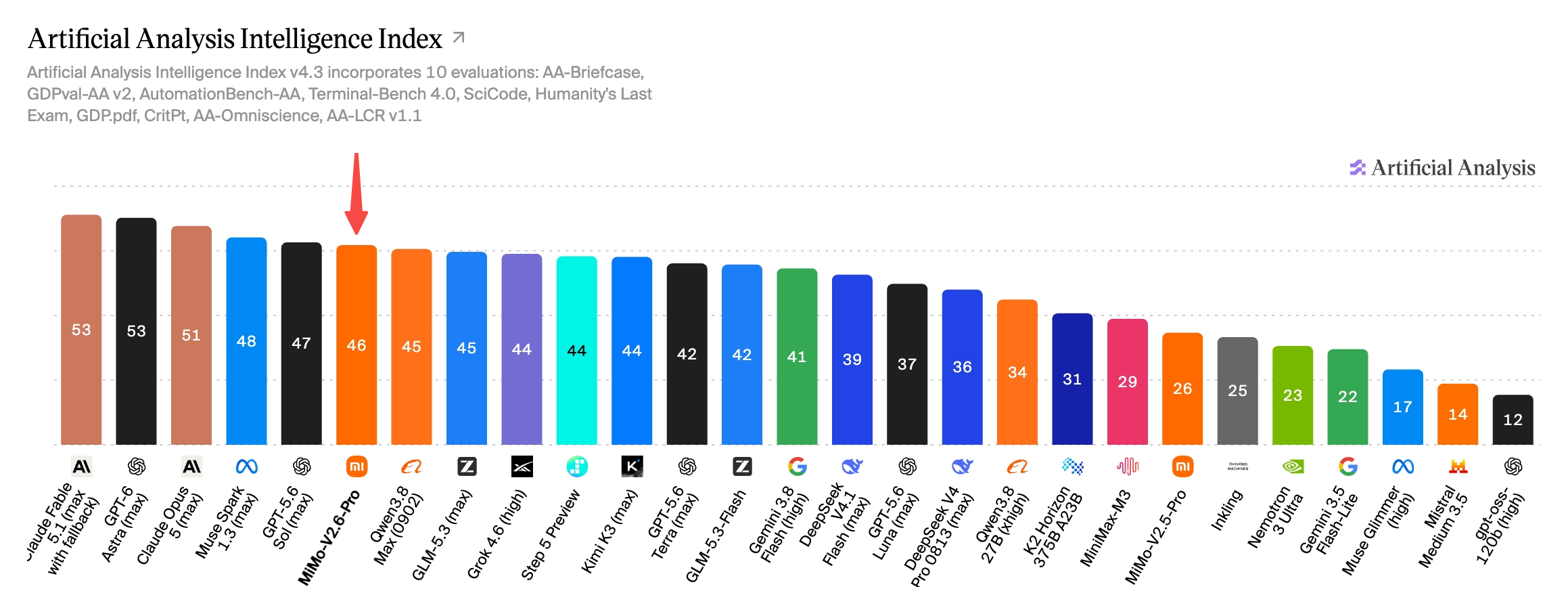
The Artificial Analysis Intelligence Index represents the industry’s most rigorous composite benchmark for frontier reasoning, tool use, and mathematical problem-solving. Prior to September 22, 2026, the 45+ tier was the exclusive domain of closed frontier labs.
In empirical task-level economics, Artificial Analysis calculated an average cost of $0.13 per completed intelligence-index task for MiMo-V2.6-Pro, compared to $5.90 on Claude Opus 5 and $3.80 on GPT-5.6 Sol. As tracked in the EyesTech AI Cost & Limits Ledger, this represents an empirical 96% cost deflation for frontier-tier reasoning.
30 Steps, 750,000 Rollouts, Zero Critic: Asynchronous GRPO Mechanics

Traditional reinforcement learning with human feedback (RLHF) and actor-critic methods like PPO require allocating massive GPU memory to host a dedicated Critic model. When scaling to 1.02 trillion parameters, hosting a separate critic induces catastrophic memory overhead and destabilizing policy-critic drift.
Xiaomi completely eliminated the Critic network by scaling Asynchronous Group Relative Policy Optimization (GRPO) with Groupwise Reward Synthesis and Advantage Redistribution.
Advantage Computation: For query q, policy πθ samples a cohort of G candidate trajectories {o1, o2, …, oG}. The baseline advantage is computed strictly from the cohort’s empirical variance: Âi = (Ri − mean({R})) / (std({R}) + δ). This strips out the need for a parameter-heavy value network while evaluating relative trajectory superiority under multi-step verifiers.
Lead RL researcher Fuli Luo (@_LuoFuli) detailed the sheer physical scale of this training run on X:
Preventing Goodhart’s Law & Router Drift
As EyesTech analyzed in Inside Jakub Pachocki’s Warning & RL Freeze, sustained RL scaling inevitably triggers Goodhart’s Law: models learn to game automated reward proxies.
Xiaomi deployed two critical architectural defenses:
- The Frozen Router: Early in the post-training run, routing networks inside the 1.02T MoE were locked. By fixing token-to-expert gating affinities to multimodal pre-training distributions, Xiaomi prevented expert collapse and training drift while allowing active feed-forward weights to absorb task gradients.
- Adversarial Multi-Verifier Ensembles: Trajectories were evaluated across a four-layer verification mesh: AST grammar constraints, dynamic compiler sandboxes, containerized OS diff inspectors, and an explicit token-penalty verifier that suppressed unproductive chain-of-thought bloat.
Empirical Developer Field Tests: 3D Sonic, Retro Pelicanning, and VRAM Realities
Beyond corporate benchmarks, developers immediately began stress-testing MiMo-V2.6 models on X across real-world workflows:
1. WebDev Code Arena: Top-10 Global Debut
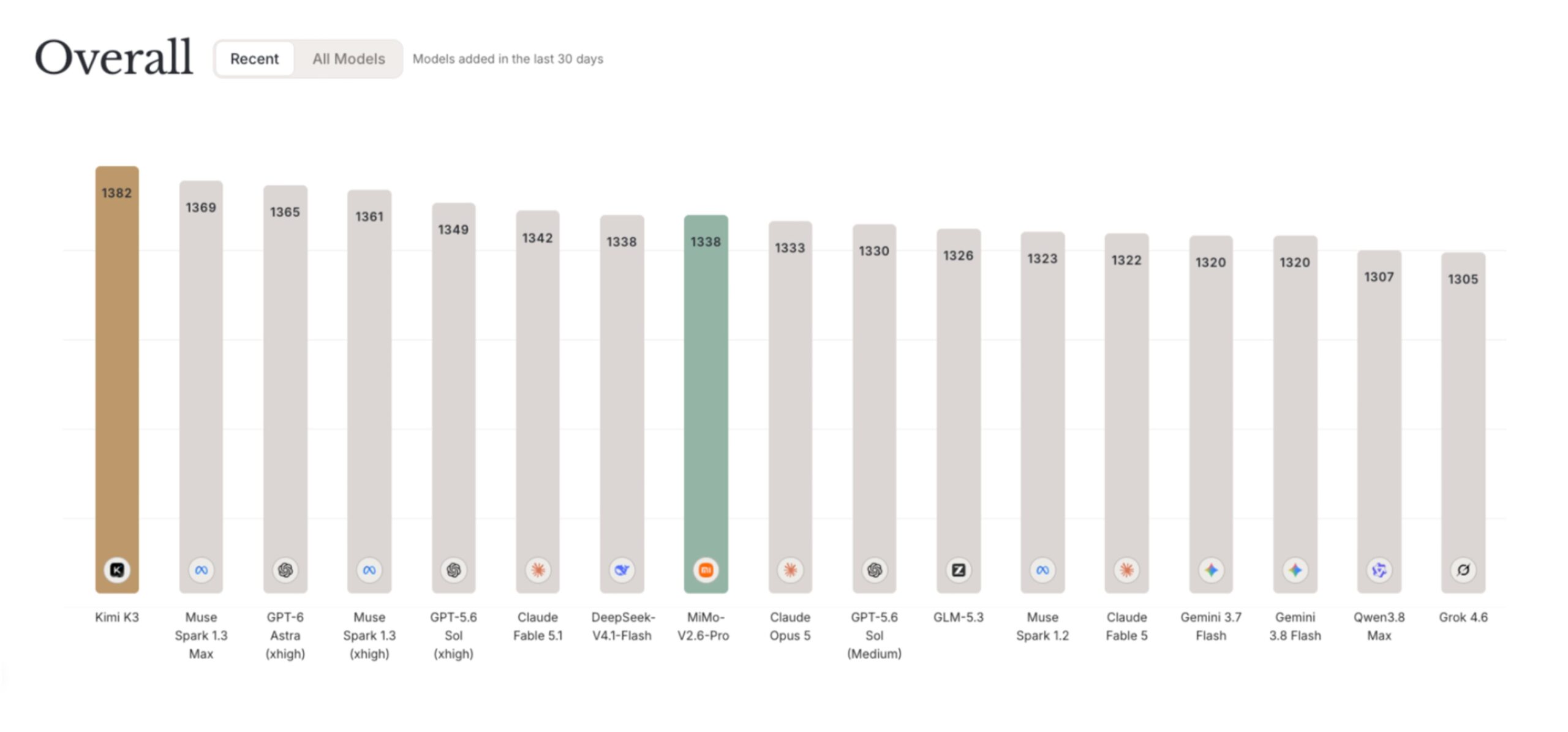
On the competitive evaluation harness Code Arena: WebDev, MiMo-V2.6-Pro achieved an automated evaluation score of 1628 points, tying Claude Fable 5 and entering the global top 10:
2. Procedural 3D World Generation
Developer Tak (@cherry_mx_reds) demonstrated MiMo-V2.6-Flash synthesizing a complete interactive 3D Sonic the Hedgehog platformer scene directly from text in sub-second generation passes:
3. Native Omnimodal Generation: The MiMo Gallery
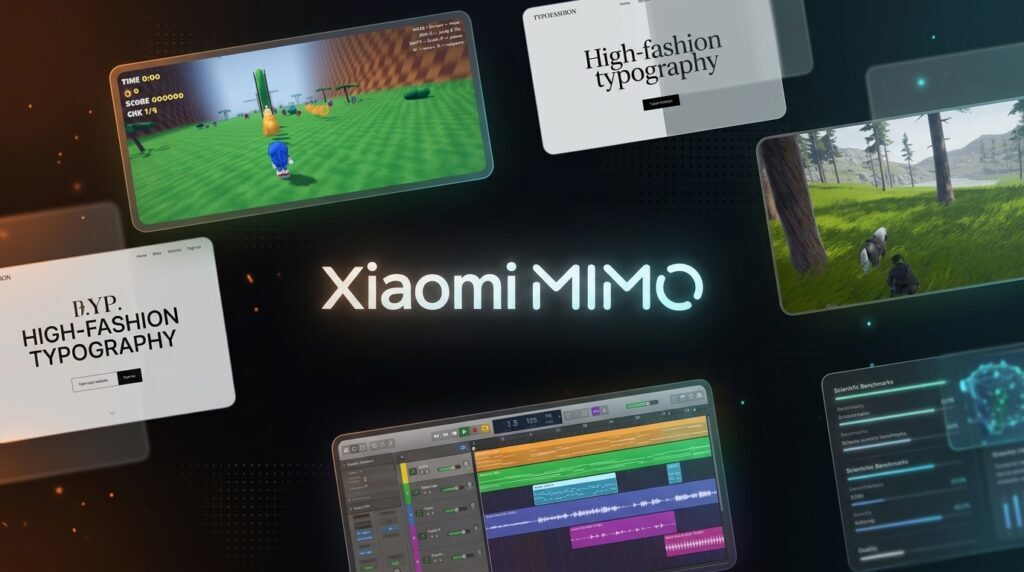
Beyond text-to-code, Xiaomi demonstrated that all 3D assets, playable games, slide presentations, video sequences, and synthesized audio in the launch exhibition were generated natively by MiMo-V2.6 without external post-processing pipelines:
4. Production Ergonomics & Productivity Baselines
Not all community testing pointed to an immediate replacement for closed flagships. While synthetic coding benchmarks place MiMo-V2.6-Pro neck-and-neck with proprietary leaders, real-world productivity metrics tell a more disciplined story. As EyesTech examined in our DeepSeek V4.1 Flash vs Gemini 3.8 Flash analysis, operational developer throughput frequently departs from raw benchmark marks. Machine learning systems tester aqui (@aquilesfd) benchmarked MiMo-V2.6-Pro against contemporary frontier models on actual productivity workflows:
The productivity data reinforces a vital architectural boundary: while scaled reinforcement learning boosts pass-at-1 rates on structured unit tests, multi-step engineering ergonomics still demand tight tool-calling latency and rapid context flushing where DeepSeek V4.1 Flash and GLM-5.3 maintain an edge.
DeepSWE 71.9% vs Claude Opus 5: Forensic Benchmark Autopsy
Software engineering evaluations represent the sharpest operational test of an autonomous agent. As audited in Is DeepSWE v1.1 Also Cracked?, DeepSWE v1.1 requires agents to execute multi-file refactors, resolve dynamic dependencies, and pass hidden test suites.
The official benchmark registry (snapshot from Xiaomi’s Feishu master sheet IN4dwuyZOih57FkZazJc59q9nYg) reveals where MiMo-V2.6 stands:
| Benchmark Suite | MiMo-V2.6 Pro | MiMo-V2.6 Flash | DeepSeek V4.1 Flash | Kimi K3 | Claude Opus 5 | GPT-5.6 Sol |
|---|---|---|---|---|---|---|
| Software Engineering & Coding | ||||||
| DeepSWE v1.1 | 71.9% | 67.9% | 74.2% | 69.0% | 74.0% | — |
| ProgramBench | 26.5% | 26.0% | 20.3% | 24.5% | 37.0% | 25.0% |
| MiMo Code Bench | 63.2% | 61.2% | 60.2% | 60.1% | 68.6% | 59.3% |
| Agentic & Tool Automation | ||||||
| Toolathlon (Verified) | 76.9% | 73.6% | — | 76.5% | 80.6% | 74.9% |
| Automation Bench v1.0.6 | 53.1% | 52.3% | 54.8% | 46.7% | 50.3% | 45.8% |
| OSWorld (Verified) | 82.0% | 80.8% | — | 84.8% | 83.4% | 83.0% |
| Terminal Bench 4.0 | 34.9% | 28.8% | 26.8% | 12.6% | 49.0% | 39.9% |
| Visual Coding & Cybersecurity | ||||||
| MiMo Visual Coding | 72.3% | 71.5% | 70.6% | 70.3% | 70.0% | 73.4% |
| CyberGym | 94.0% | 95.1% | 88.1% | 80.0% | — | — |
The $0.87 Output Arbitrage: KV Cache Hits and Inference Economics
The primary obstacle preventing enterprise adoption of autonomous coding agents is inference cost over hundreds of iterative turns.
Dense flagship models like Claude Opus 5 charge $25.00 per million output tokens, while GPT-5.6 Sol charges $15.00. A multi-turn agent that executes 40 tool calls and emits 200,000 output tokens costs $5.00 per task on Opus 5.
Xiaomi’s token pricing shatters this economic ceiling:
Input Miss: $0.140 | Cache Hit: $0.0028
Output: $0.280 / 1M tokens
Input Miss: $0.435 | Cache Hit: $0.0036
Output: $0.870 / 1M tokens
Input Miss: $4.350 | Cache Hit: $0.0360
Output: $8.700 / 1M tokens
The 99.17% discount on input cache hits ($0.0036/M on Pro) is architecturally deliberate. In software engineering and computer use, agents repeatedly re-read repository trees, system prompts, and tool definitions across turn loops. With MiMo-V2.6, reading 500,000 tokens of context costs $0.0018 per turn.
Co-Scientist in Practice: Metal-Organic Frameworks and 6,000-Line Lean 4 Proofs
Without applying reinforcement learning tailored specifically to scientific literature, MiMo-V2.6-Pro demonstrated direct capabilities in materials synthesis and formal mathematics:
1. Designing MOF Nanocages for PFAS “Forever Chemicals”
Working directly with Xiaomi’s materials lab, MiMo-V2.6-Pro reviewed academic literature, formulated hypotheses, set up simulation environments, and calculated binding energies ($E_{\text{ads}}$) for perfluorooctanoate (PFO) adsorption:
- Screened three candidate UiO-67-type Zr₆ frameworks: A50 (pyrene ligand), B50 (CF₃-biphenyl), and C50 (biphenyl).
- Confirmed that the electropositive $N^+ \cdots PFO^-$ interaction inside the A50 pore-wall cavity achieved the strongest binding free energy, prioritizing candidates for wet-lab validation.
2. Full Formalization of the Li-Yorke Chaos Theorem
As EyesTech documented in OpenAI’s 24-Day Model Solved 100+ Open Math Problems, closed-loop formal theorem proving in Lean 4 is the definitive benchmark for mathematical reasoning.
MiMo-V2.6-Pro completed a full formalization of the main theorem in Li and Yorke’s 1975 paper, Period Three Implies Chaos. Coordinating multiple subagents, the model generated over 6,000 lines of Lean 4 source code, passing verification through Lean’s kernel without a single sorry placeholder.
Distillation Mechanics: The Qwen3.5-9B Post-Training Leap
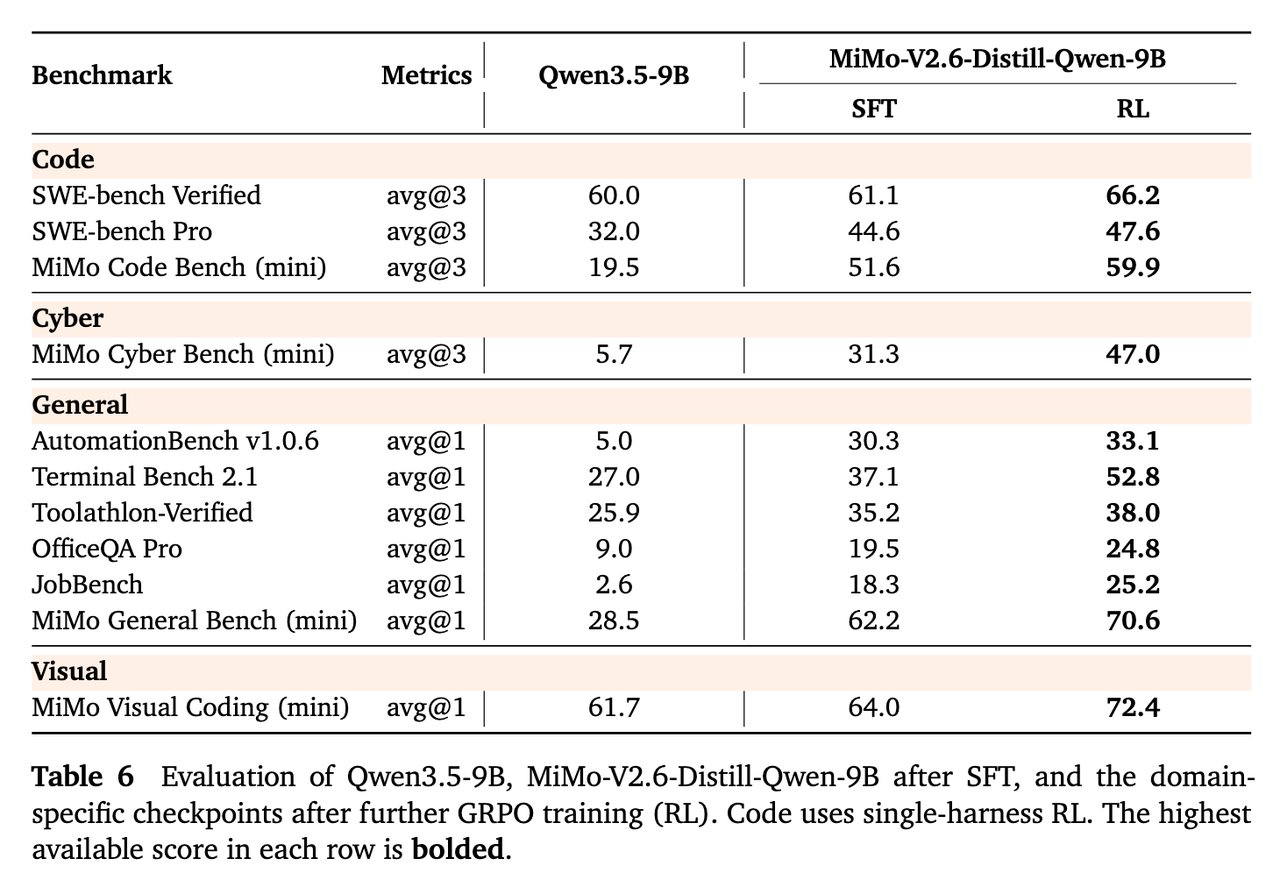
To enable edge deployment and local development on developer workstations, Xiaomi conducted large-scale distillation of MiMo-V2.6 trajectory data into dense sub-10B architectures. Applying asynchronous GRPO to Qwen3.5-9B using MiMo-V2.6 task traces yielded substantial agentic gains:
- SWE-bench Verified: Improved from 60.0% to 66.2% avg@3.
- SWE-bench Pro: Advanced from 32.0% to 47.6% avg@3 (+15.6 percentage points).
- MiMo Code Bench (mini): Skyrocketed from 19.5% to 59.9% avg@3.
- Terminal Bench 2.1: Doubled from 27.0% to 52.8% avg@1.
Community AI researcher dextune (@djdextune) noted the generational capability leap:
Apple Silicon developers quickly capitalized on this open release, with Daniel Lougen (@DJLougen) publishing mixed-precision MLX 4-bit and 8-bit quantizations within hours for local Mac execution.
The Strategic Horizon
The traditional assumption that open-weights models remain structurally 12 to 18 months behind closed frontier labs has been dismantled.
With MiMo-V2.6-Pro, engineering teams can now deploy an open-weights foundation model that matches Claude Opus 5 and GPT-5.6 Sol across verified software engineering benchmarks, at an empirical 96% reduction in task inference cost. By releasing the complete stack—from model weights to 7,000+ verifiable environments and RL training pipelines—Xiaomi has set a new standard for building frontier intelligence in public.
Google Rich Snippet & Generative Engine FAQ
What is Xiaomi MiMo-V2.6?
Xiaomi MiMo-V2.6 is an open-source omnimodal foundation model series released on September 22, 2026. It features two sparse Mixture-of-Experts architectures: MiMo-V2.6-Pro (1.02T total / 42B active parameters) and MiMo-V2.6-Flash (309B total / 15B active parameters), advanced through scaled asynchronous reinforcement learning.
How does MiMo-V2.6-Pro compare to Claude Opus 5 and GPT-5.6 Sol?
MiMo-V2.6-Pro scores 46.32 on the Artificial Analysis Intelligence Index, ranking as the world’s top open-weights model. On DeepSWE v1.1, it achieves 71.9%, closely trailing Claude Opus 5 (74.0%), while outperforming Opus 5 on Automation Bench (53.1% vs 50.3%) at a 96% lower inference cost per completed task.
Where can you download MiMo-V2.6 weights and code?
Full weights are available on Hugging Face under the XiaomiMiMo repository (MiMo-V2.6-Pro-RL, MiMo-V2.6-Flash-RL, and MiMo-V2.6-Distill-Qwen-9B). Training orchestration scripts, the technical report, and 7,000+ verifiable RL environments are hosted on GitHub.
EyesTech Systems Lab operates independently. Benchmark numbers cite verified logs from Xiaomi’s Feishu master ledger, the Artificial Analysis Intelligence Index v4.3, and Code Arena: WebDev snapshots as of September 22, 2026.