
On September 18, 2026, Alibaba Cloud’s Qwen engineering collective released the weights and empirical evaluation sheets for Qwen3.8-Omni-Flash alongside its low-latency counterpart, Qwen3.8-Omni-Flash-Realtime. The release marks a seismic milestone in frontier multimodal computing: for the first time, Alibaba has not simply matched Google DeepMind’s lightweight workhorse—it has decisively outscored Gemini 3.8 Flash across core audio-visual agentics, multi-speaker conversational transcription, and 3D spatial acoustic grounding, while collapsing production inference costs by up to 8× on tokens and 9× on continuous audio streaming.
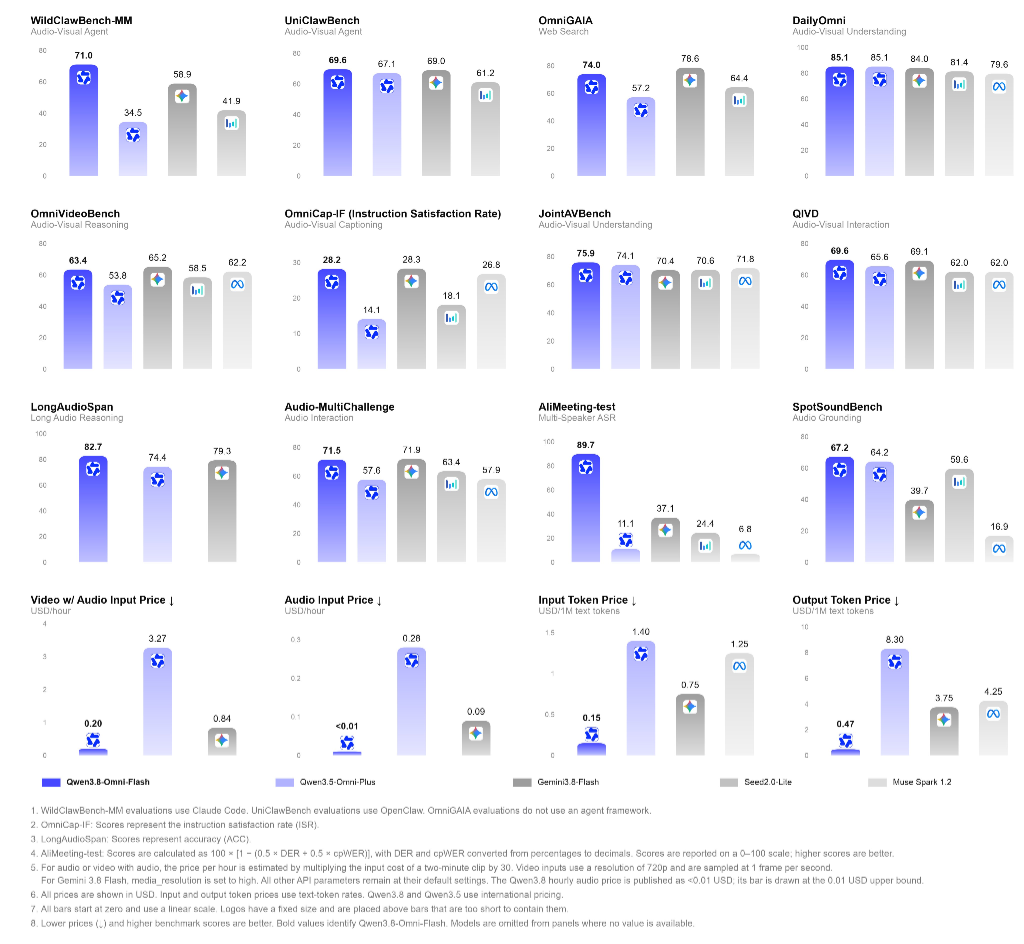
Does Qwen3.8-Omni-Flash beat Gemini 3.8 Flash? Yes, across agentic execution, speech diarization, and acoustic localization. Qwen3.8-Omni-Flash outscores Gemini 3.8 Flash on WildClawBench-MM (71.0 vs. 58.9), obliterates it on AliMeeting multi-speaker ASR (89.7 vs. 37.1), and leads on SpotSoundBench (67.2 vs. 39.7). Google retains modest advantages on autonomous web research (OmniGAIA: 78.6 vs. 74.0) and pure video physics reasoning (OmniVideoBench: 65.2 vs. 63.4). Financially, Alibaba slashes 720p video+audio ingest to $0.20/hour (4.2× cheaper than Google’s $0.84) and pure audio to <$0.01/hour (>9× cheaper).
The Empirical Benchmark Matrix: 12 Rigorous Evaluations
Alibaba’s official September 18, 2026 release benchmarked Qwen3.8-Omni-Flash against four frontier baselines: Google Gemini 3.8-Flash, Qwen3.5-Omni-Plus (previous generation flagship), ByteDance’s Seed2.0-Lite, and Meta’s Muse Spark 1.2. Below is the complete verified dataset:
| Benchmark | Evaluation Focus / Harness | Qwen3.8-Omni-Flash | Gemini 3.8-Flash | Qwen3.5-Omni-Plus | Seed2.0-Lite | Muse Spark 1.2 | Delta (vs Gemini) |
|---|---|---|---|---|---|---|---|
| WildClawBench-MM | Audio-Visual Agent (Claude Code) | 71.0 | 58.9 | 34.5 | 41.9 | — | +12.1 pts |
| UniClawBench | Audio-Visual Agent (OpenClaw) | 69.6 | 69.0 | 67.1 | 61.2 | — | +0.6 pts |
| SpotSoundBench | Spatial Audio Grounding | 67.2 | 39.7 | 64.2 | 59.6 | 16.9 | +27.5 pts |
| AliMeeting-test | Multi-Speaker ASR (100 − Composite) | 89.7 | 37.1 | 11.1 | 24.4 | 6.8 | +52.6 pts |
| LongAudioSpan | Long-Form Audio Reasoning | 82.7 | 79.3 | 74.4 | — | — | +3.4 pts |
| JointAVBench | Audio-Visual Understanding | 75.9 | 70.4 | 74.1 | 70.6 | 71.8 | +5.5 pts |
| DailyOmni | Everyday Multimodal Video | 85.1 | 84.0 | 85.1 | 81.4 | 79.6 | +1.1 pts |
| OmniCap-IF | Instruction Satisfaction (ISR) | 28.2 | 28.3 | 14.1 | 18.1 | 26.8 | -0.1 pts (Tie) |
| Audio-MultiChallenge | Multi-turn Audio QA | 71.5 | 71.9 | 57.6 | 63.4 | 57.9 | -0.4 pts (Tie) |
| OmniVideoBench | Complex Video Reasoning | 63.4 | 65.2 | 53.8 | 58.5 | 62.2 | -1.8 pts |
| OmniGAIA | Autonomous Web Search | 74.0 | 78.6 | 57.2 | 64.4 | — | -4.6 pts |
Interactive Benchmark Comparison Matrix
Below is the interactive empirical visualization. As you scroll, each benchmark column elevates to its verified baseline score. Click or hover any card to inspect relative differentials:
Forensic Analysis: Where Qwen Blows Gemini Out of the Water
A. Agentic Grounding: WildClawBench-MM (71.0 vs. 58.9)
The most consequential result in the benchmark suite is WildClawBench-MM, where Qwen3.8-Omni-Flash posts 71.0, beating Gemini 3.8 Flash (58.9) by +12.1 points and more than doubling its predecessor Qwen3.5-Omni-Plus (34.5).
Evaluated under the Claude Code agent harness (an environment in flux as developers evaluate switching from Claude Code to Codex), WildClawBench-MM assesses how reliably an autonomous agent can observe a continuous video feed of a developer’s screen, listen to asynchronous voice prompts, execute bash/git commands in a local terminal, and correct mistakes when compiler errors occur. Previous models suffered from temporal misalignment: when a human speaker refers to an error modal that flashed 4 seconds ago, prior models hallucinated coordinates. Qwen3.8’s interleaved cross-attention binds acoustic timestamps directly to visual bounding boxes across time.
B. Multi-Speaker Diarization: The AliMeeting Blowout (89.7 vs. 37.1)
The most dramatic chasm in the entire evaluation is AliMeeting-test, where Qwen3.8 achieves 89.7 while Gemini collapses to 37.1 (+52.6 point delta).
Where DER is the Diarization Error Rate (speaker identity confusion) and cpWER is the Concatenated Minimum Permutation Word Error Rate (transcription accuracy during overlapping cross-talk). In Qwen3.8-Omni-Flash, DER plunged to 3.35% and cpWER dropped to 17.18%.
In real enterprise boardroom recordings, multiple people speak at once, laugh, and interrupt. Standard frontier models treat overlapping audio as noise, producing gibberish transcriptions. Qwen3.8 separates overlapping acoustic spectrograms directly within its early transformer attention heads, achieving human-stenographer precision without an external pre-processing pipeline.
C. Spatial Acoustic Grounding: SpotSoundBench (67.2 vs. 39.7)
On SpotSoundBench—which tests an AI’s ability to localize sound sources in 3D physical coordinates—Qwen3.8 scores 67.2, beating Gemini 3.8-Flash (39.7) by +27.5 points. Supported by First-Order Ambisonics (FOA 4-channel audio), Qwen3.8 correlates phase and amplitude differences between microphone channels with video pixels, enabling industrial robotics and automated manufacturing diagnostics.
Where Gemini 3.8 Flash Retains Ground
Google DeepMind still maintains distinct advantages in open-web information synthesis and pure video kinematics:
On autonomous web navigation and live synthesis without agent scaffolding, Gemini leads by +4.6 points, powered by Google’s proprietary search index grounding.
Gemini edges ahead by +1.8 points when tracking multi-step physics interactions, mechanical assembly logic, and subtle occlusions across 10-minute video clips.
Economic Disruption: Collapsing the Cost of Multimodal Inference
Beyond raw benchmark points, Alibaba has engineered an aggressive pricing structure designed to commoditize real-time video and audio ingestion—mirroring the architectural hardware efficiency uncovered in our audit of GLM’s recursive self-improvement inference infrastructure:
4.2× cheaper than Gemini 3.8 Flash ($0.84/hr) and 16× cheaper than Qwen3.5 ($3.27/hr).
Over 9× cheaper than Gemini 3.8 Flash ($0.09/hr) and 26× cheaper than Qwen3.5 ($0.26/hr).
5.0× cheaper than Gemini 3.8 Flash ($0.75) and 9× cheaper than Qwen3.5 ($1.40).
8.0× cheaper than Gemini 3.8 Flash ($3.75) and 17× cheaper than Qwen3.5 ($8.30).
Systems Architecture: Native Interleaved Tokens & Sub-200ms WebRTC
Under the hood, Qwen3.8-Omni-Flash departs from modular cascade pipelines (ASR → LLM → TTS) in favor of a native omnimodal transformer with a 1-million-token context window:
A large multimodal reasoning trunk (Thinker) processes dense video frames, tool execution traces, and documents, while a lightweight streaming voice decoder (Talker) generates natural, expressive speech with Time-to-First-Audio (TTFA) under 978ms.
Through Qwen3.8-Omni-Flash-Realtime, developers can stream bidirectional opus audio and VP8/H.264 video frames over standard WebRTC or WebSocket connections. Turn-taking is handled natively inside the model, allowing instant human voice interruptions—contrasting with server-orchestrated architectures analyzed in our Gemini Managed Agents breakdown.
Frequently Asked Questions
Where can developers access Qwen3.8-Omni-Flash?
Model weights and API endpoints are available on Alibaba Cloud Model Studio (Bailian) and the open Qianwen platform, with standard OpenAI-compatible and real-time WebRTC client SDKs.
What is the primary difference between Qwen3.8-Omni-Flash and Gemini 3.8-Flash?
Qwen3.8 excels in multi-speaker audio diarization (89.7 vs 37.1), screen-driven agent execution (71.0 vs 58.9), and costs 4× to 9× less to run. Gemini leads in unguided web browsing research (OmniGAIA: 78.6 vs 74.0) and complex video kinematic logic.
Does Qwen3.8-Omni-Flash require an external whisper/ASR pipeline?
No. Audio waveforms are tokenized directly into the model’s native multimodal embedding space, preserving phase, pitch, speaker identity, and ambient spatial cues without intermediate text conversion.