

Step 5 Preview is StepFun’s flagship agentic AI model released on September 20, 2026. Built on a sparse Mixture-of-Experts (MoE) architecture activating 27B parameters out of 600B total per token, it pairs a 1M-token linear context window with native multimodal vision. Scoring 44 on the Artificial Analysis Intelligence Index to tie Kimi K3 Max, it shifts the Pareto frontier by executing long-horizon software engineering and financial workflows at an average task cost of ~$0.71 ($1.00/MTok input, $2.70/MTok output, $0.05/MTok cached prompt).
The announcement arrived on a Saturday morning in Shanghai without an embargoed press briefing or an executive keynote stream. StepFun—formally Shanghai Jieyue Xingchen Intelligent Technology Co., Ltd., founded in April 2023 by former Microsoft Asia Research Institute Vice President Jiang Daxin—shipped Step 5 Preview with quiet technical confidence. There is no conversational chatbot wrapper or waiting room. It is a purpose-built, high-iteration agentic engine designed to execute deep software engineering, complex financial modeling, and long-horizon knowledge retrieval without bankrupting the engineering teams running the loops.
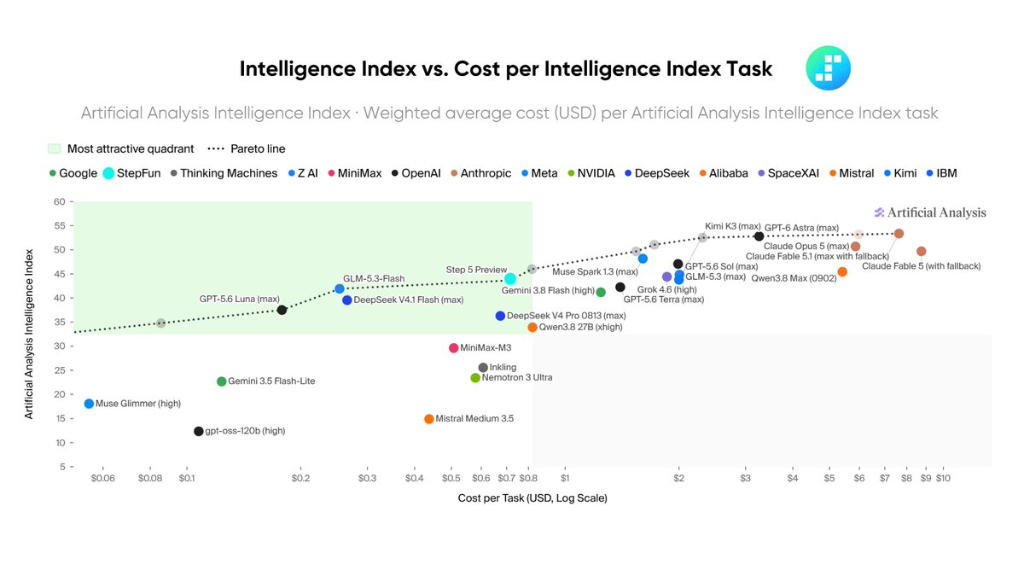
The fundamental barrier to autonomous agents has never been short-prompt reasoning; it has been the brutal mathematics of token compounding. When a coding agent inspects an abstract syntax tree, runs multi-file diffs, ingests compiler diagnostics, and retries failing integration tests over forty turns, inference bills on monolithic dense frontier models quickly balloon past $10 to $25 per resolved issue. Step 5 Preview enters the market with a verified quality score of 44 on the Artificial Analysis Intelligence Index—matching Kimi K3 Max—while delivering an average benchmark task cost of just $0.71.
The Pareto Frontier Shift: Dissecting the Intelligence-to-Cost Tradeoff
In multi-objective optimization, a model is defined as Pareto-optimal if no other competing system can deliver strictly greater capability at an equivalent or lower price point. For eighteen months, deploying frontier-grade agents meant choosing between two extremes: paying steep premiums for 400B+ dense models that maintained coherence, or watching lightweight models suffer catastrophic horizon decay after four turns.
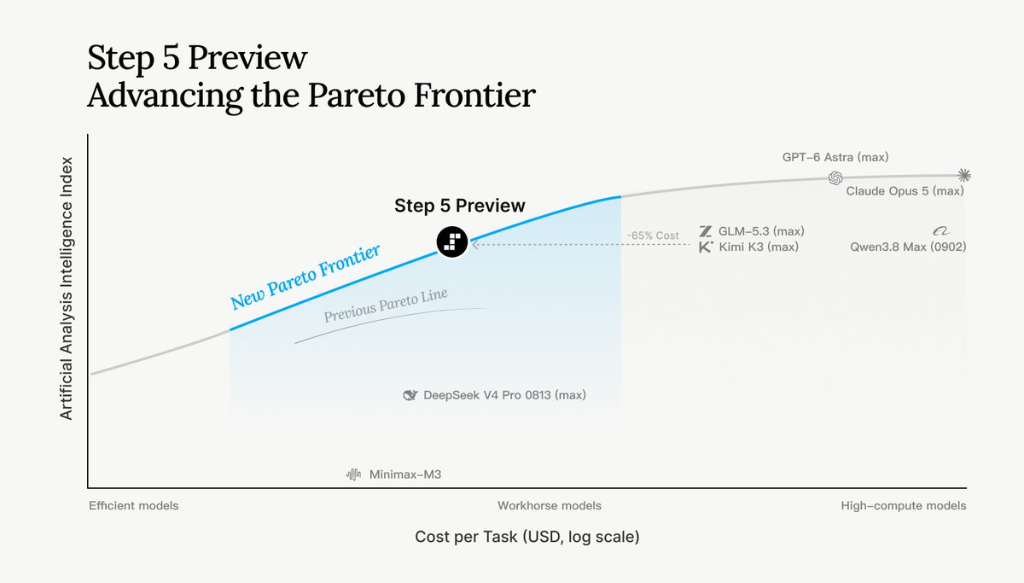
As plotted by independent evaluators at Artificial Analysis, the Pareto frontier at the 40–50 capability band was previously occupied by closed giants like Anthropic’s Claude series and OpenAI’s flagship models. Step 5 Preview redefines this boundary. It achieves parity with Kimi K3 Max (score 44) while slashing task expenditures by roughly 65% compared to legacy high-end baselines, creating an unprecedented economic opening for high-frequency agentic deployment.
Inside the 600B Total / 27B Active MoE Architecture
Mixture-of-Experts architectures have evolved from crude top-1 routing to fine-grained, load-balanced sparse routing. Step 5 Preview achieves its radical cost-to-intelligence ratio through an aggressive 4.5% activation ratio:
Stores encyclopedic world knowledge, obscure programming libraries, legacy frameworks, and niche financial accounting standards across jurisdictions.
Inference FLOPs, memory bus traversal, and decoding latency strictly scale against a compact 27B model, delivering lightning-fast token streaming.
Ingests full enterprise code repositories, 100+ page SEC filings, and extensive compiler execution traces without chunking or context clashing.
Cached input drops from $1.00 to $0.05 per MTok, making multi-turn agentic state re-evaluation economically negligible over 100+ turns.
In conventional dense transformers, every parameter participates in every token’s forward pass. In Step 5 Preview, a learned gating mechanism dispatches incoming tokens exclusively to the specialized expert sub-networks best suited for the prompt domain. When processing CUDA memory coalescing or Triton kernel syntax, code-specialized experts fire; when parsing GAAP-to-IFRS reconciliation tables, financial experts activate. This prevents expert collapse and allows the system to operate with the physical memory bandwidth footprint of a 27B model while leveraging the cognitive capacity of a 600B giant.
Tokenomics Breakdown: The Enterprise Cost Advantage
The real test of any foundation model targeting autonomous workflows lies in its serving economics. A comparison of published pricing across current frontier models reveals why Step 5 Preview changes developer calculus:
| Model & Organization | AA Intelligence | Input (Cache Miss) | Input (Cache Hit) | Output / MTok | Avg. Task Cost |
|---|---|---|---|---|---|
| Step 5 Preview (StepFun) | 44 | $1.00 / MTok | $0.05 / MTok | $2.70 / MTok | ~$0.71 |
| Kimi K3 Max (Moonshot) | 44 | $2.50 / MTok | $0.50 / MTok | $8.00 / MTok | ~$2.10 |
| Claude Opus 4.5 / 5 (Anthropic) | 45 | $15.00 / MTok | $1.50 / MTok | $75.00 / MTok | ~$6.80 |
| GPT-4o / GPT-6 Astra (OpenAI) | 41–42 | $5.00 / MTok | $1.25 / MTok | $15.00 / MTok | ~$3.40 |
| GLM-5.3-Flash (Z.AI) | 34 | $0.10 / MTok | $0.02 / MTok | $0.20 / MTok | ~$0.045 |
At $2.70 per million output tokens, a 100-turn software refactoring session generating 500,000 output tokens costs exactly $1.35 in generation fees. Combined with the $0.05 prompt cache hit rate, developers can maintain an entire 300,000-token repository in working context across hours of continuous tool calls without exceeding $2.50 for a completely verified, multi-file code repair.
Software Engineering Benchmarks: Resolving the Horizon Decay Problem
Standard code benchmarks like HumanEval or static LeetCode puzzles measure single-turn algorithmic synthesis. They provide zero telemetry on whether a model can navigate a complex Git repository, formulate an AST patch, interpret compiler backtraces, and verify its own unit tests.
The 67.7% score on DeepSWE v1.1 is particularly meaningful. DeepSWE was created specifically because SWE-bench Verified began saturating, with top models exploiting shallow single-file patch patterns. DeepSWE demands deep multi-file refactors and substantial line-count additions. Step 5 Preview demonstrates sustained execution stamina over these long horizons, preventing context drift across twenty or more consecutive terminal iterations.
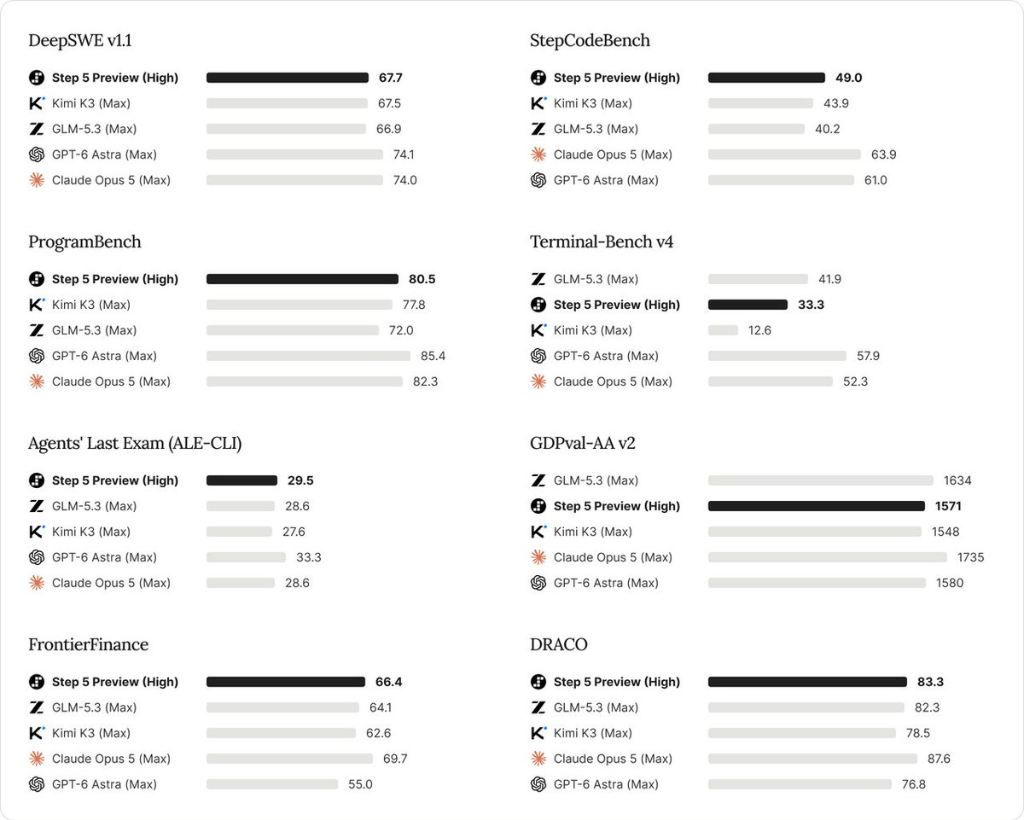
Across the broader 8-benchmark suite, Step 5 Preview demonstrates consistent advantages over its direct class peers. On StepCodeBench, it scores 49.0% (outperforming Kimi K3’s 43.9% and GLM-5.3’s 40.2%), while on ProgramBench it logs 80.5% (vs. 77.8% for Kimi K3 and 72.0% for GLM-5.3). In agentic command-line execution under Agents’ Last Exam (ALE-CLI), Step 5 Preview registers 29.5%, notably surpassing Claude Opus 5 (28.6%), GLM-5.3 (28.6%), and Kimi K3 (27.6%).
Forensic Critique: The Terminal-Bench Bottleneck and the Verbosity Gap
A serious systems audit must confront limitations directly. While Step 5 Preview excels in source code synthesis, its 33.3% resolution rate on Terminal-Bench v4 represents a notable ceiling. Terminal-Bench evaluates an agent’s ability to operate in raw Linux shells—executing package managers, configuring daemons, managing network sockets, and inspecting machine state.
Early API testing reveals a measurable “verbosity gap”: when presented with strict bash execution environments, Step 5 Preview exhibits a bias toward extensive chain-of-thought planning before emitting commands. In tight shell execution loops, over-analyzing prior stdout lines introduces latency and occasionally causes the agent to second-guess valid intermediate states. Furthermore, StepFun has not published a formal SWE-bench Verified score at launch, leaving cross-comparison with Claude Fable 5.1 indirect.
Domain Dominance: Financial Analysis and Institutional Knowledge Work
While software engineering tests logical consistency and compiler-in-the-loop repair, quantitative finance represents one of the harshest stress-tests for foundation models. Financial workflows exhibit zero tolerance for arithmetic hallucination, require strict temporal reconciliation across disjointed disclosures, and demand deep fluency with GAAP, IFRS, and debt indenture covenants.
Empirical results on the dedicated FrontierFinance benchmark confirm this strength: Step 5 Preview achieves 66.4%, outperforming GLM-5.3 (64.1%), Kimi K3 (62.6%), and decisively outstripping OpenAI’s GPT-6 Astra (55.0% by +11.4 percentage points) while approaching Claude Opus 5 (69.7%). In parallel, on the DRACO reasoning benchmark, Step 5 Preview logs 83.3%, beating GPT-6 Astra (76.8%), Kimi K3 (78.5%), and GLM-5.3 (82.3%).
Ingests 100+ page 10-K and 10-Q filings simultaneously, reconciling reported GAAP net income with Non-GAAP adjusted EBITDA, stock-based compensation add-backs, and operating lease liabilities without loss of context.
Scans syndicated credit agreements and indentures, extracting defined terms across hundreds of pages to audit restricted payment baskets, debt-to-EBITDA leverage tests, and change-of-control put rights.
Natively parses complex, multi-column scanned tables, footnotes, waterfall diagrams, and dual-axis technical trading charts directly without error-prone external OCR extraction pipelines.
Developer Access & OpenAI-Compatible Integration
Step 5 Preview is accessible immediately via the StepFun Open Platform. The API adheres strictly to the OpenAI specification, allowing engineering teams to swap base URLs and model tags inside existing agent frameworks without code restructuring:
import os
from openai import OpenAI

client = OpenAI(
    api_key=os.environ.get("STEPFUN_API_KEY"),
    base_url="https://api.stepfun.ai/v1"
)

# Step 5 Preview: 600B/27B MoE Agentic Call with 1M Context
response = client.chat.completions.create(
    model="step-5-preview",
    messages=[
        {
            "role": "system",
            "content": "You are a quantitative systems engineer and financial covenant auditor."
        },
        {
            "role": "user",
            "content": "Inspect the attached 10-K excerpt and verify leverage ratio covenants against stress projections."
        }
    ],
    temperature=0.1,
    max_tokens=8192
)

print(response.choices[0].message.content)
In addition to standard inference, StepFun provides an optional live web search tool integration (powered by Linkup) billed at $0.013 per invocation, enabling agents to pull real-time SEC filings, current SOFR rates, or live documentation into their 1M context window dynamically.
Frequently Asked Questions • Technical Specifications
EyesTech Systems Lab operates independently and receives no commercial consideration from StepFun or affiliated labs. Benchmark telemetry is drawn from StepFun’s technical disclosures, DeepSWE v1.1 evaluation harnesses, and the Artificial Analysis Intelligence Index as of September 20, 2026. Official endpoints and studio access are maintained at platform.stepfun.ai.