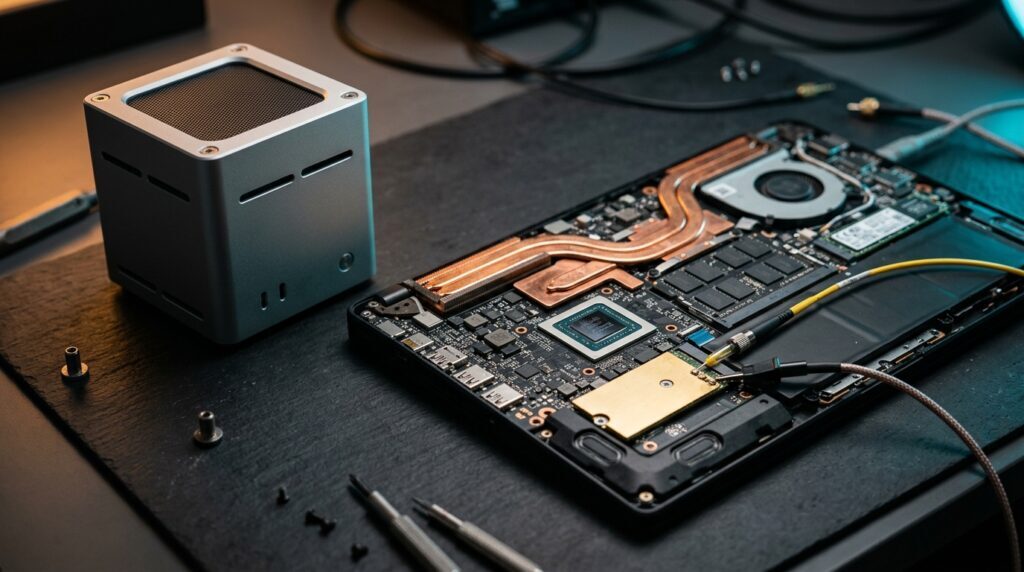
The local AI hardware battleground has split into two competing memory architectures. On one side, Thunderobot introduced the AI Master M7000—a mobile workstation powered by AMD’s Ryzen AI Max+ 395 (“Strix Halo”). Equipped with 64GB of physical LPDDR5X-8533 unified memory (256 GB/s), it pairs on-die RAM with an 85GB pseudo-SLC solid-state cache to stream 120-billion-parameter Mixture-of-Experts (MoE) models on a laptop.
On the other side, retail shipments of Apple’s 2026 M5 Max (614 GB/s, 128GB) and M5 Ultra (1.2 TB/s, 512GB) Mac Studio have triggered an engineer migration toward the native oMLX inference stack. Rather than relying on storage-bus paging, Apple Silicon relies on massive unified memory bandwidth to run frontier models at full interactive speed.
Accelerating this clash is a wave of ultra-compressed open-weight releases surging across developer channels: Continuum AI’s OrcaSAQ-2 27B (shrinking Qwen 3.8 27B to 12.06 GB at 3.21 bpw), PrismML’s Ternary Bonsai 2 27B (fitting into 6–9 GB), Qwen3-Coder-Next (80B sparse MoE), DeepSeek V4.1 Flash (552B frontier MoE), and Alibaba’s multimodal qwen-image-2.1.
Unified Memory Bandwidth
1.2 TB/s vs. 256 GB/s
M5 Ultra hits 1.2 TB/s (M5 Max: 614 GB/s) vs. Ryzen AI Max+ 395’s 256 GB/s LPDDR5X bus.
Thunderobot M7000 Pool
64GB + 85GB SLC
Phison aiDAPTIV+ carves an 85GB pSLC NAND cache out of an SSD to stream 120B MoE layers.
OrcaSAQ-2 27B Compression
12.06 GB / 70% SWE
Shrinks 55.59 GB Qwen 3.8 27B to 3.21 bpw while hitting 70.0% SWE-bench Verified.
oMLX Tiered KV Cache
<5s TTFT
Persists Apple Silicon KV cache blocks to NVMe SSD, resuming multi-file coding sessions in seconds.
How Does Thunderobot’s Ryzen AI Max+ 395 Laptop Run 120B MoE Models Using an 85GB “RAM-Like SSD”?
Running a 120-billion-parameter language model on mobile hardware previously required either an expensive 128GB unified-memory configuration or severe 2-bit quantization that compromised reasoning accuracy. With the Thunderobot AI Master M7000 and its companion D9000 cube workstation, Thunderobot and Phison attempt to bypass physical memory ceilings using flash-assisted virtual memory.
At the heart of the system is AMD’s flagship Ryzen AI Max+ 395 (“Strix Halo”) APU. The processor combines 16 Zen 5 CPU cores with a 40-compute-unit Radeon 8060S GPU across a 256-bit bus delivering 256 GB/s of bandwidth. Rather than outfitting the machine with 128GB of costly LPDDR5X-8533 memory, Thunderobot ships 64GB of physical RAM paired with a customized 1TB NVMe drive running Phison’s aiDAPTIV+ architecture:
1. The 768GB + 85GB SLC Firmware Partition Split
Standard TLC or QLC flash suffers steep write-cliff throttling and premature wear under continuous memory paging. To mitigate drive degradation, the 1TB SSD is partitioned at the controller level into 768GB of standard storage and a dedicated 85GB pseudo-SLC (pSLC) partition rated for high sustained random IOPS and multi-petabyte endurance.
2. Why Sparse MoE Succeeds Where Dense Weights Stall
A 120B dense model at 4-bit quantization demands roughly 68 GB of weights plus KV cache, requiring every parameter to be fetched on every token pass. Offloading 20 GB across PCIe at 7 to 14 GB/s drops generation speed below 0.5 tokens per second. In contrast, a 120B Mixture-of-Experts architecture activates only 8B to 16B parameters (4.5 to 9 GB) per token. By pinning active attention layers and router matrices in the 64GB LPDDR5X RAM while streaming inactive expert weights from the 85GB SLC partition, the system prevents out-of-memory crashes while sustaining interactive speeds.
3. The PCIe Bandwidth Bottleneck
Marketing an SLC partition as “RAM-like” runs straight into physics. Even high-end PCIe Gen4/Gen5 SSD caches top out between 7 GB/s and 14 GB/s—18x to 36x slower than Strix Halo’s 256 GB/s memory bus and 85x slower than Apple’s M5 Ultra (1.2 TB/s). During extensive context prefill or when complex agent queries activate diverse experts across consecutive layers, bus saturation causes noticeable latency spikes compared to native 128GB DRAM systems.
Why Apple’s M5 Max (614 GB/s) and M5 Ultra (1.2 TB/s) Mac Studio + oMLX Are Surging Among AI Engineers
While PC manufacturers rely on SLC caching to stretch 64GB notebooks, Apple’s 2026 Mac Studio approaches local inference through raw on-package memory bandwidth and massive unified capacity.
Building on the unified memory architecture benchmarked in earlier generations, the M5 Max Mac Studio scales to 614 GB/s of bandwidth across up to 128GB of memory. The dual-die M5 Ultra pushes throughput to an extraordinary 1.2 TB/s across up to 512GB of unified RAM. While Apple reserves its rack-mount M-series server clusters for private Apple Intelligence infrastructure, a 512GB M5 Ultra Mac Studio operates as an ultra-quiet, 250W deskside server.
Alongside the hardware, developer excitement centers on oMLX—a native macOS inference server optimized for local coding environments like Claude Code, Antigravity CLI, and Cursor. Rather than treating flash storage as emergency RAM, oMLX integrates solid-state storage deliberately:
Weight Preservation vs. Two-Tier KV Caching
Unlike hybrid schemes that swap model weights over the storage bus during generation, oMLX keeps all active model weights pinned in high-speed unified memory (614 GB/s to 1.2 TB/s). Flash storage is dedicated exclusively to an asynchronous, two-tier KV cache that serializes inactive context and repository prefixes directly to internal NVMe flash.
Sub-5-Second Agent Context Resumption
In standard inference engines, reloading a multi-file coding agent or toggling between reasoning models requires complete prompt reprocessing—frequently stalling workflows for 45 to 120 seconds. oMLX’s tiered cache reloads serialized prefix states into unified memory in under 5 seconds, serving OpenAI- and Anthropic-compatible API endpoints from a lightweight macOS background daemon.
| Hardware Platform | Processor / GPU | Physical RAM / VRAM | Memory Bandwidth | SSD AI Cache Layer | Max Practical Local Model |
|---|
| Thunderobot AI Master M7000 | AMD Ryzen AI Max+ 395 (Radeon 8060S 40 CU) | 64GB LPDDR5X-8533 | 256 GB/s | 85GB Phison aiDAPTIV+ pSLC | 27B–35B Dense / 80B–120B Sparse MoE |
| Strix Halo 128GB Mini-PC (D9000 / Framework) | AMD Ryzen AI Max+ 395 (16C Zen 5 + 40 CU) | 128GB LPDDR5X-8533 (Up to 96GB iGPU) | 256 GB/s | Standard NVMe mmap | 70B Dense / 120B MoE (In-RAM) |
| Apple Mac Studio (M5 Max, 2026) | Apple M5 Max (40-core GPU + Neural Accelerators) | Up to 128GB Unified | 614 GB/s | oMLX Two-Tier SSD KV Cache | 70B–100B Dense / 120B MoE at 2.4x Speed |
| Apple Mac Studio (M5 Ultra, 2026) | Apple M5 Ultra (80-core GPU + Dual UltraFusion) | Up to 512GB Unified | 1,200 GB/s (1.2 TB/s) | oMLX Two-Tier SSD KV Cache | 552B DeepSeek V4.1 Flash / 405B+ In-RAM |
| Single RTX 5090 Workstation | NVIDIA GeForce RTX 5090 (Blackwell) | 32GB GDDR7 (VRAM Wall) | 1,792 GB/s | PCIe Gen5 Host Offload | 27B–32B Dense (OrcaSAQ-2 / Bonsai 2 Screamer) |
The September 2026 Breakout Local Model Stack: Qwen 3.8 27B, Qwen3-Coder, DeepSeek V4.1 Flash & qwen-image-2.1
Memory bandwidth and caching strategies only tell half the story. Over the past 24 hours, five specific open-weight models surged simultaneously across developer benchmarks: OrcaSAQ-2 27B, Ternary Bonsai 2 27B, Qwen3-Coder-Next, DeepSeek V4.1 Flash, and qwen-image-2.1.
Together, these architectures establish the practical sweet spots across 16GB, 64GB, 128GB, and 512GB local environments.
Qwen 3.8 27B Compression Duel: Continuum AI’s OrcaSAQ-2 vs. PrismML’s Ternary Bonsai 2
Alibaba’s dense Qwen 3.8 27B checkpoint has emerged as the standard reasoning benchmark for single-machine local inference. However, its uncompressed FP16 footprint of 55.59 GB overwhelms a 64GB system once active context buffers are allocated. Two rival compression pipelines address this threshold:
OrcaSAQ-2 27B: Structure-Aware 3.21 bpw Quantization (12.06 GB)
Released by Continuum AI (OrcaRouter), OrcaSAQ-2 reduces the 55.59 GB model by 78.3% down to 12.06 GB. Unlike naive 3-bit GGUF quants that degrade on multi-step tool calls, OrcaSAQ-2 achieves 70.0% on SWE-bench Verified and 58.4% on Terminal-Bench 2.1 via custom vLLM kernels. At 12.06 GB, it runs smoothly inside a 16GB–24GB laptop and leaves over 50 GB of unified memory available for extensive repository context on a 64GB system.
Ternary Bonsai 2 27B: Rotated 1.58-Bit Compression (6–9 GB)
As detailed in our
deep dive on PrismML’s Ternary Bonsai 2 27B architecture, Bonsai 2 uses activation rotation to map weights into ternary values ({-1, 0, +1}). This produces a 6 GB to 9 GB footprint that retains 98.2% of original FP16 reasoning accuracy, running on 8GB–12GB consumer GPUs or base Mac mini units via customized MLX kernels.
MoE Coding Architectures: Qwen3-Coder-Next (80B/3B) vs. DeepSeek V4.1 Flash (552B)
For engineering teams targeting Mixture-of-Experts coding models, benchmark results reveal a definitive boundary between 80B sparse MoE and 552B frontier deployments:
Qwen3-Coder-Next: 80B Total / 3B Active MoE (45–48 GB)
Requiring 45 GB to 48 GB in 4-bit quantization, Qwen3-Coder-Next fits entirely within physical memory on a 64GB Thunderobot M7000, a 64GB/128GB M5 Max Mac Studio, or a 128GB Strix Halo workstation. Because only 3 billion parameters activate per token, generation is not severely constrained by memory bandwidth—yielding over 70% SWE-bench Verified scores at 40+ tokens per second on Strix Halo and 90+ tokens per second on M5 Max.
DeepSeek V4.1 Flash: 552B Total / 16B Decode MoE (280–310 GB)
Featuring a Causal Encoder-Decoder (CED) architecture with asymmetric routing (8B active prefill, 16B active decode), DeepSeek V4.1 Flash scores 90.6 on Terminal-Bench 2.1 and 74.2% on DeepSWE. However, its 552B total parameter footprint requires 280 GB to 310 GB in 4-bit GGUF format. It cannot run on a 64GB notebook even with SSD assistance, positioning the 512GB Apple M5 Ultra Mac Studio (1.2 TB/s) as the premier desktop system capable of holding the entire model in memory at 35–50+ tokens per second.
qwen-image-2.1: Native RGBA Transparency & Cross-Step KV Reuse
Completing the local open-source stack is qwen-image-2.1, which surged as developers integrated it into local desktop workflows. Unlike legacy diffusion models requiring distinct passes for generation and background isolation, qwen-image-2.1 provides a unified 7.1B multimodal generator and instruction-guided editor:
True Native 4-Channel RGBA Generation
Generates UI assets, game sprites, and layered visual compositions with clean alpha transparency directly from text prompts, eliminating the need for post-processing segmentation pipelines.
Block-Causal Attention & Prefix KV Cache Reuse
By reusing prefix KV cache blocks across successive image-editing iterations, qwen-image-2.1 reduces multi-turn editing latency by more than 50% while operating within an 11 GB memory footprint—directly complementing the setups covered in our
local image model deployment guide.
| Breakout Local Model | Architecture & Active Params | Compressed Footprint | Key Benchmark Score | Required Runner & Optimal Hardware |
|---|
| OrcaSAQ-2 27B (Qwen 3.8) | 27B Dense (3.21 bpw Mixed-Precision) | 12.06 GB (down from 55.6 GB) | 70.0% SWE-bench Verified / 58.4% TB 2.1 | vLLM OrcaSAQ2 plugin; runs on 16GB+ GPU/Mac or 64GB Strix Halo |
| Ternary Bonsai 2 27B | 27B Dense (~1.58-bit Ternary + Rotation) | 6.5 GB – 9.0 GB | 98.2% FP16 Quality Retention | Custom MLX / forked llama.cpp; runs on 12GB+ laptops & RTX 4060+ |
| Qwen3-Coder-Next | 80B Total / 3B Active Sparse MoE | ~45 GB – 48 GB (4-bit GGUF/MLX) | >70.0% SWE-bench Verified | oMLX / llama.cpp; ideal for 64GB M7000, 128GB Strix Halo & M5 Max |
| DeepSeek V4.1 Flash | 552B Total / 8B Prefill / 16B Decode CED MoE | ~280 GB – 310 GB (4-bit GGUF) | 90.6 Terminal-Bench 2.1 / 74.2% DeepSWE | 512GB Apple M5 Ultra Mac Studio (oMLX) or multi-node GPU cluster |
| qwen-image-2.1 | 7.1B Multimodal Native RGBA + Block-Causal | ~11.0 GB | Native Alpha RGBA + 2x Faster Edit Turnaround | ComfyUI / Diffusers / MLX; runs on any 16GB+ Mac or Strix Halo APU |
Engineering Reproduction: Spinning Up oMLX & vLLM OrcaSAQ-2
To replicate the memory-tiering benchmarks locally, engineers must configure each runner to route KV states and parameter blocks across the appropriate bus topology. Below are the verified production startup scripts for macOS Apple Silicon and Linux Strix Halo platforms:
bash — macOS (M5 Max / M5 Ultra with oMLX Two-Tier NVMe KV Cache)
OpenAI & Messages API
# Launch oMLX daemon on Apple Silicon with 2-tier NVMe KV-cache serialization
omlx serve   --model mlx-community/Qwen3-Coder-Next-4bit   --port 8000   --kv-cache-tier nvme   --kv-cache-dir ~/Library/Caches/omlx/kv_store   --max-kv-ram-gb 48   --host 127.0.0.1
bash — Linux / Strix Halo (Ryzen AI Max+ 395 with ROCm & aiDAPTIV+ Offload)
vLLM Engine
# Run OrcaSAQ-2 27B on Ryzen AI Max+ 395 (ROCm 6.4 + aiDAPTIV+ pSLC offload)
vllm serve ContinuumAI/OrcaSAQ-2-27B-W3A16   --device rocm   --max-model-len 32768   --gpu-memory-utilization 0.92   --kv-cache-dtype fp8   --swap-space 85   --enforce-eager
Hardware Buyer’s Verdict: When to Buy Ryzen AI Max+ 395 vs. Apple M5 Max / Ultra
Choose AMD Ryzen AI Max+ 395 (128GB Mini-PC or 64GB M7000 Laptop) If:
Your stack requires native x86 Linux or Windows environments, and your workload centers on sparse MoE models like Qwen3-Coder-Next (80B/3B), OrcaSAQ-2 27B, and qwen-image-2.1 at roughly half the acquisition cost of high-spec Mac hardware. On the 64GB M7000, Phison’s 85GB SLC cache acts as an effective safety net for cold experts and extensive context buffers—though it cannot replace physical DRAM throughput for dense 70B+ weights.
Choose Apple M5 Max Mac Studio (128GB Unified Memory) If:
Your daily development workflow runs through Claude Code, Cursor, or Antigravity CLI paired with local 27B to 80B models. Combining 614 GB/s of unified memory (2.4x faster than Strix Halo) with oMLX’s tiered SSD KV cache provides sub-5-second session resumption and sustained 60–95 tokens per second generation throughput.
Choose Apple M5 Ultra Mac Studio (512GB Unified Memory) If:
You intend to run frontier-class open checkpoints like the 552B DeepSeek V4.1 Flash entirely in local memory with zero external cloud telemetry, zero recurring API token invoices, and zero PCIe storage bus contention.
Frequently Asked Questions: Thunderobot 120B SSD Laptop, M5 Max/Ultra, oMLX & Qwen 3.8
How does the Thunderobot AI Master M7000 laptop run 120B MoE models with only 64GB of RAM?
The Thunderobot AI Master M7000 pairs an AMD Ryzen AI Max+ 395 (Strix Halo) APU and 64GB of LPDDR5X-8533 unified memory (256 GB/s) with Phison’s aiDAPTIV+ technology. Its 1TB NVMe SSD is partitioned into 768GB of standard storage and a dedicated 85GB pseudo-SLC (pSLC) NAND AI Cache, creating a ~149GB combined memory pool where active MoE parameters stay in RAM while cold expert weights and KV tensors stream from high-endurance flash.
How does Apple’s M5 Max and M5 Ultra Mac Studio compare to AMD Ryzen AI Max+ 395 for local LLMs?
While the AMD Ryzen AI Max+ 395 delivers 256 GB/s of memory bandwidth across up to 128GB of LPDDR5X, Apple’s 2026 Mac Studio reaches 614 GB/s on the M5 Max (up to 128GB unified memory) and 1.2 TB/s on the M5 Ultra (up to 512GB unified memory). That 2.4x to 4.7x bandwidth advantage translates directly into faster token generation on memory-bound local models and allows the 512GB M5 Ultra to hold massive 4-bit MoE checkpoints like DeepSeek V4.1 Flash entirely in RAM without SSD swapping.
What is oMLX on Apple Silicon and why is it trending for Cursor and Claude Code?
oMLX is a native macOS LLM and VLM inference server built on Apple’s MLX framework. Its signature feature is a two-tier KV cache that persists inactive conversation and repository context blocks to the internal NVMe SSD, cutting Time-to-First-Token (TTFT) on recurring Cursor and Claude Code agent sessions from minutes to under 5 seconds.
What is the difference between Qwen 3.8 27B OrcaSAQ-2 and Ternary Bonsai 2 27B?
Both models compress Qwen 3.8 27B for consumer hardware using different quantization schemes. OrcaSAQ-2 27B (by Continuum AI / OrcaRouter) uses 3.21-bit mixed-precision compression to shrink the 55.59 GB checkpoint to 12.06 GB while scoring 70.0% on SWE-bench Verified and 58.4% on Terminal-Bench 2.1. Ternary Bonsai 2 27B uses 1.58-bit ternary weights with activation rotation to fit into just 6–9 GB of memory while retaining ~98.2% of FP16 reasoning quality.
Can a 64GB laptop or MacBook run DeepSeek V4.1 Flash GGUF and qwen-image-2.1 locally?
qwen-image-2.1 (a 7.1B native RGBA text-to-image and editing model with block-causal attention) runs comfortably on any 16GB+ Apple Silicon Mac or Strix Halo laptop, requiring roughly 11GB of memory. By contrast, DeepSeek V4.1 Flash is a 552B total-parameter MoE (8B active prefill, 16B active decode) that requires ~280GB to 310GB even at 4-bit GGUF quantization—meaning it requires a 512GB M5 Ultra Mac Studio or multi-node cluster to run without severe SSD thrashing.